
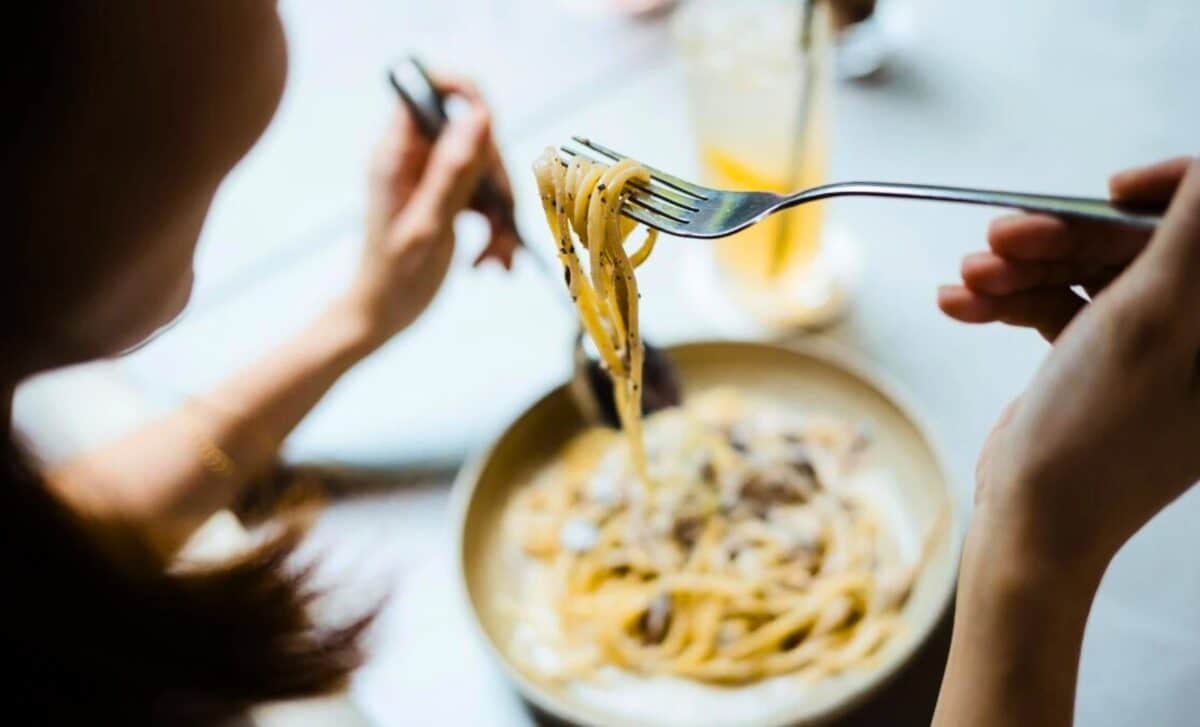
Dinner is where healthy-eating advice often turns confusing. Carbohydrates are treated like a mistake, fruit gets lumped in with sugar warnings, and many people end the day unsure whether a bowl of pasta is comforting or unhealthy. According to nutrition expert Carolin Kotke, much of that anxiety is driven less by evidence than by repetition.
Kotke pushes back on one of the most familiar ideas in diet culture: that certain foods become automatically unhealthy in the evening. The better question, she suggests, is not whether dinner should exclude foods like pasta or bananas, but what kind of evening meal actually supports the body best. On that point, the research points in a clear direction. The healthiest dinner is not the most restrictive one. It is a balanced meal, eaten with some attention to timing, and not overloaded with calorie-dense foods at the end of the day.
That makes dinner advice both simpler and more useful than many people have been led to believe. Research does show that the body handles food differently in the evening than it does in the morning. But that does not mean carbohydrates are off-limits after dark. It means that the healthiest evening meal is one built with more care than fear.
The Healthiest Dinner Starts With Balance, Not Elimination
The clearest human evidence in this set comes from a 2022 paper led by researchers at the University of Lübeck. The study asked a practical question: what changes when the same meal is eaten in the morning instead of the evening? In one part of the research, 24 healthy young men received identical 850-calorie meals at 8:45 a.m. and 6:00 p.m. under two conditions, one with a regular carbohydrate share and one with a higher carbohydrate share. The researchers then tracked glucose, insulin, and appetite-related responses.
They found that glucose and insulin responses were higher after the evening meal than after the morning meal. Their conclusion was not that dinner should be feared, but that time of day changes the body’s metabolic response. The end of the day appears to be a less favorable moment for handling carbohydrate-rich meals. In the paper’s own language, the findings reflect “an adverse metabolic constellation at the end of the day,” especially after carbohydrate-rich foods.
That is an important distinction. The study does not say pasta, rice, bread, or potatoes are inherently bad at dinner. It says that a heavier, more carbohydrate-dense meal may be metabolically harder to process in the evening than earlier in the day. So if the title asks what the healthiest evening meal is, the answer is not “no carbs.” It is a dinner that includes balance, moderation, and reasonable portions instead of an oversized plate built around refined or excess calories.
Why Dinner Feels Harder to Manage at Night
The same Lübeck paper helps explain why evening eating can feel more difficult than breakfast or lunch. In a separate experiment involving 84 healthy young adults, the researchers found a higher hedonic drive to eat in the evening than in the morning. In plain terms, people were more vulnerable later in the day to the pull of rewarding foods.
 You can’t go wrong with vegetables for dinner: they provide plenty of nutrients and keep you feeling full thanks to their fiber content. © iStock | Lyndon Stratford
That did not simply reflect stronger biological hunger. Post-meal ghrelin, leptin, hunger, and satiety did not differ in the same way across the two mealtimes. The issue may be less about the body urgently needing more food than about the brain finding food more tempting at the end of the day.
That helps explain why the healthiest dinner is rarely the one people assemble when they are exhausted, overly hungry, and ready to reward themselves. The evidence favors a calmer model: a meal that is satisfying without becoming excessive, and substantial without turning into a late-day calorie dump.
Carolin Kotke Pushes Back on the Dinner Myths
That is where Carolin Kotke’s advice fits the research. She pushes back against another durable dinner myth. She challenges the idea that certain categories of food become inherently wrong in the evening. The stronger claim is not that bananas or pasta are uniquely beneficial at dinner, but that common evening prohibitions are often overstated. The evidence is better at showing what changes across the day than at judging individual foods.
That framing is more helpful than the old no-carb rulebook. “No carbs at night” treats all carbohydrates as if they work the same way and assumes the only question is whether they appear on the plate at all. The Lübeck paper does not support that. It compares regular-carbohydrate and higher-carbohydrate meals and shows that evening tolerance is worse when meals are more carbohydrate-heavy. That still leaves room for a healthy dinner that includes carbohydrates without being dominated by them.
So what does that look like in practice? A healthier evening meal is one that avoids extremes. It is not built around restriction, but it is not carelessly heavy either. It leaves room for foods like pasta, grains, legumes, fruit, or vegetables while avoiding the kind of oversized, calorie-dense dinner that the body may handle less efficiently late in the day.
What Research Says About Timing and the Best Evening Meal
Animal research supports the broader timing argument. A widely cited 2009 study in Obesity found that nocturnal mice fed a high-fat diet during the light phase, their usual rest phase, gained significantly more weight than mice fed the same diet during the dark phase. Calorie intake and activity levels were comparable. The key variable was timing.
That does not translate neatly into a human dinner prescription, but it does reinforce the idea that metabolism is not indifferent to the clock. A 2015 review in Obesity Reviews placed this into a broader framework, describing the close relationship between the circadian system and metabolism and arguing that disruption of internal timing, through shift work, travel, or irregular eating patterns, can contribute to obesity-related metabolic changes.
Taken together, the evidence points to a version of healthy dinner advice that is much less dramatic than the myths suggest. The healthiest evening meal is not necessarily the lightest or the lowest in carbohydrates. It is a balanced dinner eaten at a sensible time, with portions kept in check and without turning the evening meal into the day’s most chaotic eating event.
That may be less catchy than a hard rule, but it is more faithful to the evidence. The healthiest dinner you can have is one that respects timing, avoids excess, and does not rely on outdated ideas about foods that supposedly become forbidden after sunset.
Carolin Kotke is a holistic nutritionist specializing in alkaline and nutrient-optimized diets. On her
social media channels, she educates people about a healthy and mindful lifestyle.