
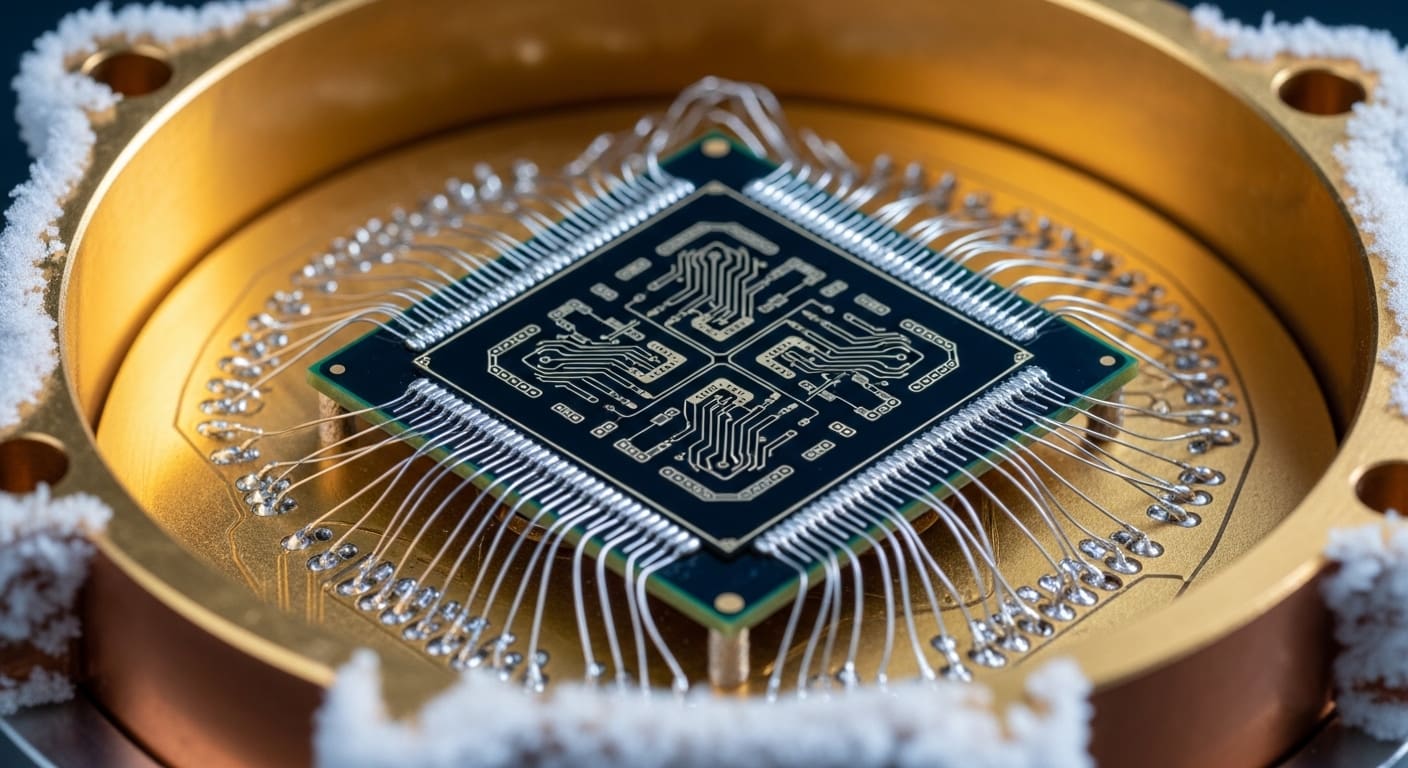
An international collaboration led by the Department of Energy’s SLAC National Accelerator Laboratory has achieved a critical milestone in the search for dark matter, successfully cooling the Super Cryogenic Dark Matter Search (SuperCDMS) SNOLAB experiment to temperatures approximately one hundred times colder than outer space. Located two kilometers underground in a Canadian nickel mine, the experiment is now ready to begin its first science run, hunting for weakly interacting massive particles (WIMPs) and other light dark matter candidates that comprise 85% of all matter in the universe. “Base temperature is the temperature our cryogenic system reaches under the full thermal load of the experiment,” said Kelly Stifter, a Panofsky fellow at SLAC and a member of the SuperCDMS collaboration, “It’s the point where the detectors can actually function the way they were designed to.” Stifter added, “We expect world-leading sensitivity between about half a proton mass and five times the proton mass; that’s a region not many searches have really explored before.”
SuperCDMS SNOLAB Achieves Millikelvin Base Temperature
Reaching this ultra-low temperature was not simply a matter of flipping a switch, but the culmination of years of preparation and detailed planning. This careful approach was essential to minimize thermal noise, the random atomic motion that can obscure the faint signals the experiment seeks. “When everything is that cold, the crystals are basically quiet,” said SLAC scientist Richard Partridge, who manages the experiment’s installation. “Even very small energy deposits become detectable.” The core of SuperCDMS relies on ultra-pure silicon and germanium crystals, each about the size of a hockey puck, designed to register the minuscule interactions between dark matter particles and ordinary matter. When a dark matter particle collides with an atom within the crystal lattice, it creates vibrations and electrical signals.
Detecting these signals requires superconducting sensors, which only operate at extremely low temperatures. “The detectors simply don’t function unless they’re cold enough to enter the superconducting transition,” Partridge added, specifying that the operational range is roughly 15 to 30 millikelvins. The experiment’s location deep underground at SNOLAB provides crucial shielding from cosmic rays and other background radiation that could otherwise obscure the delicate measurements. “We know from astrophysical observations that the Milky Way sits inside a halo of dark matter,” Stifter said. “Dark matter is going through us all the time. Our challenge is to build a detector quiet and sensitive enough to notice when one of those particles interacts.” Now that base temperature has been achieved, the focus shifts to detector commissioning, a process of calibrating and optimizing each of the 24 detectors and their multiple readout channels.
Superconducting Detectors & Phonon Signal Detection
The search for dark matter has entered a new phase of sensitivity, relying on increasingly sophisticated detectors chilled to temperatures approaching absolute zero. While numerous experiments worldwide pursue this elusive substance, the SuperCDMS SNOLAB collaboration recently achieved a critical milestone: reaching base temperature for its detectors, a feat essential for unlocking the potential of superconducting sensors. This isn’t merely about achieving extreme cold, but about creating an environment where the faint signals scientists are searching for are not obscured by background noise. The experiment’s design hinges on the principle that these phonons and electrical signals can be amplified and read out by superconducting sensors, devices that exhibit zero electrical resistance only at extremely low temperatures. This reliance on superconductivity dictates the complexity of the cooling process.
Achieving base temperature is not a simple matter of flipping a switch, but a carefully orchestrated multi-stage process, beginning with cooling from room temperature down to 50 kelvins, then 4 kelvins, 1 kelvin, and finally into the millikelvin range. A dedicated cooling system also manages the readout cables, preventing them from introducing unwanted heat. The sensitivity gained from these ultra-cold detectors allows SuperCDMS to focus on a specific range of dark matter particle masses, a region largely unexplored by other experiments.
It’s more complicated than just hitting the ‘go’ button and watching the temperature drop.
Stifter
Deep Underground Location Shields Against Background Radiation
The ambitious SuperCDMS SNOLAB dark matter experiment relies on a carefully chosen location to maximize its chances of success, and scientists working on SuperCDMS have successfully cooled the experiment to its base temperature. Situated two kilometers underground in an active nickel mine near Sudbury, Ontario, the experiment isn’t merely seeking darkness; it’s actively shielded from a constant barrage of interfering signals. The choice of SNOLAB as a host facility directly addresses a fundamental challenge in dark matter research: distinguishing genuine interactions from false positives. Cosmic rays, high-energy particles originating from outside our solar system, continuously bombard Earth. These particles, and the secondary particles they create when they collide with the atmosphere, can mimic the signals expected from dark matter, creating a significant hurdle for scientists. Beyond simply reducing the number of interfering particles, the underground location also filters out specific types.
Cosmic muons, for example, are particularly troublesome due to their ability to penetrate shielding materials. The two-kilometer depth provides sufficient material to attenuate these muons to a level where their contribution to the background signal is minimized. This meticulous shielding is particularly important for SuperCDMS, which is designed to detect light dark matter. The experiment’s sensitivity is so high that background radiation could obscure the signals it seeks. This multi-layered approach, combined with the experiment’s ultra-cold operating temperature, creates an exceptionally quiet environment for detecting these elusive particles.
The team meticulously planned the cooling process, recognizing the complexity of reaching base temperature. “It’s more complicated than just hitting the ‘go’ button and watching the temperature drop,” Stifter said. “For the past two years, we’ve been installing the experiment in anticipation of this moment.” The culmination of these efforts promises to open a new window into the nature of dark matter, potentially revealing the identity of this mysterious substance that makes up 85% of all matter in the universe.
We know from astrophysical observations that the Milky Way sits inside a halo of dark matter.
Stifter
Sensitivity Target: Half to Five Proton Masses
This focused approach stems from a growing understanding of dark matter’s possible composition and the limitations of existing experiments. The experiment’s sensitivity to this low-mass range isn’t accidental; it’s a direct result of design choices and the ultra-low operating temperature achieved within the SNOLAB facility. Detecting these lighter particles requires exceptional detector quietness and the ability to discern incredibly subtle signals from background noise. SuperCDMS achieves this quietness through a combination of deep underground placement and extreme cooling. The location, two kilometers below the surface in a nickel mine, shields the detectors from cosmic rays and other interfering particles. More importantly, the experiment operates at temperatures just tens of millikelvins above absolute zero. This extreme cold is not merely a technical feat, but a fundamental requirement for the superconducting sensors used to detect the faint interactions. The principle behind the detection is elegant in its simplicity: these signals are then amplified by the superconducting sensors. The experiment’s design, incorporating multiple detectors and advanced data analysis techniques, will allow scientists to distinguish these rare events from background noise with unprecedented fidelity.
With many more sensors per detector than in the previous SuperCDMS Soudan experiment, along with new simulation tools and AI-enabled reconstruction, the data will be far richer than we originally planned.
Kurinsky