
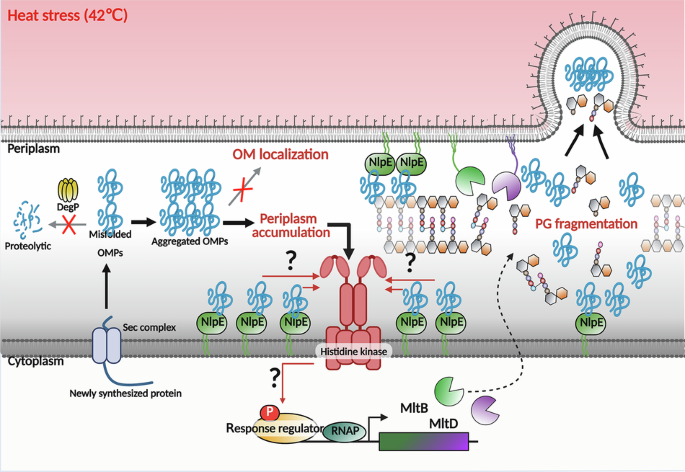
Schwechheimer, C. & Kuehn, M. J. Outer-membrane vesicles from Gram-negative bacteria: biogenesis and functions. Nat. Rev. Microbiol. 13, 605–619 (2015).
Park, J. et al. A novel decoy strategy for polymyxin resistance in Acinetobacter baumannii. eLife 10, e66988 (2021).
Sartorio, M. G., Pardue, E. J., Feldman, M. F. & Haurat, M. F. Bacterial outer membrane vesicles: from discovery to applications. Annu. Rev. Microbiol. 75, 609–630 (2021).
Li, C. et al. T6SS secretes an LPS-binding effector to recruit OMVs for exploitative competition and horizontal gene transfer. ISME J. 16, 500–510 (2022).
Juodeikis, R. & Carding, S. R. Outer membrane vesicles: biogenesis, functions, and issues. Microbiol. Mol. Biol. Rev. 86, e0003222 (2022).
McMillan, H. M. & Kuehn, M. J. The extracellular vesicle generation paradox: a bacterial point of view. EMBO J. 40, e108174 (2021).
Caruana, J. C. & Walper, S. A. Bacterial membrane vesicles as mediators of microbe-microbe and microbe-host community interactions. Front. Microbiol. 11, 432 (2020).
Clairfeuille, T. et al. Structure of the essential inner membrane lipopolysaccharide–PbgA complex. Nature 584, 479–483 (2020).
Shen, Z. et al. Outer membrane vesicles mediating horizontal transfer of the epidemic bla(OXA-232) carbapenemase gene among Enterobacterales. Emerg. Microbes Infect. 13, 2290840 (2024).
Zhao, X., Wei, Y., Bu, Y., Ren, X. & Dong, Z. Review on bacterial outer membrane vesicles: structure, vesicle formation, separation and biotechnological applications. Microb. Cell Fact. 24, 27 (2025).
Flannagan, R. S., Aubert, D., Kooi, C., Sokol, P. A. & Valvano, M. A. Burkholderia cenocepacia requires a periplasmic HtrA protease for growth under thermal and osmotic stress and for survival in vivo. Infect. Immun. 75, 1679–1689 (2007).
Fu, X. et al. DegP functions as a critical protease for bacterial acid resistance. FEBS J. 285, 3525–3538 (2018).
Leandro, M. R. et al. DegP protease is essential for tolerance to salt stress in the plant growth-promoting bacterium Gluconacetobacter diazotrophicus PAL5. Microbiol. Res. 243, 126654 (2021).
Šulskis, D., Thoma, J. & Burmann, B. M. Structural basis of DegP protease temperature-dependent activation. Sci. Adv. 7, eabj1816 (2021).
McBroom, A. J., Johnson, A. P., Vemulapalli, S. & Kuehn, M. J. Outer membrane vesicle production by Escherichia coli is independent of membrane instability. J. Bacteriol. 188, 5385–5392 (2006).
Birkle, K. et al. An unprecedented tolerance to deletion of the periplasmic chaperones SurA, Skp, and DegP in the nosocomial pathogen Acinetobacter baumannii. J. Bacteriol. 204, e00054-22 (2022).
Kim, S. Y. et al. The sensor kinase BfmS controls production of outer membrane vesicles in Acinetobacter baumannii. BMC Microbiol. 19, 301 (2019).
Schwechheimer, C. & Kuehn, M. J. Synthetic effect between envelope stress and lack of outer membrane vesicle production in Escherichia coli. J. Bacteriol. 195, 4161–4173 (2013).
Sonntag, I., Schwarz, H., Hirota, Y. & Henning, U. Cell envelope and shape of Escherichia coli: multiple mutants missing the outer membrane lipoprotein and other major outer membrane proteins. J. Bacteriol. 136, 280–285 (1978).
Takaki, K. et al. Multilamellar and multivesicular outer membrane vesicles produced by a Buttiauxella agrestis tolB mutant. App. Environ. Microbiol. 86, e01131–20 (2020).
McBroom, A. J. & Kuehn, M. J. Release of outer membrane vesicles by Gram-negative bacteria is a novel envelope stress response. Mol. Microbiol. 63, 545–558 (2007).
Bernadac, A., Gavioli, M., Lazzaroni, J. C., Raina, S. & Lloubès, R. Escherichia coli tol-pal mutants form outer membrane vesicles. J. Bacteriol. 180, 4872–4878 (1998).
Betton, J. M., Boscus, D., Missiakas, D., Raina, S. & Hofnung, M. Probing the structural role of an alpha beta loop of maltose-binding protein by mutagenesis: heat-shock induction by loop variants of the maltose-binding protein that form periplasmic inclusion bodies. J. Mol. Biol. 262, 140–150 (1996).
Mathelié-Guinlet, M., Asmar, A. T., Collet, J. F. & Dufrêne, Y. F. Lipoprotein Lpp regulates the mechanical properties of the E. coli cell envelope. Nat. Commun. 11, 1789 (2020).
Rojas, E. R. et al. The outer membrane is an essential load-bearing element in Gram-negative bacteria. Nature 559, 617–621 (2018).
Fenn, K. L. et al. Outer membrane protein assembly mediated by BAM-SurA complexes. Nat. Commun. 15, 7612 (2024).
Bryant, J. A. et al. Bam complex associated proteins in Escherichia coli are functionally linked to peptidoglycan biosynthesis, membrane fluidity and DNA replication. eLife 13, RP99955 (2024).
Chamachi, N. et al. Chaperones Skp and SurA dynamically expand unfolded OmpX and synergistically disassemble oligomeric aggregates. PNAS 119, e2118919119 (2022).
Subrini, O. & Betton, J. M. Assemblies of DegP underlie its dual chaperone and protease function. FEMS Microbiol. Lett. 296, 143–148 (2009).
Gilmore, M. C. & Cava, F. Peptidoglycan recycling mediated by an ABC transporter in the plant pathogen Agrobacterium tumefaciens. Nat. Commun. 13, 7927 (2022).
Simpson, B. W., Gilmore, M. C., McLean, A. B., Cava, F. & Trent, M. S. Escherichia coli utilizes multiple peptidoglycan recycling permeases with distinct strategies of recycling. PNAS 120, e2308940120 (2023).
Sverak, H. E. et al. Cryo-EM characterization of the anydromuropeptide permease AmpG central to bacterial fitness and β-lactam antibiotic resistance. Nat. Commun. 15, 9936 (2024).
Hayashi, J.-I., Hamada, N. & Kuramitsu, H. K. The autolysin of Porphyromonas gingivalis is involved in outer membrane vesicle release. FEMS Microbiol. Lett. 216, 217–222 (2002).
Schwechheimer, C., Rodriguez, D. L. & Kuehn, M. J. NlpI-mediated modulation of outer membrane vesicle production through peptidoglycan dynamics in Escherichia coli. Microbiologyopen 4, 375–389 (2015).
Egan, A. J. F., Errington, J. & Vollmer, W. Regulation of peptidoglycan synthesis and remodelling. Nat. Rev. Microbiol. 18, 446–460 (2020).
Garde, S., Chodisetti, P. K. & Reddy, M. Peptidoglycan: structure, synthesis, and regulation. EcoSal Plus. 9, (2021).
Dik, D. A., Marous, D. R., Fisher, J. F. & Mobashery, S. Lytic transglycosylases: concinnity in concision of the bacterial cell wall. Crit. Rev. Biochem. Mol. Biol. 52, 503–542 (2017).
Kaul, M., Meher, S. K., Nallamotu, K. C. & Reddy, M. Glycan strand cleavage by a lytic transglycosylase, MltD contributes to the expansion of peptidoglycan in Escherichia coli. PLoS Genet. 20, e1011161 (2024).
Hoang, Y. et al. An experimental framework to assess biomolecular condensates in bacteria. Nat. Commun. 15, 3222 (2024).
Ma, B., Reynolds, C. M. & Raetz, C. R. H. Periplasmic orientation of nascent lipid A in the inner membrane of an Escherichia coli LptA mutant. Proc. Natl. Acad. Sci. USA. 105, 13823–13828 (2008).
Morán-Barrio, J. et al. The lipoprotein biosynthesis pathway: key to OXA-mediated carbapenem resistance in Acinetobacter baumannii. Antimicrob. Agents Chemother. 69, e0109925 (2025).
Huang, K. et al. Deletion of a previously uncharacterized lipoprotein lirL confers resistance to an inhibitor of type II signal peptidase in Acinetobacter baumannii. Proc. Natl. Acad. Sci. USA. 119, e2123117119 (2022).
Martorana, A. M. et al. Degradation of components of the Lpt transenvelope machinery reveals LPS-dependent Lpt complex stability in Escherichia coli. Front. Mol. Biosci. 8, 758228 (2021).
Son, Y. et al. Unexpected vulnerability of Enterococcus faecium to polymyxin B under anaerobic condition. Gut Microbes 16, 2438465 (2024).
Yang, J., Yun, S. & Park, W. Blue Light Sensing BlsA-mediated modulation of meropenem resistance and biofilm formation in Acinetobacter baumannii. mSystems 8, e00897-22 (2023).
Manioglu, S. et al. Antibiotic polymyxin arranges lipopolysaccharide into crystalline structures to solidify the bacterial membrane. Nat. Commun. 13, 6195 (2022).
Marotta, J., May, K. L., Bae, C. Y. & Grabowicz, M. Molecular insights into Escherichia coli Cpx envelope stress response activation by the sensor lipoprotein NlpE. Mol. Microbiol. 119, 586–598 (2023).
Roch, M. et al. Thermosensitive PBP2a requires extracellular folding factors PrsA and HtrA1 for Staphylococcus aureus MRSA β-lactam resistance. Commun. Biol. 2, 417 (2019).
Penwell, W. F. et al. Molecular mechanisms of sulbactam antibacterial activity and resistance determinants in Acinetobacter baumannii. AAC 59, 1680–1689 (2015).
Kocaoglu, O. & Carlson, E. E. Profiling of β-lactam selectivity for penicillin-binding proteins in Escherichia coli Strain DC2. AAC 59, 2785–2790 (2015).
Crépin, S. et al. The lytic transglycosylase MltB connects membrane homeostasis and in vivo fitness of Acinetobacter baumannii. Mol. Microbiol. 109, 745–762 (2018).
Le, N. H. et al. Peptidoglycan editing provides immunity to Acinetobacter baumannii during bacterial warfare. Sci. Adv. 6, eabb5614 (2020).
Raustad, N. et al. A phosphorylation signal activates genome-wide transcriptional control by BfmR, the global regulator of Acinetobacter resistance and virulence. Nucleic Acids Res. 53, gkaf063 (2025).
Rao, S. et al. Characterizing membrane association and periplasmic transfer of bacterial lipoproteins through molecular dynamics simulations. Structure 28, 475–487.e3 (2020).
Micelli, C. et al. A conserved zinc-binding site in Acinetobacter baumannii PBP2 required for elongasome-directed bacterial cell shape. PNAS 120, e2215237120 (2023).
May, K. L., Lehman, K. M., Mitchell, A. M. & Grabowicz, M. A stress response monitoring lipoprotein trafficking to the outer membrane. mBio 10, e00618-19 (2019).
Gottesman, S. Proteases and their targets in Escherichia coli. Annu. Rev. Genet. 30, 465–506 (1996).
Soltes, G. R., Martin, N. R., Park, E., Sutterlin, H. A. & Silhavy, T. J. Distinctive roles for periplasmic proteases in the maintenance of essential outer membrane protein assembly. J. Bacteriol. 199, 10 (2017).
Birkle, K. et al. An unprecedented tolerance to deletion of the periplasmic chaperones SurA, Skp, and DegP in the nosocomial pathogen Acinetobacter baumannii. J. Bacteriol. 204, e00054–2 (2022).
Spiess, C., Beil, A. & Ehrmann, M. A temperature-dependent switch from chaperone to protease in a widely conserved heat shock protein. Cell 97, 339–347 (1999).
Krojer, T., Garrido-Franco, M., Huber, R., Ehrmann, M. & Clausen, T. Crystal structure of DegP (HtrA) reveals a new protease-chaperone machine. Nature 416, 455–459 (2022).
Fantappiè, L., Irene, C., De Santis, M., Armini, A. & Gagliardi, A. Some Gram-negative lipoproteins keep their surface topology when transplanted from one species to another and deliver foreign polypeptides to the bacterial surface. Mol Cell Proteomics 16, 1348–1364 (2017).
Raivio, T. L., Leblanc, S. K. & Price, N. L. The Escherichia coli Cpx envelope stress response regulates genes of diverse function that impact antibiotic resistance and membrane integrity. J. Bacteriol. 195, 2755–2767 (2014).
Cian, M. B., Giordano, N. P., Mettlach, J. A., Minor, K. E. & Dalebroux, Z. D. Separation of the cell envelope for Gram-negative bacteria into inner and outer membrane fractions with technical adjustments for Acinetobacter baumannii. J. Vis. Exp. 10, 10.3791-60517 (2020).
Cho, T. H. S., Wang, J. & Raivio, T. L. NlpE is an OmpA-associated outer membrane sensor of the Cpx envelope stress response. J. Bacteriol. 205, e00407-22 (2023).
Lin, M. F., Lin, Y. Y. & Lan, C. Y. The role of the two-component system BaeSR in disposing chemicals through regulating transporter systems in Acinetobacter baumannii. PLoS ONE 10, e0132843 (2015).
Palethorpe, S. et al. Acinetobacter baumannii Regulates its stress responses via the BfmRS two-component regulatory system. J. Bacteriol. 204, e0049421 (2022).
Laloux, G. & Collet, J. F. Major Tom to ground control: how lipoproteins communicate extracytoplasmic stress to the decision center of the cell. J. Bacteriol. 199, 3 (2017).
Delhaye, A., Collet, J. F. & Laloux, G. Fine-tuning of the Cpx envelope stress response is required for cell wall homeostasis in Escherichia coli. mBio 7, 1128 (2016).
Price, N. L. & Raivio, T. L. Characterization of the Cpx regulon in Escherichia coli strain MC4100. J. Bacteriol. 191, 1798–1815 (2009).
Raivio, T. L., Leblanc, S. K. & Price, N. L. The Escherichia coli Cpx envelope stress response regulates genes of diverse function that impact antibiotic resistance and membrane integrity. J. Bacteriol. 195, 2755–2767 (2013).
Scheurwater, E., Reid, C. W. & Clarke, A. J. Lytic transglycosylases: bacterial space-making autolysins. Int. J. Biochem. Cell Biol. 40, 586–591 (2007).
Avila-Cobian, L. F., De Benedetti, S., Kim, C., Feltzer, R. & Champion, M. M. In vitro studies of the protein-interaction network of cell-wall lytic transglycosylase RlpA of Pseudomonas aeruginosa. Commun. Biol. 5, 1314 (2022).
Lee, M. et al. Reactions of all Escherichia coli lytic transglycosylases with bacterial cell wall. J. Am. Chem. Soc. 135, 3311–3314 (2013).
Weaver, A. I. et al. Lytic transglycosylases RlpA and MltC assist in Vibrio cholerae daughter cell separation. Mol. Microbiol. 112, 1100–1115 (2019).
Alvarez, L. et al. Control of bacterial cell wall autolysins by peptidoglycan crosslinking mode. Nat. Commun. 15, 7937 (2024).
Yunck, R., Cho, H. & Bernhardt, T. G. Identification of MltG as a potential terminase for peptidoglycan polymerization in bacteria. Mol. Microbiol. 99, 700–718 (2016).
Sassine, J., Pazos, M., Breukink, E. & Vollmer, W. Lytic transglycosylase MltG cleaves in nascent peptidoglycan and produces short glycan strands. Cell Surf. 7, 100053 (2021).
White, C. L. & Gober, J. W. MreB: pilot or passenger of cell wall synthesis? Trends Microbiol. 20, 74–79 (2012).
Yun, S. et al. Experimental evolution under different nutritional conditions changes the genomic architecture and virulence of Acinetobacter baumannii. Commun. Biol. 7, 1274 (2024).
Yang, J., Son, Y., Kang, M. & Park, W. AamA-mediated epigenetic control of genome-wide gene expression and phenotypic traits in Acinetobacter baumannii ATCC 17978. Microbial Genomics 9, 001093 (2023).
Wang, Y. et al. A highly efficient CRISPR-Cas9-based genome engineering platform in Acinetobacter baumannii to understand the H2O2-sensing mechanism of OxyR. Cell Chem. Biol. 26, 1732–1742.e5 (2019).
Park, Y. et al. Alleviation of H2O2 toxicity by extracellular catalases in the phycosphere of Microcystis aeruginosa. Harmful Algae 137, 102680 (2024).
Choi, J. et al. Efficient hepatic differentiation and regeneration potential under xeno-free conditions using mass-producible amnion-derived mesenchymal stem cells. Stem Cell Res. Ther. 12, 569 (2021).
Cian, M. B., Giordano, N. P., Mettlach, J. A., Minor, K. E. & Dalebroux, Z. D. Separation of the cell envelope for Gram-negative bacteria into inner and outer membrane fractions with technical adjustments for Acinetobacter baumannii. J. Vis. Exp. 10, 10 (2020).
Damke, P. P. et al. Identification of the periplasmic DNA receptor for natural transformation of Helicobacter pylori. Nat. Commun. 10, 5357 (2019).
Simpson, B. W. et al. Acinetobacter baumannii can survive with an outer membrane lacking lipooligosaccharide due to structural support from elongasome peptidoglycan synseparatemutantsthesis. mBio 12, e03099-21 (2021).
Vroom, M. M. et al. Modeled microgravity alters lipopolysaccharide and outer membrane vesicle production of the beneficial symbiont Vibrio fischeri. npj Microgravity 7, 8 (2021).
Matano, C. et al. Corynebacterium glutamicum possesses β-N-acetylglucosaminidase. BMC Microbiol. 16, 177 (2016).