
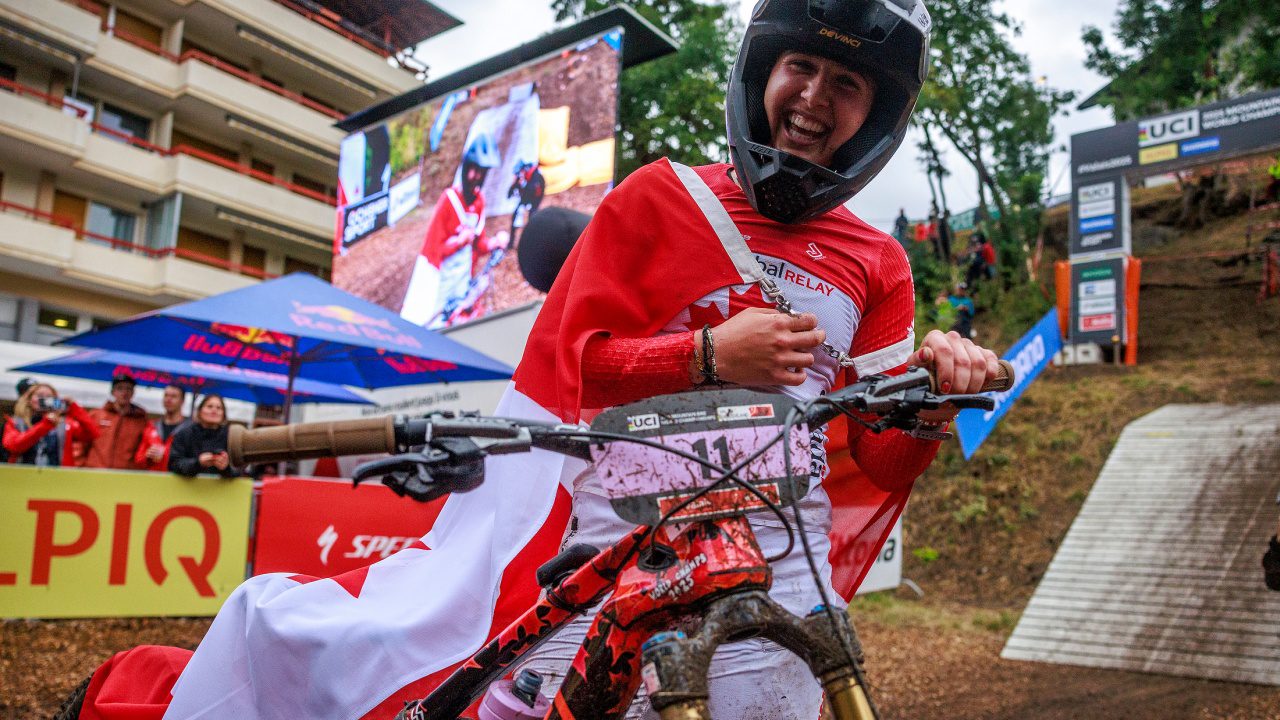
Elly Hoskin still doesn’t have a laundry detergent sponsor so she’s judicious about when she rides her mostly white enduro world champion’s kit. She revealed that little tidbit in a wide-ranging conversation for the Canadian Cycling Magazine Podcast. The chat was shortly before the announcement by her bike sponsor, Devinci, that Hoskin would be part of the brand’s Movement group. That news means Hoskin, who calls herself a pro privateer, has more support in the season to come. Her setup continues to evolve, as does her mountain biking discipline.
A conversation with an enduro rider can’t help but veer into the topic of the sport’s health. It’s faced many challenges throughout the past few seasons as Warner Bros. Discovery and the UCI took charge of the discipline’s top series for 2023. Hoskin seems optimistic for what lies ahead.
In 2025, Hoskin racked up a slew of successes: two Enduro World Cup wins, a victory at Crankworx Whistler, the world championship gold, as well as the national enduro title. Not bad for a rider in her first year as an elite rider.
In this in-depth interview, which has been edited for length and clarity, Hoskin looks back at her breakout 2025 season and ahead to new goals in 2026. She also discusses racing here at home compared with abroad, wrenching on her own bike, race prep and strategies, and why she sometimes doesn’t know whether to say “beanie” or “tuque.”
You can catch the full interview on the podcast, starting at 20:00.
SUBSCRIBE Apple Podcasts | YouTube | TuneIn | Spotify | Simplecast | RSS
What does a world and national enduro champion do in her off season?
Quite a lot of skiing. Yeah, not as much biking as you think. This is my off time, my rest time. I just reset and do the work that makes the rest of the season as easy as I can make it, really. It’s working hard, but you know, when training is kind of the only thing you got to do, it’s a pretty easy job.
Is there crocheting in the mix?
Yes, of course. Yes.
What are you crocheting right now?
I’ve got a beanie, another beanie in the works. I pretty much only do beanies now. I have a sweater that’s about a third of the way done that’s been sitting for about a year.
By beanies, do you mean tuques?
Yeah, yeah, sorry.
You’re speaking with Canadian Cycling.
I get corrected both times. I’ve been corrected so many times for saying tuque that, yeah, beanies have it. But, yes, I mean tuque.
OK, beanies for international readers, tuques for everyone else.
Exactly.
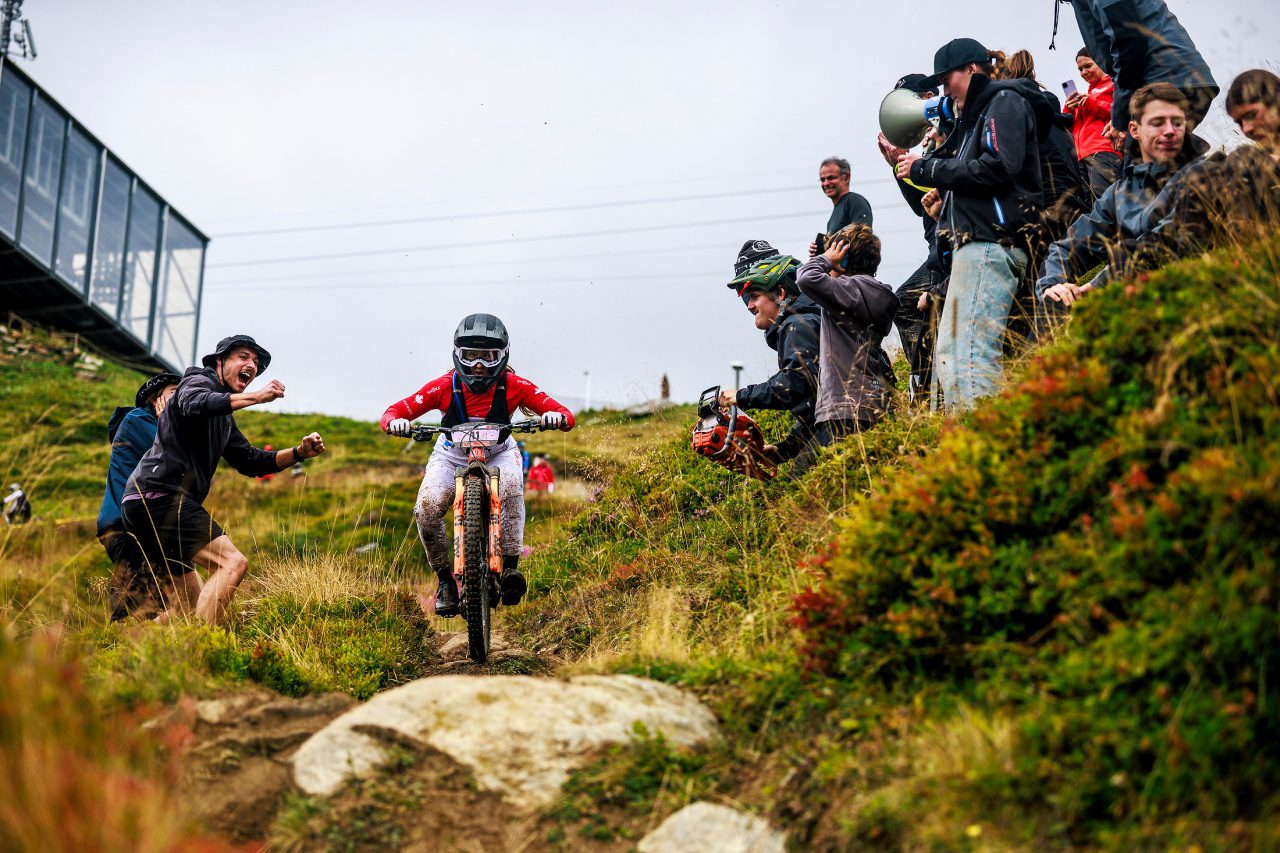 Elly Hoskin rides during the 2025 enduro mountain bike world championships in Valais, Switzerland at the Aletsch Arena/Bellwald. Image: @svenmartinphoto
You’re in Squamish. You said you’re skiing lots, but are you hitting the trails? Are you doing road rides? What does some of your training look like?
I’m in the gym a lot in the winter. That’s probably my favourite part of training. There’s still lots of big rides, but somewhat unstructured. I’ll go until I run out of snacks or until I don’t want to ride. I’m sure my coach would love it if I did some more road riding. And there are big, long ski tour days—really good for cross-training. I like to run, too.
You have support from Devinci Bikes, Shimano and Fox, but you develop your own program. You call yourself a pro privateer. What does the support you have look like at races?
It depends on the race. Overseas, like at a World Cup, I have support from Fox and Shimano to help me with my bike if something breaks. I’ve become quite the mechanic over the years. I enjoy being the person who’s set up my own bike. I can go to Fox and Shimano and ask questions, and then get them to show me how to do it. If I’m in a pinch and I’m like, oh, my God, everything’s broken, they’re there for me.
I take a lot of my own setup on. I’m the one driving myself around and cooking for sure. I have friends that I travel with. We kind of have this great little community. I’ve learned to embrace that it’s kind of like a little bit of a circus. You never know exactly what’s going to happen. But I can be as dialed as I can. I trust that there’s nothing I haven’t handled before.
Your relationship with Devinci is continuing, but evolving. Can you say a bit more about that?
Yeah, I’m really excited about that. In 2023, I rode for them for the first time just through a shop ambassador program here in Squamish. When I went to my first World Cup in Tasmania, I kind of went up to the team and I was like, “Can I stay with you?” They said sure. They let me crash with them. I was kind of just following them around all year. They slowly took me under their wing.
The following year, they disbanded their enduro team. But they said they really want to keep me on. That’s when I started piecing together my own program. I was getting bikes from them. My suspension was a separate deal through Fox. I had my shop deal here and everything else was individually contracted. It was a lot to organize, but I learned a lot on the business side of things.
Then this year, Devinci is bringing me onto its Movement. Its riders are Yoann Barelli, Georgia Astle and Steve Vanderhoek. The other main purpose of the Movement is to support a community grant that distributes funds to trail societies or grassroots teams. We’re just basically the face of it. Really, we all go our different ways. But it’s really cool because we’re all based here in the Sea to Sky. We get to hang out once in a while. The group includes a coach and a free rider. Georgia’s doing Rampage. I’m racing in enduro. It’s really cool that we all connect over bikes.
Does being part of Movement mean any new or different duties for you?
Probably not. They’ve taken a few responsibilities off my plate just by organizing some sponsors that I wouldn’t have had. For example, we have Maxima, which I’ve never even thought about contacting. But now I get to have grease for my bikes, which are desperate for it. I’ll be riding for SDG, Maxima and Abus.
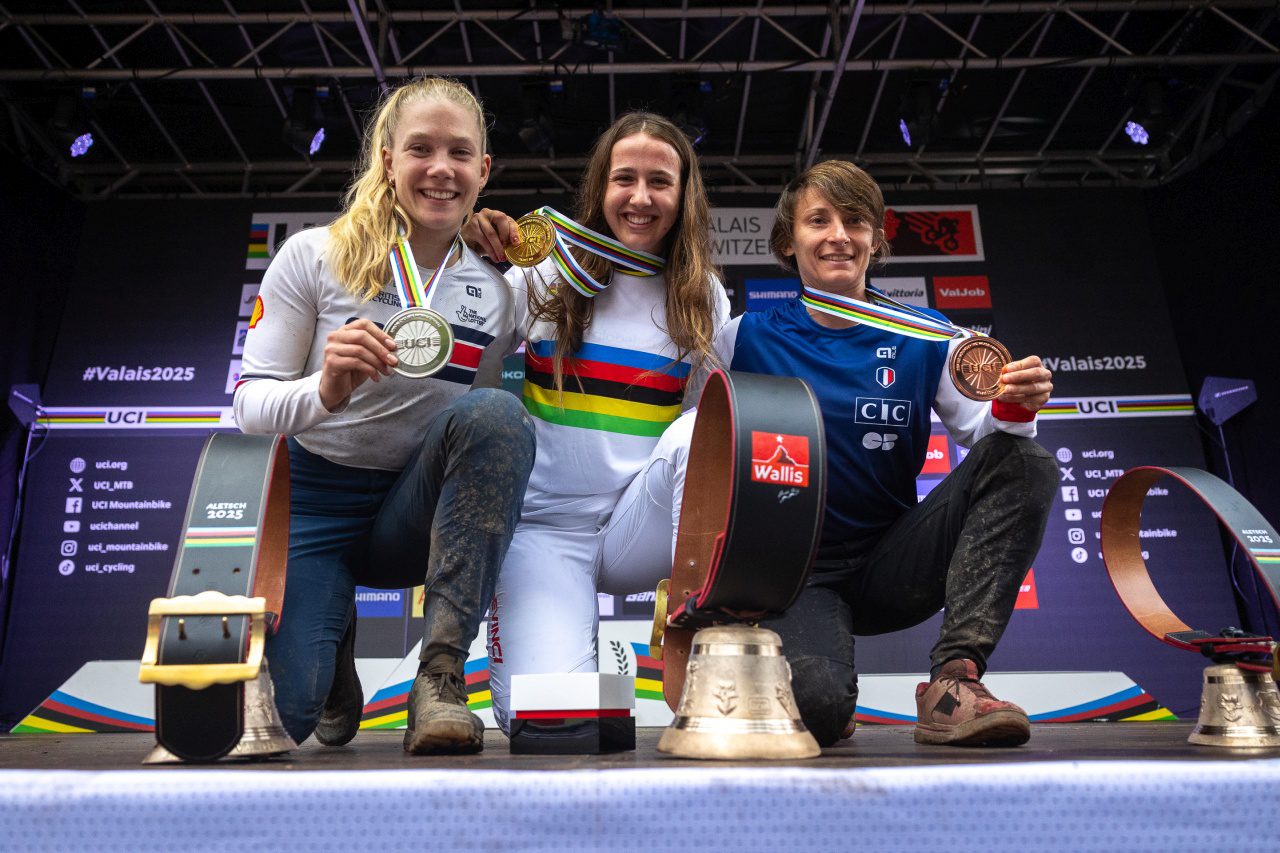 The 2025 enduro world championship medallists: Ella Conolly (sliver), Elly Hoskin (gold), Mélanie Pugin (bronze). Image: @davetrumporephoto
Returning back to racing, tell me about the importance of studying trails. How do you prepare for the descents you face throughout an enduro event?
I’m pretty meticulous, I’d say. First look at the trail. I try to ride it as intuitively as possible. I only really stop if there’s something where I’m like, that felt awful, I should probably go figure that out. If there’s significant line choice, I’ll watch a few people go through and make my own decision.
Obviously, I use a GoPro and study my footage in the evening. I make notes as well. Even before we get to the venue, I’ll have a peruse on TrailForks and YouTube to try to get an idea of what the dirt’s going to look like. Is this in the alpine? How can I make my practice day as easy as possible before I even get there? I mean, we ride six to 10 tracks over a weekend. You’re not going to know every rock and root, but I like to try—or at least try to remember sections so I can know if I’m three quarters of the way down. It’s a lot of study.
I have a very thick notebook that I travel with.
A paper notebook?
Yeah, I got it right here.
Look at that. It seems that’s not just random scribbles. You have subheadings and bullet points.
 Elly Hoskin celebrates at the 2025 Crankworx Whistler Open Enduro. Image: @joewakefield
Can you tell me about some of the strategies that go into enduro racing?
Take the world championships. There was a good variety of stages: some flat with kind of flowy trails where the mud was awful you couldn’t carry speed. We had an old downhill track. There were a few 10-plus-minute stages and some really short ones. I knew some of those were going to play to my strengths. It was very motivating on the ones that I knew I could do as much damage on to then minimize losses later.
Where are your strengths?
I’d say my overall fitness. I come from XC and I still cling to that. I like to think that I like to suffer even though that bit ended before I graduated high school. But I think my tolerance for suffering is pretty high, and my tolerance for fear is kind of low. I don’t like to scare myself so much on the really technical features. I’d rather be more cautious and just pedal my way out of things.
How would you compare the health of grassroots enduro, the enduro that’s close to where you live, with the health of enduro at the UCI/pro level?
I think it’s pretty comparable. I mean, obviously both are relying on an industry that’s taken a big hit in the past couple of years. It makes sense that there’s been a bit of a struggle from organizations to provide races. I’m really excited to see that the Canadian enduros are back this year.
It’s also cool because it’s being run by a friend of mine. He’s my age, in his early 20s. I feel like it’s great timing with this kind of generational change. We have a young person running the Canadian Enduro League. We have younger people coming up on the world circuit.
On the topic of generational change, there are some notable riders who have either retired or are stepping back from racing. I’m thinking of Jesse Melamed, ALN, Ed Masters and Jack Moir. How do you think that will shape the character of the racing this year?
Where there’s gaps, there’s room for people to step up. I think that’s exactly what’s going to happen. I think what we’ll probably feel a lot is the lack of their presences because they all did quite a bit of media around the races with their YouTube channels and videos. There will be different people stepping up into those roles. It’ll be really interesting.
With changes come renewal, and I’m looking forward to it.
On the topic of media, I remember at Bielsko-Biała you were willfully ignorant of your place in the standings by design. You didn’t want to know how you were doing. But you got suspicious when cameras started coming up to you and people were asking you questions. Do you think now that you’re world champion that you won’t be able to maintain your information blackouts?
No, I even felt it toward the end of the year. You just have to be more accepting of it. Your right to a lack of information is other people’s right to have it as well. You can’t stop people from telling you. Also, it feels kind of good. You’re like, oh, yeah, they’re interviewing me? Something must be going well.
To bring it back to strategy, I think I let a few stages go by without knowing. Then I’ll have someone tell me if I’m looking at a podium or a top-five. How many seconds I have to the person behind me. And that’s about all I need to know. I think that’s enough to decide if I really need to turn it on.
There’s also the chance that we get re-seeded on the last stage. In that case, it’s really important to know. At worlds, for example, I was sitting in second, going into the last stage. I had—I want to say—two or three seconds to first and four or five seconds to third. I kind of made the decision that not podiuming meant a lot more than not winning. I was conservative. Do not lose the podium. Then, let the cards fall where they may. All you can do is your best, and you let everyone else do the same.
I’m guessing you’re going to face more media attention throughout the year with your rainbow jersey. Have you already planned for that?
I’ve definitely thought about it—more how it’s going to affect my mental state on race days. I guess we’ll have to see. But it is fun. I do like to chat. So yeah, I don’t really mind.
What is the most misunderstood thing about enduro?
It’s hard to say. I think probably that it’s a “loose discipline.” People are just like, “Oh, yeah, we’re going for a bike ride.” The training and preparation that my peers and I do is massive, and it is dialed. We’re doing everything we can to be the best athletes that we can. Enduro is this big adventure sport. That’s the charm. It’ll never lose that. The spirit of enduro is pretty loose. I think we’re kind of embracing that. And then also, you know, we’re pushing to have it be taken seriously as well because the margins are tight and the fields are deep. If you’re not not showing up prepared, you’re not going to make it.
I find that really interesting because I remember when the EWS started, a lot of the chatter around it was like, “Oh, it’s kind of like what you do anyway. It’s the authentic style of mountain bike racing: moseying on up to the top and then ripping it down.” It’s funny how that persists, and you find yourself kind of challenging it.
To make that transfer time, you have to be fit. You not only want to make it to the top and not be cracked, but you want to have energy for six more stages. But yeah, we are sharing snacks and we’re talking to each other and we’re playing Would You Rather and we’re hiking our bikes and we’re doing it efficiently. It’s hard but there’s this beautiful balance. I think it’s really great.
At the same time, it is the most relevant discipline compared with what the average person would do on the weekend. They’re pushing their bike with their friends, having a snack at the top and then dropping in for a top-to-bottom lap. I don’t know how many people are going for six of those on a Saturday, but I sure enjoy it. From a marketing perspective, that’s the bike that most people would choose to buy. If you’re going to have one bike, you’d probably want it to go up and down.
Has anything changed for you since you’ve become world champion?
Yes and no. I think any doubt that I had about my capacity for my training and my effort has been—not extinguished, but definitely put to rest a bit. I have a lot of trust that I really don’t think I need to do that extra set. You know, I’m probably good.
I see a lot of world champ gear and paraphernalia, even just around my house. We have my world champ jerseys on the wall. And I’m like, wow, OK. There’s not a day that goes by where I forget or I’m not reminded by someone or something. It’s an honour, but it gets followed by a desire to prove myself, to keep growing and look to other things that I can do.
At the same time, I’m just, I’m so proud of it. It may very well never happen again, as much as I would love it to. I’m going to try my hardest to make it happen again.
You’ve joked about needing a detergent sponsor to keep the white kit with the rainbows on it clean. How’s that going? Do you have a detergent sponsor yet?
No, but I definitely choose the days I wear my white pants wisely.
You can’t follow that old rule of white only after Easter and not after Labour Day.
It’s going to be May through October this year.
What are some of the races that you are targeting in 2026? You’re going to be doing the World Cup series, but what else are you looking at?
I think a big goal this year would be the series overall. I’ve never done that before. So why not? World champs is the last race of the World Cup season, so that’ll be interesting. It’s after our nationals as well, which is another race I’ll be doing. There’s Crankworx Whistler. I always love to do the Squamish Enduro. It’s a pretty awesome event that we have here. I’m going to Sea Otter for the first time. At the end of the year, in October, I’m doing my first Trans race, TransSierra Norte, which I am so excited about.