
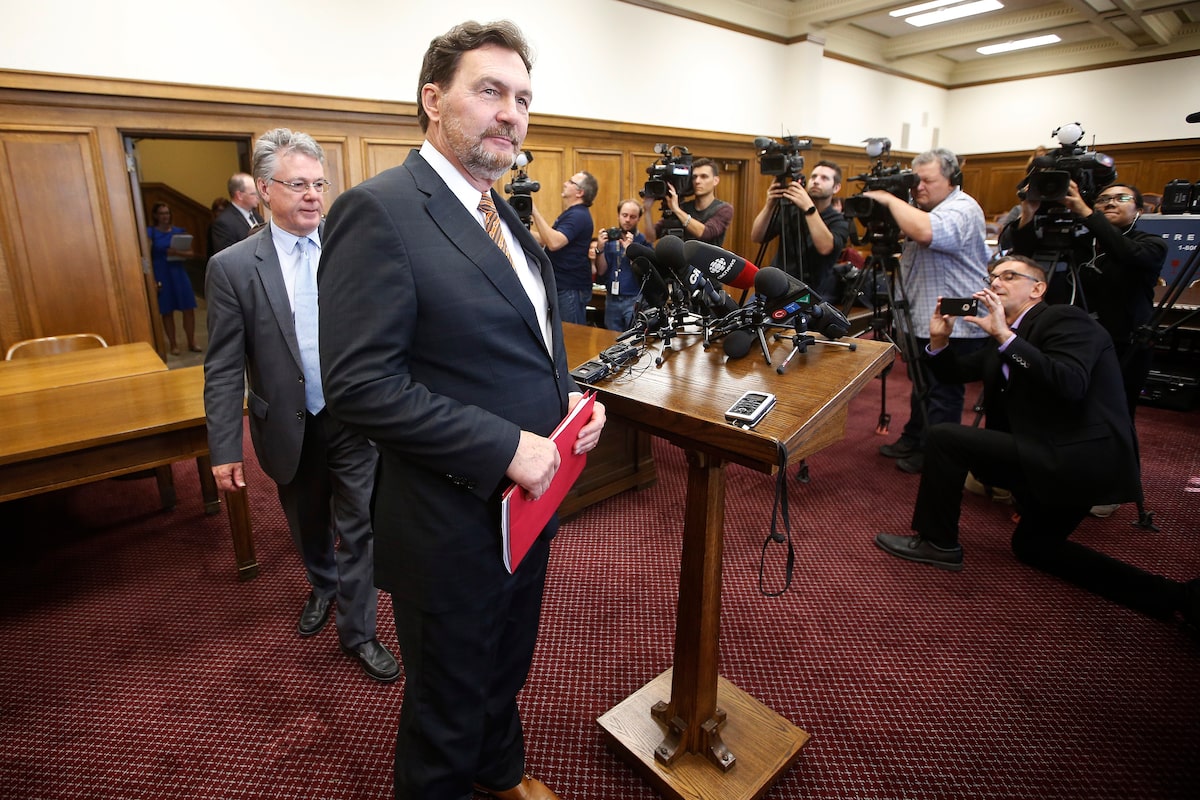
Supreme Court Chief Justice Richard Wagner in Winnipeg, in September, 2019.JOHN WOODS/The Canadian Press
One of the groups appealing the Emergencies Act case at the Supreme Court of Canada is asking the top court whether Chief Justice Richard Wagner should recuse himself from the deliberations because of alleged potential bias.
On Tuesday, the federal government filed an application with the Supreme Court to appeal the Emergencies Act decision made by the Federal Court of Appeal in January.
An appeal application in the case on a separate issue was filed with the Supreme Court by Canadian Frontline Nurses, which is the group raising the issue of potential bias about Chief Justice Wagner.
Lawyer Alexander Boissonneau-Lehner, counsel for Frontline Nurses, questioned in one of the legal filings whether it would be “inappropriate” for Chief Justice Wagner to take part in the court’s deliberations on whether to hear the case.
Mr. Boissonneau-Lehner cited comments from Chief Justice Wagner that were published in an April, 2022, article in Le Devoir, a Montreal newspaper. The article appeared a few months after the weeks-long protests that gridlocked central Ottawa were cleared, in the wake of the federal government’s invocation of the Emergencies Act.
Ottawa appeals Emergencies Act case to the Supreme Court
In one of the newspaper comments cited, Chief Justice Wagner likened the Ottawa protests to the initial stages of anarchy – “c’est un petit début d’anarchie,” he was quoted as saying – and said he found that worrying.
Mr. Boissonneau-Lehner, in Frontline Nurses’ legal filing, said the comments “could reasonably be perceived as expressing negative bias and may undermine public confidence in judicial impartiality.”
Frontline Nurses is a small group of several dozen people connected with former nurse Kristen Nagle, who protested against government safety measures during the pandemic and was part of the Ottawa protests in 2022.
She thereafter challenged the federal government in court after the invocation of the Emergencies Act. She was not granted standing by the Federal Court, a decision upheld by the Federal Court of Appeal. Ms. Nagle and Frontline Nurses have applied to appeal that ruling at the Supreme Court, where the group is also questioning Chief Justice Wagner’s potential bias.
The main appeal, however, in the Emergencies Act case at the Supreme Court comes from the federal government. In mid-January, the Federal Court of Appeal ruled that the invocation of the Emergencies Act was not legally justified.
Trudeau’s use of Emergencies Act to clear convoy protests unjustified, appeal court rules
The Supreme Court declined to comment on the issue raised by Frontline Nurses. “The Court does not comment on [appeal] applications filed with the Court,” said Daniel Byma, executive legal officer to Chief Justice Wagner.
Chief Justice Wagner’s comments to Le Devoir have previously been questioned for an alleged reasonable apprehension of bias. In May, 2022, a complaint from a group of about a dozen people, mostly lawyers, was submitted to the Canadian Judicial Council on the issue of potential bias because the case could eventually end up at the Supreme Court.
The council’s acting executive director at the time, Jacqueline Corado, dismissed the complaint that June, saying it was “manifestly without substance” and called it hypothetical.
Beyond the commentary to Le Devoir, Chief Justice Wagner in mid-June of 2022, at his annual news conference, also addressed the protests in response to a question.
“You asked what impact that had on us: Obviously, like any other residents of Ottawa, it was deplorable,” he said in French, relayed in English by a translator.