
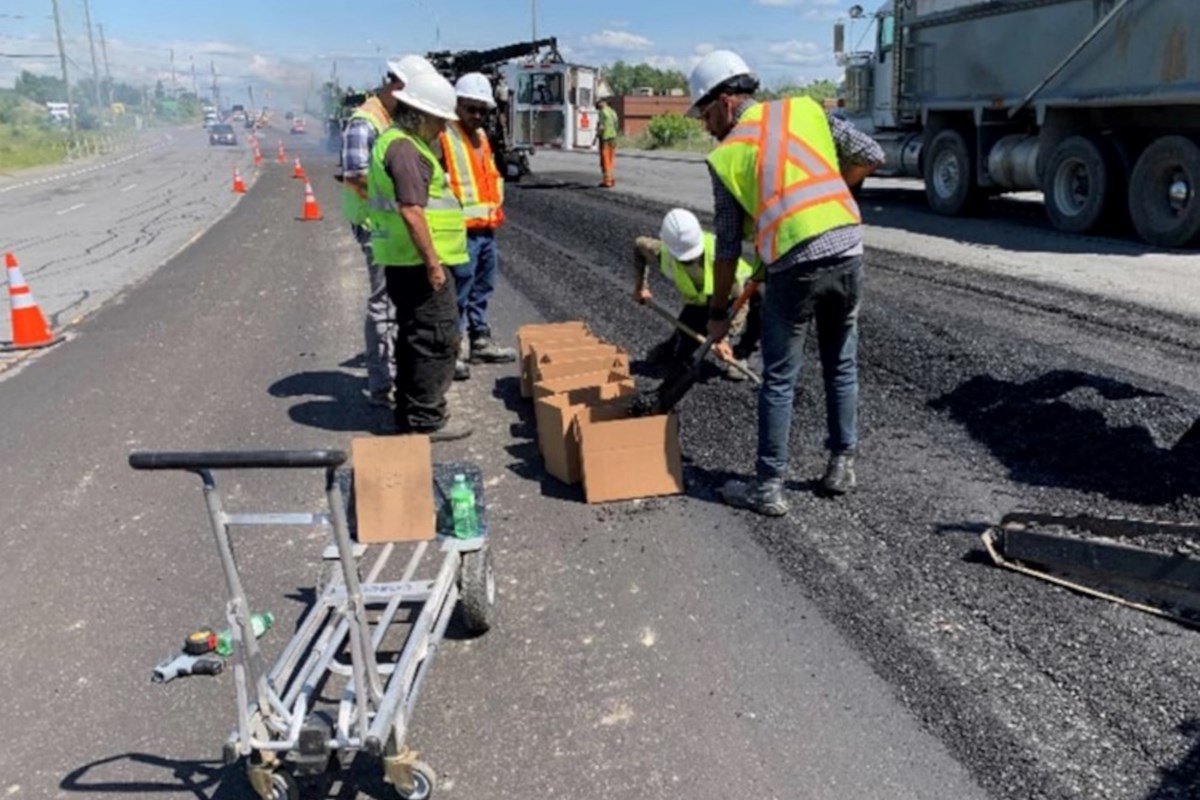
The City of Greater Sudbury isn’t currently looking at this means of asphalt recycling, but is still recycling asphalt using other methods, including in this year’s work on Municipal Road 35
Hot-in-place asphalt recycling will be hailed as an innovative practice in paving during this year’s Ontario Good Roads Conference, from March 29-April 1.
During the conference, Road Surface Recycling and Durham Region are receiving the 2025 Municipal Paving Award for a hot-in-place asphalt recycling project totalling 8.8 km.
This is the same company that attempted the same asphalt recycling method in Greater Sudbury in 2023, which the city removed them from for failing to meet specifications.
The award, Good Roads Technical Programs and Research manager James Smith said, is “to promote and recognize successful collaboration between municipalities and your hot-mix asphalt producers, looking at excellence and innovation in paving projects.”
Nominees are evaluated in several areas, he said, including specifications (how well the material tests against the specifications set out by the municipality), its visual appearance and workmanship.
“They were able to consistently produce that mix, and the end result looks fabulous,” Smith said. “You wouldn’t actually be able to tell it was a hot-in-place recycling versus a new asphalt put down.”
Stripped down to its basics, hot-in-place asphalt recycling consists of a crew grinding up existing road, mixing it with a rejuvenator and placing it back down as freshly recycled surface-layer asphalt.
This process is faster than traditional asphalt paving, cost savings and environmental benefits due to its repurposing of old materials, Smith said.
“I see it being used more by municipalities,” he said. “It’s always, with a new technology or something being reintroduced, once that first municipality tries it, it might take a couple of years to actually see the benefits for it. … You’ll start to see that growing adoption.”
A similar means of asphalt recycling has been around since the late 1970s, he said, disappeared for a while and started to return in an improved form in the late 2010s, at which time skyrocketing asphalt prices made the practice more appealing.
It’s good for roads in fair condition with some life left, Smith said, costs 20 to 40 per cent less than traditional asphalt paving and extends the lifespan of a road by 10 to 15 years, whereas a newly constructed road with no recycled materials will last approximately 20 years.
The City of Greater Sudbury’s experience with hot-in-place asphalt recycling is a complicated one.
Road Surface Recycling took on a hot-in-place asphalt recycling project in Greater Sudbury but were removed from the site mid-way through an effort on The Kingsway in July 2023.
Both the city’s testing and a third-party report by WSP concluded that Road Surface Recycling did not meet city specifications.
Road Surface Recycling sued the city for $1 million and the city issued a counterclaim of $4.5 million. These cases are ongoing.
“The city continues to explore efficient and effective approaches to road rehabilitation and road‑work delivery,” a city spokesperson told Sudbury.com. “This includes reviewing evolving industry practices and technologies as part of our long‑term asset management planning.
“As the matters involving Road Surface Recycling remain before the courts, we’re not able to comment on the status of the claim, the counterclaim, or any questions related to the company specifically.”
City Community Infrastructure general manager Antti Vilkko told Sudbury.com that hot-in-place recycling is “not currently actively being investigated, but it’s certainly something that can be an option to be considered in the future.”
Smith said Road Surface Recycling is the only company in Ontario currently undertaking hot-in-place asphalt recycling projects, and although city staff are declining comment due to ongoing legal action, Sudbury.com published a story in late 2023 highlighting how the city’s procurement policies and procedures might disqualify the company from working with the city again.
Vilkko, who joined the city in July 2025, said that although this particular means of asphalt recycling is not being actively pursued, they’re still moving forward with asphalt recycling in a different form.
This year’s work on an 8.2-kilometre stretch of Municipal Road 35, from Big Nickel Mine Road to Notre Dame Street in Azilda, will include asphalt recycling, he said.
Along stretches that require deeper-surface rehabilitation, the entire roadway will be pulverized and repurposed as underlayment, covered by new granular A (crushed gravel material that contains 3/4” size stone) and a fresh layer of new asphalt.
In less-damaged areas, asphalt will be milled between 50 mm and 90 mm and fresh asphalt will be placed on top. Anything deeper than 90 mm will be pulverized.
Similar processes will also be used on Montée Principale (from Municipal Road 15 to Municipal Road 35), and on Municipal Road 15 (600 metres west of St. Laurent St. to 1.2 km west of Montée Principale).
Although he didn’t have exact numbers to share, Vilkko said recycling asphalt on-site saves the city money.
“You save on trucking material out and in, so with the pulverizing option the material can stay in place, which is a cost savings,” he said, adding that pulverized asphalt underlayment results in a roadway with a similar lifespan as using all new materials and makes for a deeper road base.
On a similar front, Vilkko said there are no immediate plans for the city’s existing stockpile of used asphalt at the Frobisher municipal yards, adding, “We are exploring opportunities on how we can reuse that material.”
Tyler Clarke covers city hall and political affairs for Sudbury.com.