
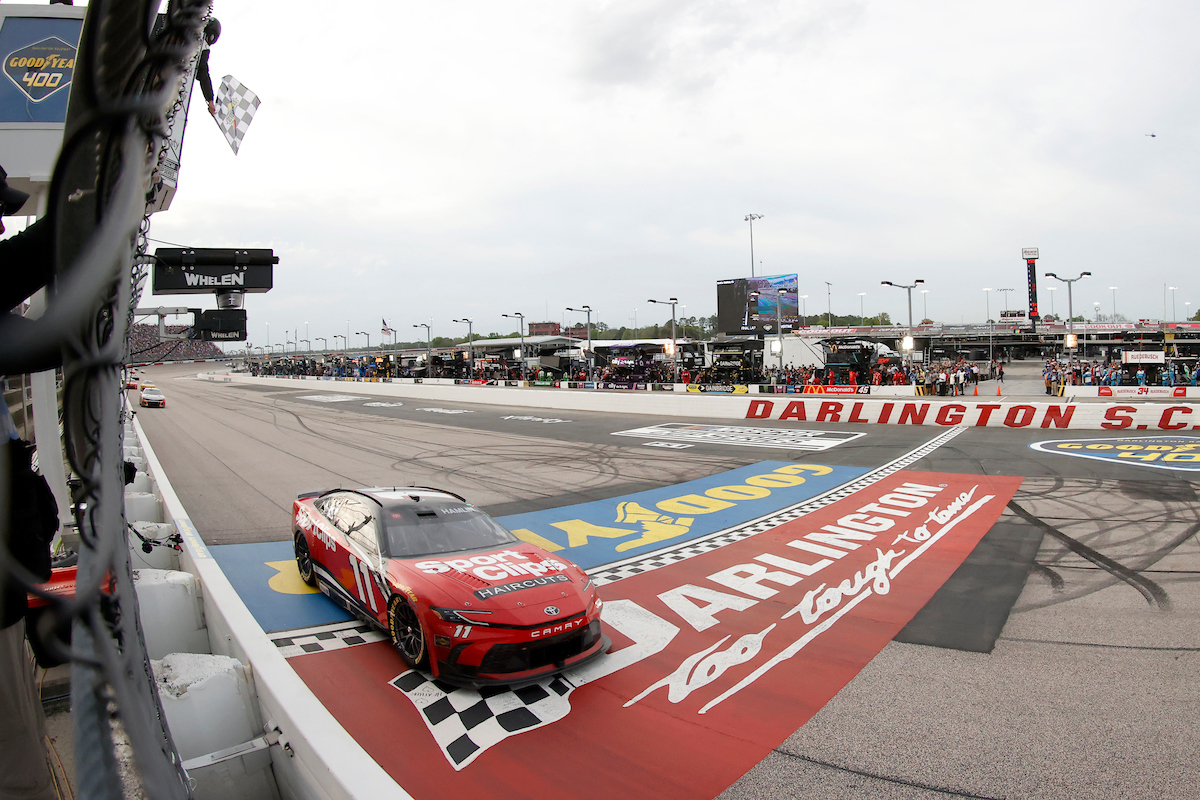
DARLINGTON, S.C. — NASCAR drivers are bracing for one of the most unpredictable and demanding weekends of the season as the Cup Series heads to Darlington Raceway with a new aerodynamic and horsepower combination expected to push teams to the edge.
Several drivers spent recent weeks testing the updated package in simulators, and the early feedback points to a drastically different feel. With significantly reduced underbody downforce and increased horsepower, many anticipate extreme tire falloff, sliding, and handling instability from the opening laps.
Denny Hamlin said the changes could produce some of the most difficult conditions the series has faced in years. Teams will run a short‑track aero package that trims underbody components and simplifies the diffuser, a move that he believes will make cars wildly unstable even on fresh tires. Hamlin expects dramatic lap‑time drop‑off, predicting that tire wear could increase at a rate not seen in recent races.
Chase Briscoe echoed that sentiment, calling Darlington possibly the toughest track drivers will face this season. After extended simulator time, Briscoe described an environment in which cars continually lose grip, making it difficult to complete laps cleanly. He expects the weekend to reward the few teams that immediately find the right setup, and he anticipates large performance gaps across the field.
Defending Cup champion Ryan Blaney views those challenges as a positive, welcoming heavy tire wear and the comers-and-goers dynamic the track is known for. Brad Keselowski, however, said managing tires may become even more demanding. In recent years, he said completing long runs was already difficult, and there is uncertainty about whether cars will be able to stretch a set of tires even half as long under the new rules.
Christopher Bell believes fans may witness a completely different style of racing compared to previous Next Gen events at the track. He pointed to Phoenix earlier this month as evidence that more horsepower and less downforce allow drivers with faster cars to make meaningful progress through the field. Bell expects Darlington to produce similar movement, especially as drivers fight loose, worn-out conditions throughout a run.
Daniel Suárez, after simulator sessions this week, found the track especially difficult under the new package. He said cars were so unstable that maintaining direction felt like a challenge, and he acknowledged that simulator accuracy remains uncertain until teams hit the track Sunday. Still, he welcomes the unpredictability and the test it will bring.
Kyle Busch emphasized the traditional difficulty of Darlington, noting the constantly changing balance that forces teams to chase adjustments throughout the race. With the track’s narrow racing groove and its worn surface, he expects even more volatility as conditions shift from loose to tight and back again.
Cole Custer expects the field to slide around throughout the weekend, calling the combination of reduced downforce and added horsepower a major test for every organization. He said the race may come down to which team learns the new handling characteristics fastest.
Rookie Connor Zilisch also anticipates a chaotic event, noting that the new package creates significant unknowns. His team has worked to prepare for what they expect to be a low‑grip, high‑tire‑wear race requiring constant adaptation.
With a convergence of new rules, increased power, and Darlington’s notoriously abrasive surface, teams enter the weekend facing the possibility of one of the most challenging events of the year — and perhaps one of the most entertaining.