

Ottawa now speaks the language of the housing crisis. What Canadians are still waiting to hear is a clear plan to protect what the crisis has put at risk: the ability to own a home. The federal government deserves credit for acting with greater urgency on housing, including through initiatives like Build Canada Homes. Those efforts matter. But urgency is not the same as direction, and the federal government still lacks a clear plan to restore homeownership.
 Kevin Lee is the CEO of the Canadian Home Builders’ Association. Handout photograph
Recent public opinion research conducted by Abacus Data for the Canadian Home Builders’ Association captures the national mood, with more than eight in 10 non-homeowners under the age of 45 confirming that homeownership remains a goal. Yet, only 29 per cent of non-homeowners believe they will ever achieve it. That gap highlights a growing loss of confidence in the housing system and in the policies shaping it.
This is where federal action and public expectations are diverging. Two-thirds of Canadians say the federal government should be most responsible for addressing the housing crisis, but fewer than one in five are satisfied with federal action on homeownership affordability. That disconnect should be a warning sign for policy makers.
Build Canada Homes, which we hear a lot about, will provide government-subsidized non-market housing, which is needed for lower-income households in core housing need. But it was never designed to address market-rate homeownership for the middle class. As planned, it will deliver less than one per cent of the 480,000 annual housing starts the government says are needed to restore widespread market affordability. Addressing non-market housing is necessary, but is not a substitute for a broader strategy focused on homeownership.
Homeownership remains a cornerstone of middle-class economic security and social stability. Restoring it will require a comprehensive approach that enables far more homes to be built, and allows young families and new Canadians to enter the market. That cannot happen without clearing the barriers to build more housing faster, and policy change to make ownership more affordable.
Get Innovation & Industry Newsletter
From investment to regulation, the policies, decisions and people working on industry and innovation. Tuesday.
By entering your email address you consent to receive email from The Hill Times containing news, analysis, updates and offers. You may unsubscribe at any time. See our privacy policy
But instead, policy has too often moved in the opposite direction. Layer by layer, government decisions have added cost and complexity to new housing construction. Taxes, development charges, lengthy approvals, restrictive zoning, building code changes, and mortgage rules all affect whether projects proceed and whether homes are affordable once they are built. Together, these barriers slow supply and push prices higher.
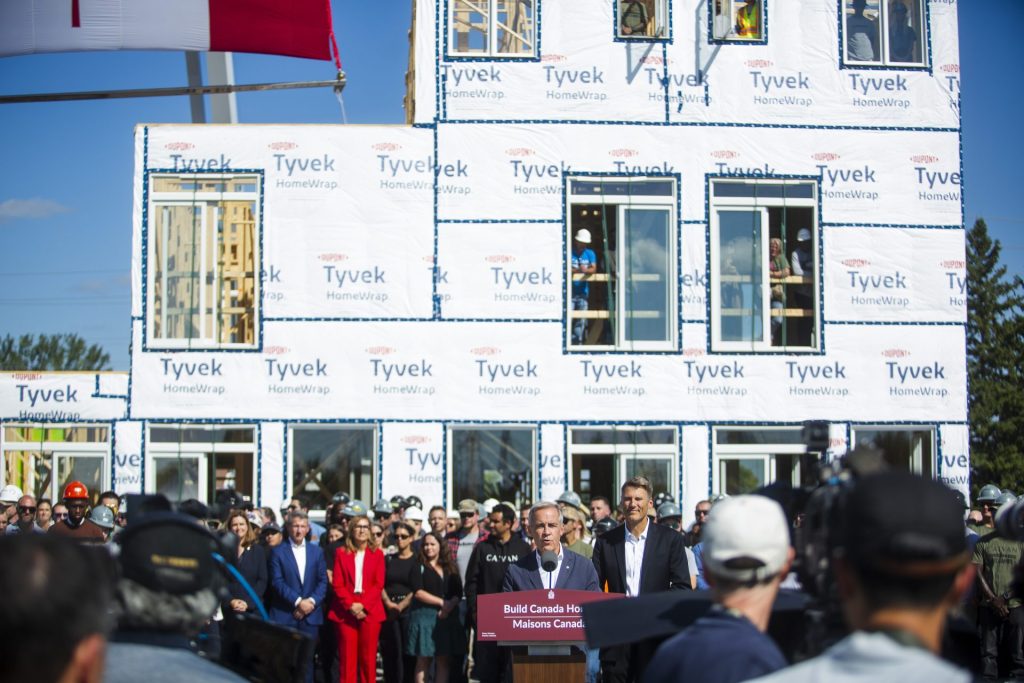 Prime Minister Mark Carney announces the creation of Build Canada Homes in September 2025. The government deserves credit for initiatives like this, but it was never designed to address market-rate homeownership for the middle class, writes Kevin Lee. The Hill Times photograph by Andrew Meade
The GST on new homes is a clear example. GST thresholds have not kept pace with today’s housing market, quietly increasing the tax burden on new homebuyers and discouraging new construction. This affects not only what buyers pay at closing, but whether projects are viable and homes are built at all.
As new Abacus Data shows, Canadians recognize these trade-offs, and support for expanded GST relief increases when it is understood to reduce costs and enable more housing supply, rather than simply as a demand-side measure. The same is true for policies that speed up approvals, support secondary suites and missing middle housing, and ensure infrastructure is in place to support growth.
Ottawa cannot control every aspect of housing delivery, but it does set the framework for making homeownership accessible to well-qualified Canadians. Federal decisions on taxation, housing finance, and infrastructure funding shape the conditions under which homes are built. Those tools can either continue to constrain supply or help unlock it. The federal government also has an important role in using its levers to impact policies at provincial and local levels that inhibit supply and drive-up costs.
With ownership housing starts trending downward, the Canadian Home Builders’ Association recommends three immediate priorities.
First, expand GST relief to all buyers of new homes and extend it to renovations that add an additional housing unit.
Second, work with provinces and municipalities to reduce development charges on new homes, which have risen by more than 700 per cent over the last two decades and place an unfair burden on new homebuyers.
Third, fix the mortgage stress test, which is locking out too many well-qualified buyers, and limiting new housing supply.
These steps would signal clearly that the federal government is serious about restoring homeownership affordability for the middle class. They can have immediate impact and are the first step in clearly showing Canadians that the federal government cares about homeownership affordability for the middle class.
Non-market housing remains important, but it is not enough. Restoring opportunity for the middle class means putting homeownership back at the center of housing policy, and removing the barriers that prevent those homes from being built.
Kevin Lee is the CEO of the Canadian Home Builders’ Association.
The Hill Times