
Engineers at Stripe have developed Minions, autonomous coding agents capable of completing software development tasks end-to-end from a single instruction. The system integrates large language models (LLMs) with internal developer tooling to generate production-ready pull requests with minimal human intervention. Stripe engineers reported that Minions now produce over 1,300 pull requests per week, up from 1,000 in earlier trials. All changes are human-reviewed but contain no human-written code.
The code managed by Minions supports more than $1 trillion in annual payment volume at Stripe and operates across complex dependencies with financial institutions, regulatory frameworks, and compliance obligations. Reliability and correctness remain central to deploying autonomous agents at this scale.
Cameron Bernhardt, Engineering Manager at Stripe, mentioned in a LinkedIn post:
Minions have progressed from concept to generating over a thousand pull requests per week, All code is human-reviewed, but the agents are increasingly producing changes end-to-end.
Minions differ from interactive coding assistants such as GitHub Copilot or AI code editors like Cursor by executing one-shot, end-to-end tasks. Tasks can originate from multiple sources, including Slack threads, bug reports, or feature requests. A task description is sent to a Minion, which orchestrates the work using blueprints, a combination of deterministic code and flexible agent loops to produce the required code, tests, and documentation. The workflow concludes with a pull request submitted for human review, allowing engineers to move from task definition to production-ready code with minimal manual intervention.

Sample Slack message invoking Minion (Source: Stripe Blog Post)
The system evolved from an internal fork of Goose, one of the first widely used coding agents developed by Block. Goose was customized for Stripe’s LLM infrastructure and refined to meet the specific requirements of Minions, while interactive tools such as Cursor and Claude Code continue to support human-supervised workflows.
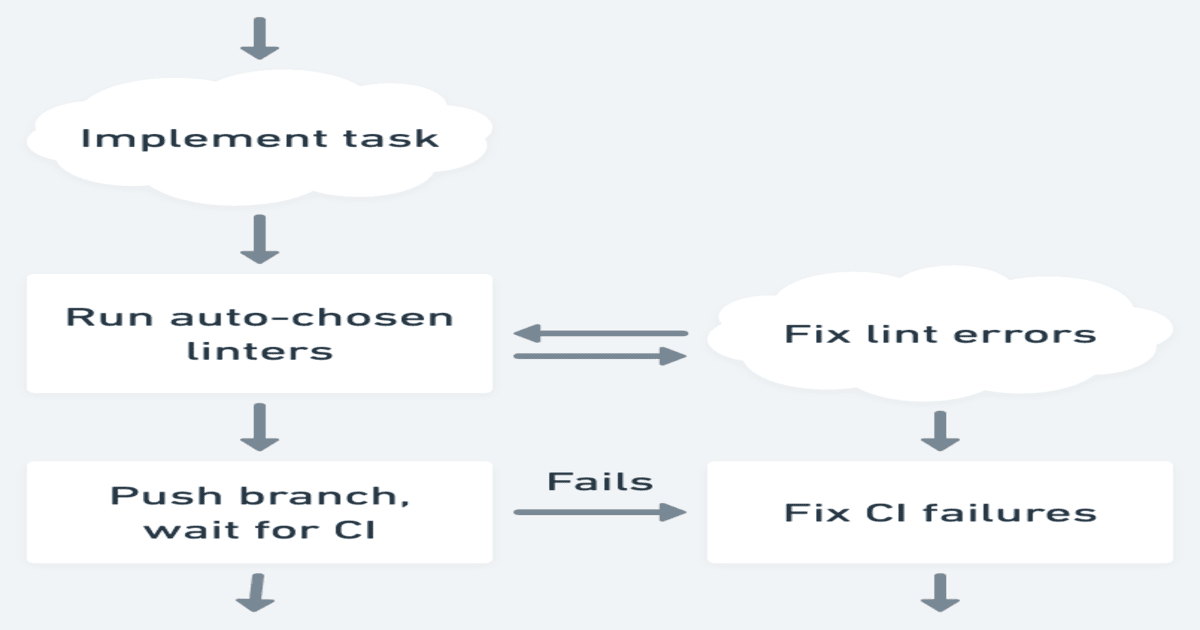
Minions are orchestrated using blueprints, workflows defined in code that specify how tasks are divided into subtasks, handled either by deterministic routines or by the agent, depending on the task. Stripe engineers describe blueprints as a collection of agent skills interwoven with code to ensure efficiency while retaining adaptability.

Minion example blueprint (Source: Stripe Blog Post)
Reliability is reinforced through CI/CD pipelines, automated tests, and static analysis, ensuring generated changes meet engineering standards before human review. Engineers noted that Minions perform best on well-defined tasks such as configuration adjustments, dependency upgrades, and minor refactoring.
The system reflects a broader trend in agent-driven software development, where LLM-based agents are tightly integrated with development environments, version control, and CI/CD pipelines to produce production-quality code with minimal supervision. Stripe’s experience suggests that autonomous coding agents can significantly augment developer productivity while maintaining strict quality controls.