
There was a time when Manitobans used to consider Saskatchewan a rural, underdeveloped backwater.
This characterization is out of date.
Over the past two decades, horizontal drilling turned our neighbours to the west into oil producers and worldwide demand for potash took off, followed by renewed interest around the globe in uranium.
While Manitoba still has a more diverse economy and is less exposed to fluctuations in commodity prices, Saskatchewan is wealthier and financially healthier, when you consider metrics such as per capita GDP, median wages and provincial debt.
Given the friendly rivalry between the two provinces, it’s worth noting when Saskatchewan does something Manitoba has not.
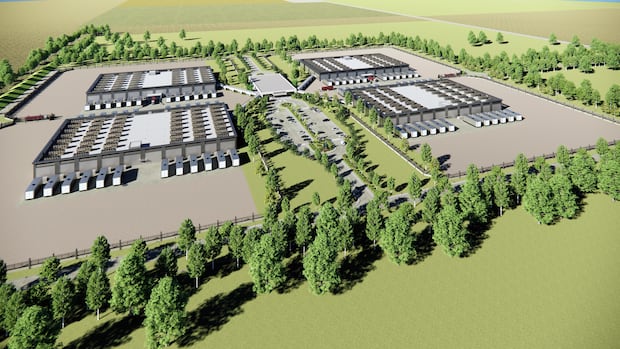
This week, Saskatchewan Premier Scott Moe proudly announced his province will soon be home to Canada’s largest artificial intelligence data centre — a $1.7-billion project Bell Canada plans to build south of Regina.
The project, slated for completion at the end of 2027, requires a tremendous amount of electricity: 300 megawatts, which is about five per cent of Saskatchewan’s current generating capacity.
Bell Canada said it has deals with SaskPower and SaskEnergy subsidiary TransGas Limited to provide this electricity, meaning the data centre will run partly on natural gas.
“This is one of the few provinces where we do have available power to build, at scale, the data sovereignty that we very much require as Canadians,” Moe said Monday.
That statement should perk up the ears of Manitobans who’ve listened closely to Premier Wab Kinew for the past few months.
In October, when Kinew unveiled an AI strategy for this province, he said Manitoba must be a leader in ensuring Canadian data is controlled and stored in Canadian jurisdictions, and subject to Canadian rules governing the way it can be accessed.
“You’ll see servers and data centres in Manitoba in the future,” Kinew told reporters after that announcement.
Kinew made that statement four weeks after he met with Bell Canada CEO Mirko Bibic and other company officials to discuss “AI in Manitoba,” according to the provincial lobbyist registry.
The premier was asked directly what he discussed with Bell Canada officials in that meeting.
“I don’t know if we have any news to share on that today, but I’d encourage you all to check out the state of the province address this December,” Kinew said on Oct. 27.
That address came and went on Dec. 9 without any announcement about a Bell Canada data centre in Manitoba.
 Mirko Bibic, Bell Canada’s president and CEO, is shown in a September 2025 file photo in Montreal. He met with Manitoba Premier Wab Kinew in October. (Christopher Katsarov/The Canadian Press)
Bibic, meanwhile, was front and centre in Saskatchewan when Bell Canada announced its project outside Regina. His company would not say whether Manitoba was considered for the project now planned for Saskatchewan.
“We regularly engage with governments and public sector partners across the country, including in Manitoba,” Bell Canada spokesperson David Marcille said in a statement this week.
Manitoba’s NDP government also refused to say whether the Bell Canada project was on the table for this province.
“Any current projects, we’re not going to talk about the details of them,” Jamie Moses, Manitoba’s business minister, said in an interview this week.
Data centres no panacea
Data centres can be a tough sell for politicians. While there’s no question $1.7 billion worth of construction would provide Manitoba with a short-term taxation windfall in the range of hundreds of millions of dollars, the long-term economic benefits are not as clear.
Once data centres are up and running, they don’t require a lot of people to operate. What they do require is a lot of energy.
That could have been a sticking point if Bell Canada wanted to open up shop here. While Manitoba Hydro’s generating capacity exceeds the total capacity in Saskatchewan, the Crown corporation has been issuing public warnings about its inability to serve new large-scale industrial customers for nearly three years.
Perhaps more significantly, the Kinew government does not appear to be as enthused with the idea of burning natural gas to fuel a data centre as the Moe government.
Manitoba’s NDP government has been unwilling to characterize Hydro’s $2-billion fuel-burning generating station slated for Brandon as a natural gas-fired project even though that will be the fuel utilized by this station when it starts operating.
Moses did not entertain the idea of gas or energy being a sticking point. What he would say is his government plans to scrutinize data centre proposals.
“We’re going to make sure that we evaluate those types of projects properly and make sure that if we are looking at those projects, that they’re going to benefit Manitobans,” Moses said.
In the United States, data centres frequently face opposition at the municipal level because they are unpleasant to look at and because they require a lot of water.
This sort of local opposition, in addition to the power requirements, may factor into future NDP government decisions about data centres.
Energy policy has already proven to be a challenge for the Kinew government, as the premier’s support for a fossil fuel pipeline to Churchill has rankled environmentalists and placed the Manitoba NDP offside with its federal counterpart.
In Saskatchewan, however, there appears to be no political discomfort with the idea of burning natural gas to power new industrial developments.
Time will tell whether the Bell Canada project will be regarded here as the big, energy-thirsty fish that got away.