
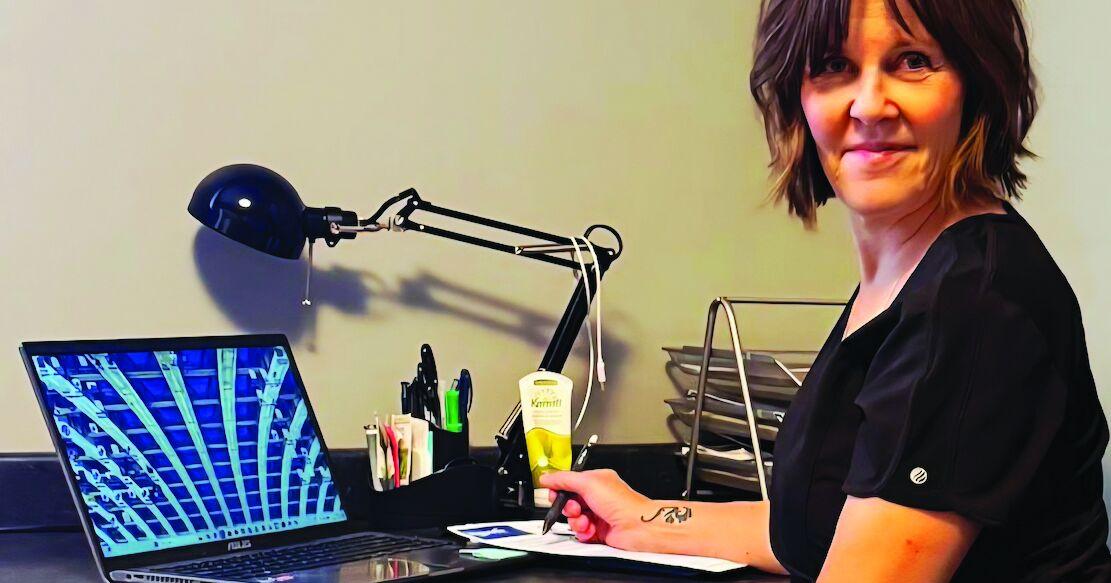
Local clinicians attend Alzheimer’s summit
By Ross Freake
Local Journalism Initiative
The first gold-standard brain and dementia care clinic in the Okanagan is planned for Penticton.
The gold standard is based on the Brain Health Initiative, which focuses on early diagnosis, comprehensive patient care, and advancements in brain health to help people with dementia. It also focuses on modifiable risk factors that can prevent or delay dementia.
Some of the 14 modifiable risk factors are cardiovascular risk, exercise, diet, hearing loss and sleep.
“We want to not only push toward a dementia care strategy in B.C., but we would want to incorporate this brain health clinic as well,” said Laurie Devolder, who attended the second annual International Conference on the Prevention of Alzheimer’s Disease in Geneva last month. The conference bought together leading clinicians, researchers, and health care professionals from all over the world.
“Our goal is to open a clinic in Penticton to be the first of many, an all-inclusive clinic, but we are not there yet.”
Devolder is a clinical study nurse at Medical Arts Health Research Group, a research company that has offices in Penticton, Vancouver, Kelowna, Kamloops and Nanaimo.
It also does memory testing, looking for early signs of Alzheimer’s disease, the most common form of dementia, often years before severe symptoms appear. The clinic also raises awareness and provides best practices for measuring and monitoring brain health.
It has also done research trials on Alzheimer’s disease, an irreversible progressive neurodegenerative condition characterized by changes to brain structure and function that often results in a deterioration of cognition, memory, and physical function and mobility.
Devolder has dedicated much of her nursing career to advancing dementia care and research. Her first job after graduating from the Penticton Okanagan College nursing program was in dementia care.
“It is a difficult, difficult, difficult journey, both for the person struggling with dementia and the family members.”
To ensure it stays a cutting-edge research company, the Penticton Medical Arts group sent Devolder to the Geneva convention to find out more about its brain-health programs.
“They have this new generation memory clinic with brain-health-services protocols. It’s very exciting.
“They are focusing on cognitively well people, what they call worried-well people, people who don’t have any symptoms. But they don’t want to have any symptoms and they come in and say, ‘what are my risk factors?’
“The (Swiss) response: Let’s get you on a better path. They say modifiable risk factors (there are 14) can delay or even prevent dementia.”
Devolder said Canada has not kept up with Switzerland. Its research and its programs are government funded and supported because they are trying to keep people from needing long-term care beds.
“Most European countries have specialized memory clinics, brain health services and prevention focused programs. Canada does have a national dementia strategy, but implementation and funding vary. B.C. does not currently have a provincial dementia strategy, unlike some other provinces.
“It’s a much more proactive approach over there. We don’t necessarily have that.”
She said in B.C. when someone goes to a doctor with dementia concerns, they are often told to have their memory tested. “If it comes back, ‘you have dementia,’ well, good luck.
“We are behind. It is a money thing. It always boils down to money. It is also a mentality thing that I think we need to change.”
The Penticton clinic aims to do blood bio markers, a blood test that will either say you have or don’t have Alzheimer’s.
“It’s totally non-invasive, easy and simple. We’re not quite there, but we’re getting there. We want to not only push toward a dementia care strategy in B.C., but we would want to incorporate this brain health clinic.”
There is definite data indicating that dementia can be prevented and prolonged with a healthy lifestyle, by using the four pillars that were presented and discussed at the Geneva convention, in particular by Giovanni Frisoni, professor of clinical neurosciences at Geneva University Hospitals.
“He wrote a paper in Lancet, and came up with a four-pillar model of how to prevent or delay dementia,” Devolder said. “Listening to him and his passion of how important this work was and the difference this work made, was inspiring.”
The four pillars are risk assessment, risk communication, risk reduction and cognitive enhancement.
His paper in Lancet: “An action plan to prevent Alzheimer’s disease. As the population ages, the number of people with Alzheimer’s disease in Europe will double by 2050. A task force led by UNIGE and HUG is laying the foundations for a preventive protocol.”
It can be found at: unige.ch/medecine/en/public-outreach/media/an-action-plan-to-prevent-alzheimers-disease
Devolder said she suffered from brain overload after the conference because of the number of speakers and the volume of information.
“They talked to people who were doing those brain health clinics around the globe, and successfully, and statistics proved everything that they’re saying.
“It was very exciting and my team was 100% infected with my enthusiasm. We, including our CEO, Donna Benson, are excited to go this route. We’re just getting going, but we’re going.”
—
Nurse Laurie Devolder’s mission against Alzheimer’s
By Ross Freake
Local Journalism Initiative
People with Alzheimer’s disease face a long, hard journey, something Laurie Devolder knows from painful experience.
But, ironically, it also helped her find not only purpose, but joy.
“My mother developed Alzheimer’s and ended up in a facility in Kelowna,” said Devolder, a clinical study nurse at Medical Arts Health Research Group in Penticton, which also runs Memory Cafes, a pilot project with University of British Columbia Okanagan.
“I went through the dementia journey with her. She was diagnosed when she was about 70, and passed at 85.”
As a child, Devolder wanted to be a nurse, but married her high-school sweetheart, Peter, after they graduated and they had their first child right away.
“My nursing plans were put on hold. We had three children quite young and that was my life, but when I was 38, I went back to school to become a nurse.”
While she did practicums in the hospital while in college, “that wasn’t my calling. My first job was at Village by the Station. I worked in the dementia cottages there.”
That was her calling and she has been involved with dementia care ever since, the last 10 years at Medical Arts.
“I have the best job in the entire world. I’m grateful for my job every day.”
She works with patients in clinical trials, but also does memory testing with people who are concerned about their cognitive abilities.
“I see people at all levels of dementia. Some folks are cognitively well but they want to be proactive. We also have some people who are struggling who doctors have referred to us. Some are there against their will, who don’t think they have a problem, but there is a problem.”
She said no one likes being tested, so she tried to make the environment as comfortable and tried to reduce the anxiety and stress.
“There are definitely some heart-breaking situations. Sometimes we share a lot of tears when they can’t do the simplest procedures, when they realize, ‘oh, my goodness, I don’t know that? Why don’t I know this? Why can’t I answer this?’”
She said the journey is difficult not only for the person struggling with dementia, but also their family.
“It can be heart breaking and very emotional. It can be heart wrenching. The biggest thing I learned was to remember there are still there. They might not always be present, they might not know you any more, but they know how you make them feel.”
She finds it frustrating when caregivers argue with the person with dementia instead of accepting them and making them feel safe.
One of her “famous stories” is about a woman who sat by the door every day at 4 p.m., waiting for her husband, John, to come home.
“Some of the staff would say, ‘Oh, Mary, John is dead.’ That was news to her every single day and led her to tears.
“Don’t do that. Just say, ‘why don’t we grab a coffee while we’re waiting for John.’”
Dementia is not just Devolder’s job and her passion, it is ever present because she knows she might have Alzheimer’s genes like her mother.
“There can be that genetic link. I do have that in the back of my mind. My sisters and I talk about this all the time. We’re very mindful. I am aware of things to look for, and if there is anything concerning, I want to be on it right away.
“A lot of people are in denial even when they’re on the path.”
She said the stigma attached to having Alzheimer’s is still strong, but it is changing. “There is more conversation and acceptance.”
She said the Memory Cafes — 26 are planned for this year — are raising awareness, creating more acceptance, and helping create dementia friendly communities.
“After every Memory Cafe I go to, I’m on Cloud Nine and a little bit between tears and laughter, a whole array of emotions.
“We just want to move forward.”
—
Is Alzheimer’s disease preventable?
By Ross Freake
Local Journalism Initiative
An Australian neuroscientist claims that Alzheimer’s disease is 95% preventable.
It is, she said, a lifestyle disease, like type 2 diabetes. Do the right things and you won’t get it, unless you are one of the five per cent that have genes for Alzheimer’s, and even then, that is not a guarantee you will get it.
Some research studies have proposed that Alzheimer’s disease should also be classified as type 3 diabetes.
Neuroscientist Louisa Nicola said 60 million people worldwide suffer from Alzheimer’s, but that will explode to 150 million in 25 years and 110 million will be women.
“Being a woman is a risk factor for getting the disease,” she said.
The reasons are still unclear. It was often thought women got it more often than men because they live longer, but, instead, or in addition to, it may have something to do with estrogen and the immune system.
In Canada, dementia, of which Alzheimer’s is the most common type, is expected to increase 187% by 2050, with more than 1.7 million living with the disease.
Not everyone shares her claim that Alzheimer’s is a lifestyle disease. According to ChatGBT, the relationship between lifestyle and dementia, including Alzheimer’s disease, is one of the hottest topics in neuroscience.
“There is strong evidence that lifestyle plays a major role in dementia risk — but the figure of 95% preventable is not supported by current science,” ChatGPT says.
But there’s an emerging international consensus that dementia risk can be reduced substantially. Some globally recognized neurologists and epidemiologists argue dementia is not inevitable and that prevention is most effective when it starts early in life.
However, they emphasize “modifiable risk” — of which there are 14 factors — rather than “lifestyle disease,” since there are complex genetic contributors and neurobiological processes beyond individual control.
A U.S. study found that a combination of four lifestyle changes — diet, exercise, cognitive activity and managing heart health — can improve cognition in older adults.
Three of the best things we can do to prevent or delay dementia:
• Daily exercise
• Weight control
• Sugar control — don’t eat it.
“It’s a nice, clean pattern” — risk rises as blood sugar does,” said Dallas Anderson, a scientist at the U.S. National Institute on Aging.
Most, if not all, experts agree there are strategies we can use to prevent or delay Alzheimer’s. In addition to daily exercise, Nicola said resistance training should be done two to three times a week.
“Having strong legs is the most important tool in your tool box for preventing Alzheimer’s,” she said.
A twin study in the United Kingdom found leg power predicts cognitive ageing, despite controlling the common genetics and early life environment of the twins.
Dementia generally starts in our 30s, but symptoms don’t normally show up until our late 60s, 70s and beyond.
“If we don’t take care of our brain, we start getting a decline in these functions,” she said.
And sleep deprivation, poor diet, lack of physical activity and environmental toxins slowly erode brain function.
There are many other things we can do, but these are easy and within our control. We don’t have to go anywhere or do anything. We can go to the gym or pool, but it isn’t necessary.
All we need is the will to do them, to prevent the scourge of the century from claiming us as a victim, as another dementia statistic, from robbing us of who we are.
But not only us, but our spouse, our children, our grandchildren, our siblings.
And, of course, the health-care system. Caring for someone with dementia not only takes a toll on the family and caregiver, but also on the health-care system, where dementia sufferers often end up.
But it isn’t just the financial, which is, globally, more than US$1.3 trillion annually, projected to exceed US$2.8 trillion by 2030, and social costs, but also the toll on the caregiver and the family who have to watch a loved one die twice — the mental death of them fading away, and the physical death when they take their final breath.
While we’re waiting for a cure, we can take action now to prevent us from needing it when it is found.
If we reduce our risk factors and take the advice of the experts, we can thrive.
“They say those modifiable risk factors can delay, even prevent Alzheimer’s,” said Laurie Devolder, a clinical care nurse at Medical Arts Health Research in Penticton.
“That’s huge.”
Remember that. It’s important.