

Listen to this article
Estimated 6 minutes
The audio version of this article is generated by AI-based technology. Mispronunciations can occur. We are working with our partners to continually review and improve the results.
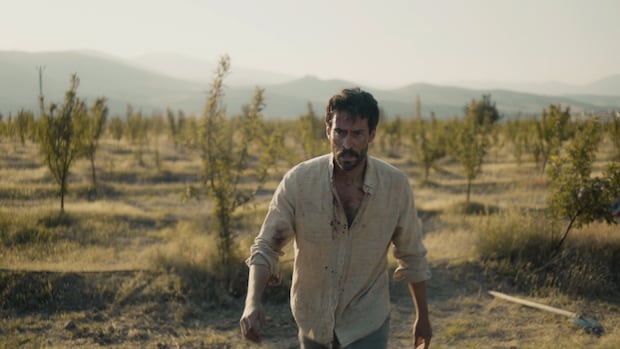
Iranian Canadian filmmaker Alireza Khatami travelled a long road to release his new movie today in Montreal and Toronto. His Turkish language movie, The Things You Kill, is about a son trying to kill his father.
The film is a co-production between Canada, Turkey, Poland and France. Yet many film festivals turned down the film, including Canada’s own Toronto International Film Festival. The Things You Kill eventually received national recognition, with Telefilm submitting it for best international film for Canada at this year’s Oscars, though it ultimately didn’t receive the nomination.
But the film has ignited conversations about what is considered a “Canadian” movie. Today on Commotion, host Elamin Abdelmahmoud speaks with film critics Radheyan Simonpillai, Barry Hertz and Sarah-Tai Black about The Things You Kill and what it says about the Canadian film industry.
We’ve included some highlights below, edited for length and clarity. For the full discussion including a review of Project Hail Mary, a discussion of AI Val Kilmer and a recap of The Bachelorette news, listen and follow Commotion with Elamin Abdelmahmoud on your favourite podcast player.
WATCH | Today’s episode on YouTube:
Elamin: Sarah-Tai, what did you think of the movie when you saw it?
Sarah-Tai: I liked it a lot. I love the way Alireza Khatami deliberately breaks the film apart in the mid-point. It really collapses in on itself, in a good way. And it pulls you into this very surreal, internal, psychic disorientation that forces you to find your own footing again. It’s the kind of work that makes you, as a viewer, an active participant instead of just a passive observer, and I love that. The way that it unfolds is really symptomatic of the inherited patriarchal violence we see on screen of the male characters. It becomes clear that the story of revenge is not really about revenge, it’s about why revenge is a symptom of that family. And I think it’s very haunting.
It’s a movie that I really want to watch again. I feel like once wasn’t enough for me to fully immerse myself in that self-meaning making it asks of its audiences…. It has this one incredibly, incredibly stunning shot that I can’t stop thinking about. I rewound the film, like, 10 times to see it play out over and over again. And I love being woken up like that. I love movies.
Elamin: I think watching a movie that makes you go, “I love movies,” that’s the most satisfying thing you could possibly do.
Barry, do you want to talk a little bit about the obstacles that Alireza had to face in order to just get this movie made and then released?
Barry: Yeah, so Alireza made a very good and interesting talking point when he was at the TIFF’s Canada’s Top Ten event last month, which celebrates the best in Canadian film from the preceding year. And he was on stage and he was talking about the arduous journey that it took to get this film out there. He was rejected roundly from festival to festival — Cannes, Locarno, Telluride and TIFF, in fact, which he made a point of pointing out on stage there, much to some audible murmurs in the crowd.
He has a very pointed question to the Canadian programmers of TIFF asking: am I Canadian enough? Does my name ring Canadian enough? Are the expectations of what I am doing as an Iranian Canadian filmmaker, is it good enough for what the festival is seeking? These are grand existential questions, I think not only for the Toronto International Film Festival, but for the Canadian film ecosystem as a whole.
When this film was announced as Telefilm’s submission for best international film for Canada, there were questions. It was like, well, is this a Canadian film? It’s a co-pro — and a minority co-pro at that in terms of Canada’s participation. Are we celebrating films that tell Canadian stories? Are we celebrating films from Canadian voices? I think these are great conversations to have. And as much discomfort as those comments that he made at the TIFF event caused in the room, you could feel the energy shifting in there.
It was a breath of fresh air, whether you agree with it or not. Because these are dialogues that are not really had all that often, and when they do, they generate discussion and discussion’s great. And as [Alireza] told me in our interview, he doesn’t want TIFF to fail, he wants TIFF to succeed, he wants a Canadian film to succeed. He’s there to make things more open.
Elamin: Rad, do you think TIFF made a mistake in passing over this film?
Radheyan: I would say that if you hold this movie up against all the Canadian films that premiered at this last TIFF in the year before, this would be one of the best — if not the best film. So that says something about it being missed there.
I can’t project the reasoning to what they were trying to meet in terms of the demands, in terms of popularity demands and filling in a theatre, I don’t know that stuff. But in terms of quality, this is a movie where I felt like I was watching Christian Petzold’s Yella again, this incredible international talent that then grows into something big. It’s a huge stepping stone for this filmmaker that I think can go on to greater things. And the fact that it wasn’t programmed at TIFF, the fact that I only saw it two weeks ago because of that, is disheartening.
You can listen to the full discussion from today’s show on CBC Listen or on our podcast, Commotion with Elamin Abdelmahmoud, available wherever you get your podcasts.
Panel produced by Stuart Berman.