
As Calgary city hall receives hundreds of speakers at a public hearing this week for the repeal of blanket rezoning, let’s turn the clock back for a moment to our last big housing controversy: secondary suites.
There was a great deal of unease at the idea of giving homeowners a pathway to legalize secondary suites and making it easier to bring illicit units up to code.
Safety was an obvious factor. At least one fatal fire in the late oughts served partly as a political impetus to bring more basement apartments in line with regulations.
Time was another. Homeowners wanting to legally build secondary suites were forced to parade in front of city councillors, often having to share very personal stories of their family struggles to justify renovations.
Those opposed to streamlining the bureaucratic process for secondary suites and making it possible to build them citywide argued it would destroy neighbourhoods and aggravate existing parking problems.
This month marks eight years since Calgary’s secondary suite reforms, with the data showing very interesting patterns.
Despite being legal everywhere, most of the applications have come from outlying neighbourhoods, as opposed to those in older areas, according to statistics.
And while there have been reports over the years of isolated issues with parking, it would be unfair to say it’s a problem everywhere.
Of course, every neighbourhood is different. Your mileage may vary.
Related
I live on a street where secondary suites have always been allowed. We’ve been getting a lot of infill development over the years, too. There’s also a small apartment building on our block and other multi-family buildings close by.
In theory, parking here should be a disaster. There is one- and two-hour curb-side parking during the day but unlimited parking at night. There are no limits at all a couple of blocks away.
Assuming everyone around here owns at least a couple of vehicles, there shouldn’t be enough room and yet, there are open spots on our block all the time, even overnight.
Maybe it’s because we have some half-decent bus routes nearby, or maybe a lot of people partake in active transportation. (For those willing and able to hoof it, the CTrain is a reasonable walking distance away.)
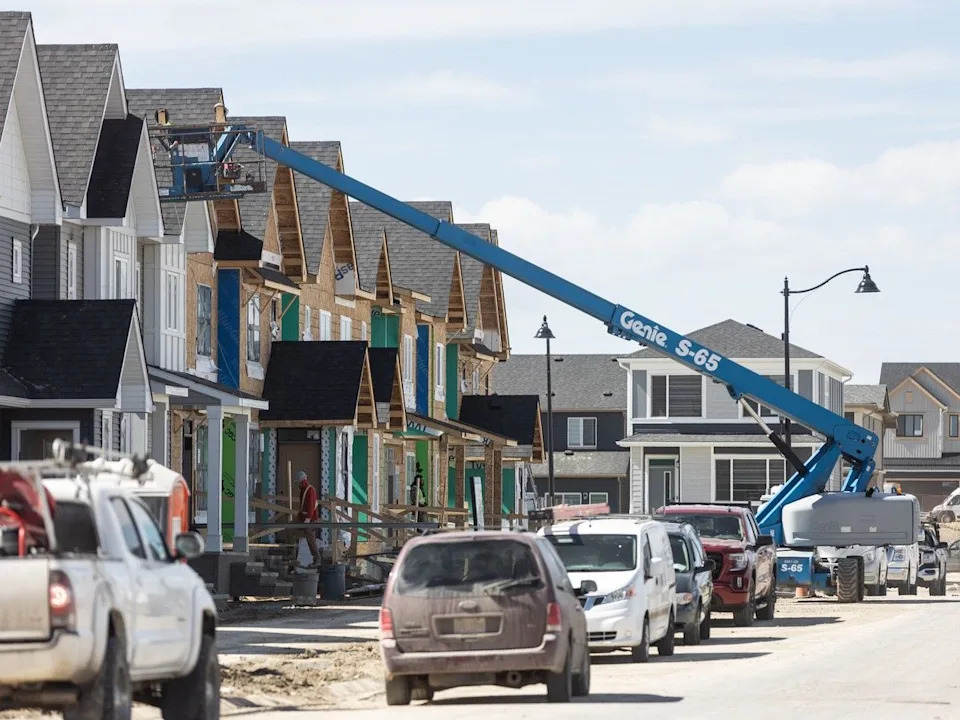
Rows of new homes under construction are shown in the new Homestead neighbourhood on the northeast edge of Calgary on Monday, April 15, 2024.
The situation is hardly apocalyptic and it would be quite the exaggeration to say our neighbourhood is being destroyed.
That kind of harsh language has been used all through the debate over rezoning.
Its proponents in the last city council frankly did an awful job explaining and selling it — although they were not helped by some extremely over-the-top rhetoric by opponents.
Rezoning applications at city hall were just like the secondary suite hearings of years past: people showed up to plead their case, with council rubber-stamping the requests almost all the time.
Certainly, there needs to be a way to appeal egregious applications that really don’t fit, but for the vast majority of them, there is really no reason for the red tape.
And besides, despite all the rhetoric, blanket rezoning never allowed people to build whatever they want, wherever they want.
In any case, it’s not as if there’s been a massive change in the fabric of Calgary in the year-plus since zoning rules changes: as predicted, homes can only be built if an owner wants to do it. And there are only a limited number of workers available to take projects on.
The new rules were meant to open the door to slow, incremental evolution that would — and should — naturally occur in any growing city.
Anyone needing a preview can peek at the edge of town, because local developers put together very nice suburbs. (You never thought you’d see me write that sentence, eh?)
There’s a pleasant mix of single-family homes of all types, with bigger multifamily buildings along major transit routes and near commercial/retail areas. Green spaces abound.
It’s certainly denser than older parts of Calgary but it’s also not midtown Manhattan. It’s not a hodgepodge eyesore and with good transit, it doesn’t have to be a transportation nightmare.
If that kind of construction helps to bring younger families and new life to older parts of Calgary, we should all be for it.
A uniform, citywide residential zoning policy makes sense. City council members need to use input from the public hearing to correct the previous council’s mistakes and straighten misconceptions about how we can create more housing to benefit everyone.