
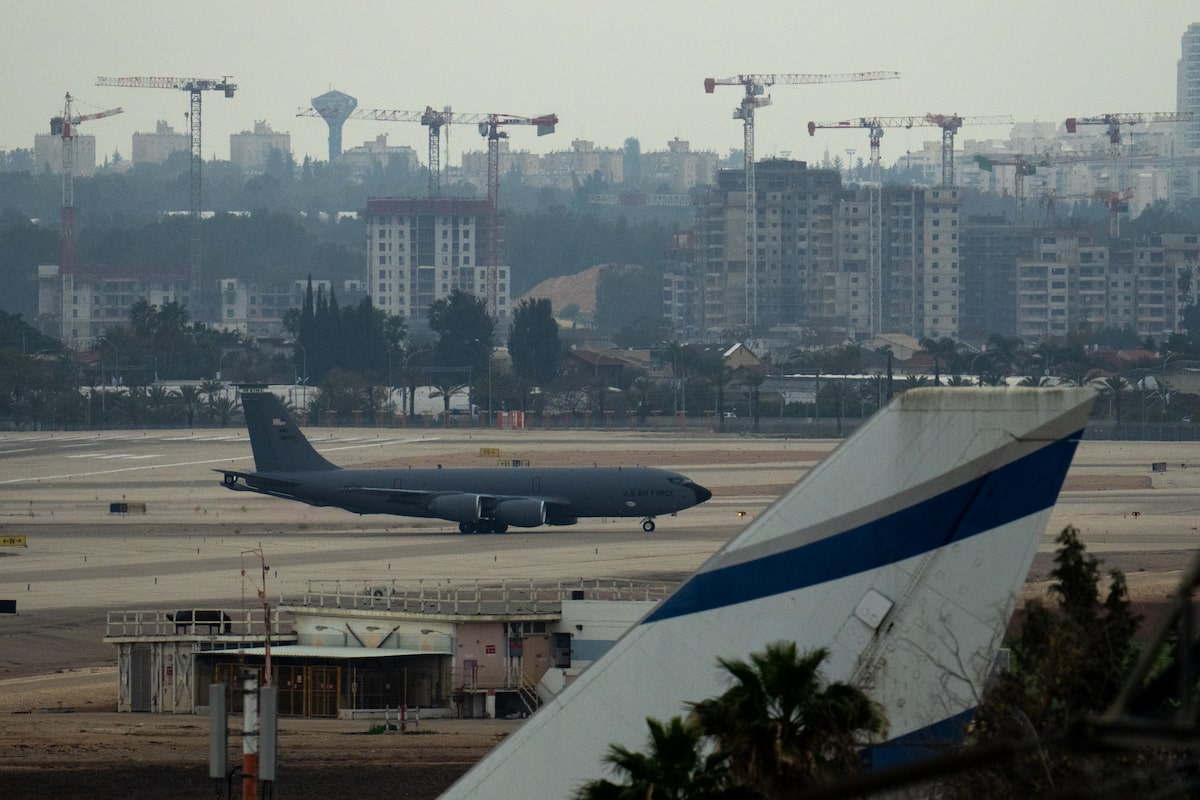
A U.S. Air Force KC-135 Stratotanker refuelling aircraft on the runway at Ben Gurion airport in Lod, Israel, on March 13.Erik Marmor/Getty Images
American military aircraft have been using Canadian airspace to refuel on their way to the Middle East, backed by a long-standing NORAD agreement that does not require the U.S. to ask permission from Canada to do so.
On March 12, between 10:30 a.m. and 12:30 p.m. ET, two KC-135T Stratotankers – large American refuelling aircraft – were observed overhead by residents of Moose Factory, Ont., along with several other aircraft, the make and model of which could not be identified from images captured by a resident of the town.
On the same day, a second formation of two refuelling aircraft and other planes was also spotted over Eastmain, Que.
Canadian military personnel left Iraq with NATO allies, Defence Minister says
Using Flightradar24, a publicly available flight-tracking website, a total of eight refuelling aircraft were identified in the James Bay region, tracked from Salt Lake City and back to Pittsburgh.
All of the U.S. military tanker aircraft abruptly vanished from public flight-tracking systems, an action consistent with active aerial refuelling. Video from Moose Factory showed multiple aircraft flying in close formation, including one positioning itself behind the tanker.
The Globe and Mail began a probe into the use of Canadian airspace for U.S. Air Force refuelling operations on March 16 after receiving photos and video from the resident in Moose Factory.
Further analysis of Flightradar24 tracking track data revealed near-daily refuelling operations over Canadian airspace from March 12 onward, primarily over Nova Scotia and Newfoundland, indicating a sustained operation rather than a single event. The scale and flight profiles are consistent with long-range bombers.
As well, that data showed that a transport aircraft landed in Gander, Newfoundland, en route to Saudi Arabia, the first confirmed use of Canadian territory as part of the logistical chain supporting operations in the Middle East. Taken together, these operations point to the emergence of a northern logistics corridor for U.S. force projection.
U.S. President Donald Trump, who alongside Israel started the war on Iran with minimal consultation from allies, has increasingly called for their help as the war drags into its fourth week.
The Globe’s findings were presented to two Canadian defence experts – James Fergusson, an associate professor at the University of Manitoba, and David Bercuson, a professor at the University of Calgary. Both reviewed the information and reached the same conclusions.
Under Canada’s Aeronautics Act and bilateral agreements through the North American Aerospace Defence Command (NORAD), U.S. military aircraft do not require formal permission to transit Canadian airspace. However, such operations typically involve giving notice to Canadian authorities.
“They need to give notification to Canadian sources,” said Dr. Fergusson, an expert on NORAD. “They’d have to register their flight paths, and these would be classified.”
Canada, Japan, European allies willing to use ‘appropriate efforts’ to reopen Strait of Hormuz
Global Affairs Canada confirmed in an e-mail that the U.S. military is not required to seek overflight permission. “Canadian military aircraft are granted the same privilege as part of a reciprocal arrangement with the U.S.,” said spokesperson John Babcock.
When asked if Canada had been notified of the March 12 operation, he would not comment.
The Department of National Defence, NAV Canada, and U.S. Central Command also declined to answer questions about the March 12 operation.
“They’re not going to communicate this,” Dr. Fergusson said. “They never have – the Canadian government, not just this government, but all previous governments that go out for decades. Their desire always in the Canada-U.S. defence relationship in North America is to keep it, as the term goes, off the radar, as quiet as possible.”
Added Dr. Bercuson: “Because of our military agreements with the United States, we’re tied into [this] whether we like it or not.”
While the aircraft receiving fuel do not appear on public-tracking systems and cannot be visually confirmed, the scale, structure and timing of the tanker operation are consistent with U.S Air Force B-2 Spirit stealth-bomber missions.
Ottawa’s Middle East response aims to help Canadians and reopen the Strait of Hormuz, ministers say
The B-2 operates exclusively from Whiteman Airforce Base, in Missouri, and requires multiple aerial refuellings on long-range missions. Video released by U.S. Central Command on March 14 shows a B-2 departing what appears to be Whiteman base ahead of the Iran strikes, confirming the aircraft’s participation in the campaign.
Other U.S. bombers used in the strikes, including the B-1B Lancer and B-52H Stratofortress, are forward deployed to bases in Britain and would not require transit through Canadian airspace.
The direct route from Missouri to the Persian Gulf crosses central Canada and the Hudson-James Bay region, shortening bomber flight times by hours and simplifying tanker logistics, making Canadian airspace the most efficient corridor for an initial refuelling.
“Given the flight paths from the B-2 base in Missouri, this is the direction they would go.” Dr. Fergusson said.
On March 12, Flightradar24 revealed that eight U.S. tanker aircraft, the majority from the 171st Air Refueling Wing, converged over the James Bay region before switching off their transponders for roughly 40 minutes, a duration consistent with aerial refuelling operations.
“It’s only when they get to the position where they are doing classified military operations that they turn them off,” Dr. Ferguson said. “That would be the physical refuelling.”
The number of tankers effectively rules out fighter aircraft, but not the B-2 stealth bomber. A deployment of this size could support dozens of fighter jets, an operation that would almost certainly have been widely observed. Instead, the tanker-to-aircraft ratio aligns with long-range strategic bombers requiring large volumes of fuel and multiple refuelling stages.
“I think there’s only one answer.” Dr. Bercuson said. “They must be refuelling B-2s.”
In the days after the March 12 operation, additional U.S. Air Force tanker activity over and near Canadian airspace suggests the mission was not an isolated event.
Between March 14 and March 20, Flightradar24 revealed six cases of multiple refuelling KC-135T and KC-135R aircraft conducting similar loitering patterns over Newfoundland and Labrador, and Nova Scotia, including repeated instances of transponders being switched off.
Routing through northern Canada provides sparsely populated airspace and reduced air traffic, allowing the U.S. Air Force to conduct refuelling operations with fewer constraints and greater security.
That is an uncomfortable reality for Mark Gagnon, a resident of Moose Factory who recorded the aircraft.
“I don’t think it should be allowed.” he said about the refuelling operation.
Mr. Gagnon, who is a cable technician and works outside, said “we always see the jets flying over and whatever, but I noticed right away that there was more than one. And then I kind of looked over to the other side, and then I saw the other group, and I was like, okay, this is something I’ve never seen before, so I pulled out my phone and started recording.”
“[Mr. Trump] started a war and he’s expecting everyone to help him,” he said.
“Leave us out of it.”
With reporting by Raven Brascoupe