
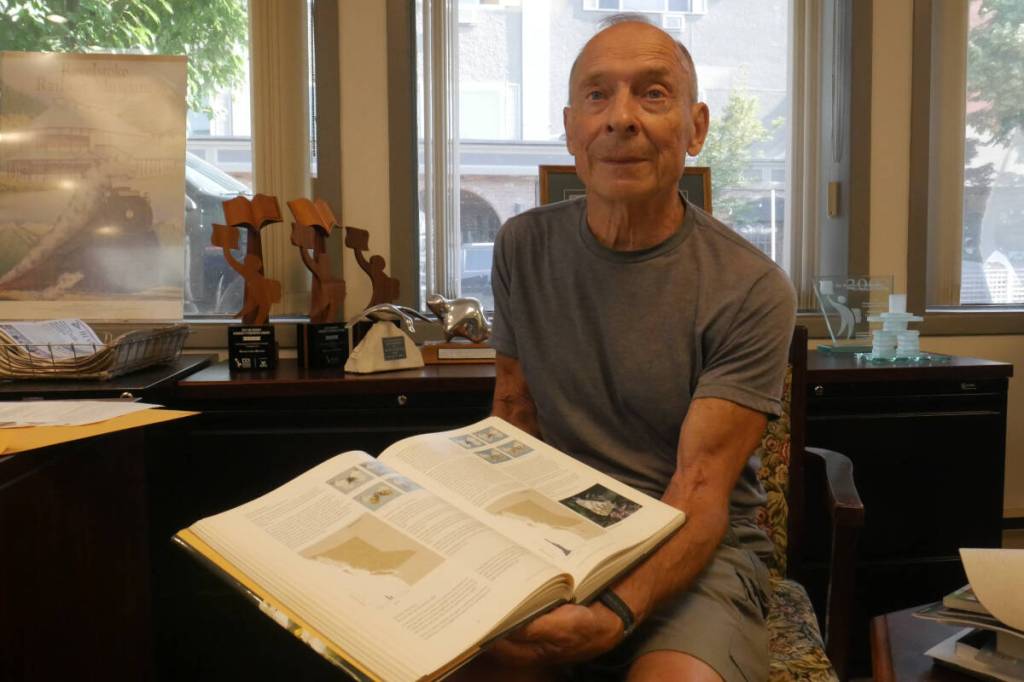
Walking around downtown Revelstoke every day, 81-year-old Dave Threatful always has time to chat about anything — but of all topics, butterflies strike a chord.
He enjoys stopping by the Revelstoke Review office each week to discuss the latest news, as well as the diverse range of wildlife that the inland temperate rainforest has to offer.
Several times in the last year, Threatful has helped Black Press Media identify butterfly species photographed around Revelstoke and Rogers Pass. In these conversations, a dedication to studying lepidoptera throughout his life and contributing to scientific knowledge across B.C. and the Pacific Northwest has been evident.
And with spring slowly starting for Revelstoke, it’s the perfect time to talk about the diversity of butterflies that call this region home and will soon be taking flight again.
Encouraged by Grade 3 teacher Miss Eva Burn back in 1953 to take an interest in wildlife, Threatful began studying butterflies on his own time. He learned through a lepidopterist magazine about Clifford Ferris, a butterfly researcher at the University of Wyoming, and started mailing letters. Ferris further encouraged him in his lepidoptery studies after high school.
“He got me going pretty good,” Threatful recalled.
Today, he’s dedicated most of his life to observing and collecting butterflies. His personal collection totals 17o species, including 111 of the 188 currently known to exist in B.C. In 1997, he donated it all to the North Okanagan Naturalist Club, from where the collection ended up on display at Vernon Museum & Archives, and today it remains stored in the building.
Helping park research
Prior to Threatful’s work, butterfly research in Mount Revelstoke and Glacier national parks hadn’t been extensive, besides the collecting Mark Hobson in Rogers Pass completed during the 1970s.
Threatful connected with John Woods, Parks Canada’s chief naturalist for Mount Revelstoke and Glacier. He signed a volunteer naturalist agreement in 1980, and Woods issued a collecting permit so Threatful could gather butterflies and define their ranges in the parks for a year. He’d place his specimens in glassine envelopes to dry out, and record their scientific name, location, elevation, and date of capture.
These specimens were sent to the Biosystematics Research Institute in Ottawa. This led to the publication of two scientific papers with nearly 30 pages of formal research in 1982 and ‘89, which found that 64 butterfly species occur in the two parks. A total of 70 species have been documented in the Columbia Mountains around the Revelstoke area more broadly.
Threatful’s butterfly work “is among the first examples of such research conducted in Mount Revelstoke and Glacier national parks, and his butterfly collections have significantly contributed to our understanding of Lepidoptera species type and distribution within the national parks,” Parks Canada staff shared in a statement. “Unfortunately, most of the physical collection held by Parks Canada was lost in a flood in 2010.”
Still, the surviving specimens from his 1980s collection remain on display for the public at Mount Revelstoke’s Snowforest Campground Welcome Centre.
From 2000 to 2009, Threatful also curated butterfly collections for Calgary lepidopterist Norbert Kondla, visiting Lillooet’s forest district and the eastern Cascade Range in Washington State to gather specimens. Kondla’s private collection contains a large series of butterflies from Alberta and B.C. that continue to be used for taxonomic research.
Threatful enjoyed collecting butterflies for the hiking, camping, and backpacking it involved, as well as for the contributions to science by mapping butterflies’ local habitat and distribution records.
“You get out and enjoy the environment, travel to different areas of the province,” he remarked.
That said, it requires studying the habitat, finding host plants, and setting out at the right time of year when the butterflies are flying, and the weather is sunny, not wet and cloudy.
He also took satisfaction from how the work challenged him, such as when trying to identify variable genera, including Sulphurs and Fritillaries.
“It’s not like birds,” he distinguished. “It’s unpredictable. You leave at four in the morning if you’re going to get out there to the high alpine country.”
At times, this also required him to camp out in the evening to access the right butterfly habitat at the right time.
One interesting find for Threatful was identifying the Rocky Mountain Apollo in the high open subalpine of Mount Cartier — a species that otherwise appears absent from Mount Revelstoke and Glacier.
A favourite find of his was documenting the first B.C. record of the Magdalena alpine near McBride in the Cariboo Mountains on Ozalenka Ridge, back in August 1984. He found three more specimens the following summer, which ended up in butterfly researcher Jon Shepard’s collection donated to Oregon State University. This species is typically found far south in Colorado, Wyoming and Utah, but also occurs in Yukon, Alaska and even eastern Siberia.
Some butterfly trivia
Naturally, Threatful is full of fun butterfly facts.
These insects have six legs, circle around puddles for moisture and mineral salts, and taste with their feet. They can also be found ingesting sodium and amino acids from carcasses and feces to boost their protein for egg production.
Butterflies frequently visit flowers for nectar, a food source they need for energy. You’ll further see them feeding on rotting fruit and tree sap, using the sugar for food and the water for moisture.
First-generation monarch butterflies are known to migrate north to lay their eggs before dying, while the second generation is renowned for returning thousands of kilometres south to California and Mexico for winter hibernation.
Other species, including the Compton tortoiseshell, have brightly-coloured patterns such as rich orange-brown, with black markings on the upper side of the wings. When flapped, these markings can scare off chipmunks and other predators. The camouflaged underside of wings, grey-brown and leaf-like in colour, also helps butterflies blend into their surroundings when perched with their wings in an upright position.
“All of a sudden, they close the wing and the (predator)’s confused,” Threatful said. “It doesn’t know what happened.”
Numerous species from the Revelstoke area that hibernate, including the satyr anglewing, use an unknown antifreeze substance to help them survive extreme cold in winter. They’re found sheltering in tree cavities, deserted buildings, and wood piles.
Some people may confuse butterflies with moths, but Threatful added that North American butterflies aren’t as bulky as moths and have a club on the end of their antennae, while moths will have stringy or feathered antennae.
“When the butterfly’s flying, the antennae help balance the butterfly” and maintain its direction, he noted.
And in Canada and the U.S., “there are many more moths than butterflies,” Threatful said — an estimated 725 to 750 butterfly species to anywhere between 12,000 and 13,000 moth species. “They’re still finding more.”
While Canada has 275 butterfly species total, B.C. alone enjoys more than 2,000 moth species.
High praise from experts
In 1985, Threatful was introduced to Thomas Manley, head of entomology at Yale University’s Peabody Museum of Natural History. He spent 1986 to 2005 collecting numerous butterflies in the Parnassius genus from B.C.’s Southern Interior, sending Manley a large series of specimens with at least 30 of each kind.
Researchers have come from around the world to study butterflies at Yale, where specimens such as Threatful’s are loaned out to lepidopterists doing taxonomy work.
As a member of the North Okanagan Naturalist Club from 1997 to 2001, Threatful took others interested in entomology on butterfly walks to help them learn the species of the North Okanagan.
It was 2001 when Shepard and B.C. entomologist Crispin Guppy described a completely new butterfly subspecies: Polygonia oreas threatfuli. Threatful had collected the specimen back on Sept. 21, 1982, around Vernon and Kalamalka Lake Provincial Park. As an honour to his years of contributions to B.C. entomology, and for collecting the new specimen, Shepard and Guppy named it after him. Today, Threatful’s namesake specimen can be found at the Royal BC Museum.
In 2005, he received high praise from Charles Lee Remington, a Yale professor known as the father of modern lepidoptery, who for years had used Threatful’s B.C. butterfly specimens for his own research and teaching.
“I am writing you to convey our warmest appreciation for this crucial collection of scientific research specimens,” Remington said via letter. “I have never known of a field worker to produce such top quality and quantity of treasured specimens.”
Even today, Threatful hasn’t lost the knack.
On a visit up the Asulkan Valley in Rogers Pass on July 29, 2025, he recorded a dozen butterfly species between 1,300 and 2,100 metres above sea level. Among them were the lustrous copper, Arctic blue, faunus anglewing and Milbert’s tortoiseshell.
In Revelstoke during the past five years, he has been shown butterfly photos by other locals to help identify the correct species — including writer and historian Laura Stovel, Revelstoke Museum and Archives curator Cathy English and mixed-media artist Zuzana Riha.
But Threatful cautioned that building and agricultural development are continuing to fragment lower-elevation habitat for B.C.’s butterflies.
“Many areas where the butterflies are, the habitat’s destroyed, so they’re harder to find,” he described.
He noted there are also fewer places today where butterflies may be caught and collected for scientific study. Threatful encourages people instead to take pictures of the specimens they find, “and just enjoy them.”
This summer, he hopes to get back out to Glacier and scour the slopes for butterflies around Prairie Hills, in the park’s east.