
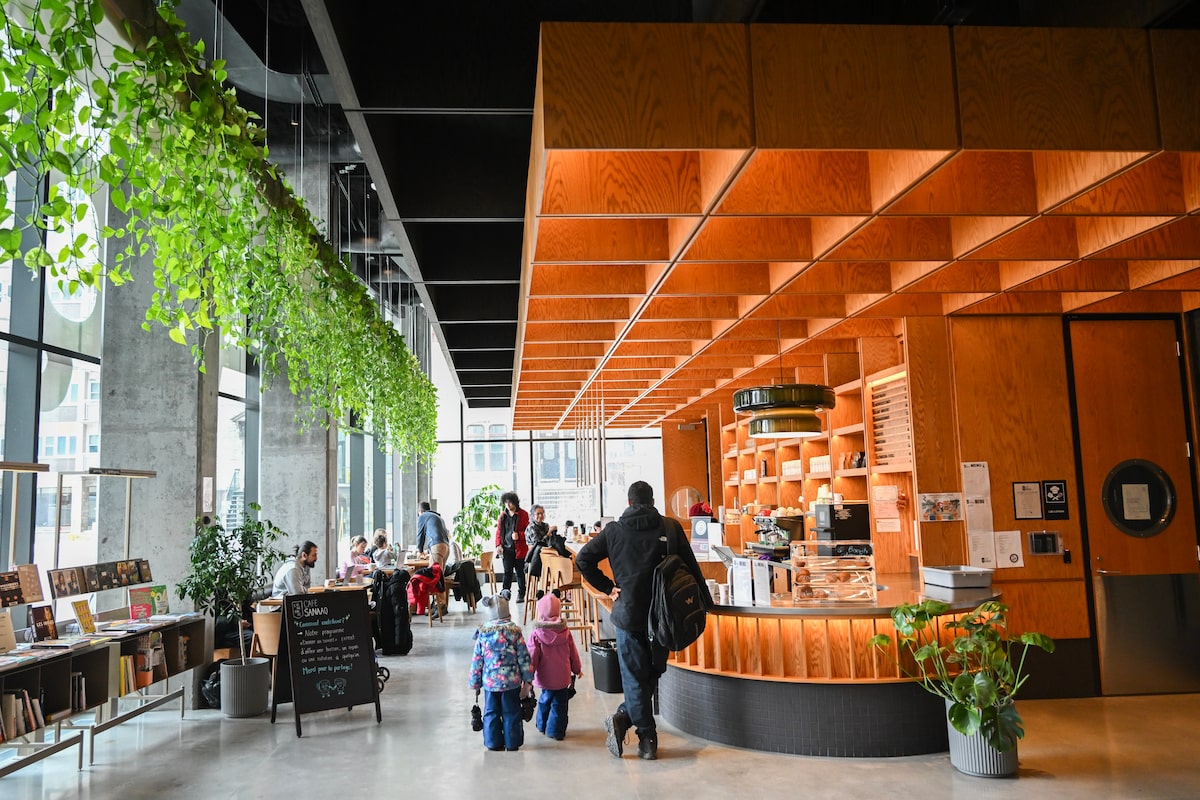
The welcoming café at Sanaaq exemplifies an interior design ethos summed up by architect Hubert Pelletier: “Wood, light, texture, plants.”Graham Hughes/The Globe and Mail
Glasses clink against the bar, the coffee machine hums, and two mothers chat alongside their babies beneath a canopy of hanging vines. Light slides down through fir woodwork, providing the glow of a chic hotel lobby.
But this is a public place: Sanaaq Centre in downtown Montreal, which upends the conventions of North American public space. Rather than offering a single function, the 57,000-square-foot space on downtown’s western edge contains multitudes. It combines a public library, a black-box theatre, a media lab, a social services hub, urban agriculture and the café under one roof.
This is a deeply democratic environment that provides people choices: of space, of atmosphere, of activities, between solitude and collective experience.
The facility occupies the first three floors of a new condo building on the former site of the Montreal Children’s Hospital.Graham Hughes/The Globe and Mail
It is also a design triumph. Created by local architects Pelletier de Fontenay and Architecture49 with interior designers Atelier Zébulon Perron, Sanaaq is the most beautiful and comfortable public building to open in Canada.
The design and the mix of activities are interlinked. The place “serves different types of publics,” Johanna Aman, the centre’s head of public engagement, said in French. “Students, small children, Innu who are visiting, all sorts of people who live in the district.”
And that ethos shaped the bones of the place and its activities: a nearly utopian list that includes a staffed recording studio and a community greenhouse. “This is a community space, and that is what is needed in this district,” said Stéphanie Quer, the head of the Sanaaq library branch.
The facility occupies the first three floors of a new condo building (designed by Menkès Shooner Dagenais Letourneux) on the former site of the Montreal Children’s Hospital. The trapezoidal space was delivered to the city as part of a development deal.
Montreal’s 57,000-square-foot Sanaaq Centre sits on the western edge of downtown and features a library, media lab, café, social services hub and more.Graham Hughes/The Globe and Mail
After a complex wish list was assembled through a set of community meetings, the agency Design Montreal launched a two-stage design competition that honed in on a clear conceptual approach. The architect Hubert Pelletier describes the centre as “a radical assemblage,” a mix of activities in which the library is only half of the space. “We embraced this heterogeneity, trying to talk about this mosaic of different people and different communities or origins, but also different functions.”
This is interior design and interior architecture at an extraordinarily high level. Mr. Pelletier and colleagues carved up the interior into a large open atrium and a string of smaller spaces. They have played some high-architectural games with building materials. In the atrium, the walls are lined with a sprayed-on foam that reads like a layer of icing; it is topped with a steel mesh that conceals warm, pulsing lights.
But the kids get to play, too. In the children’s section of the library, turquoise bookcases snake across the floor, subtly signalling to littles that they are welcome. A play area features bulbous rubber mounds; during my visit, some toddlers were wheeling toys up and down the slopes.
The children’s section of the library.Graham Hughes/The Globe and Mail
The café’s Douglas-fir cabinets are matched by small display cases where librarians present a few favourite books with the skill of retail merchandisers. At the other end of the building, dark oak panelling lines a zone with chairs and tables, ready for neighbours to work or just sit. The lighting throughout is indirect and warm. Everyone looks great.
No surprise there. Zébulon Perron is one of the city’s leading interior designers of restaurant and hospitality spaces; he brought principles from those spaces to Sanaaq. Mr. Pelletier summed up a simple recipe: “Wood, light, texture, plants.”
Most new public libraries in Canada feel institutional. Here, the café and the hangout space feel like corners of a good luxury hotel, except that nobody is pressuring you to buy anything.
Or to leave. Sanaaq uses a subtle technique to manage disruptions, what Design Montreal head Patrick Marmen calls “quiet security.” I spent a few hours in the facility, and every 10 minutes or so a pair of young men in black jackets would walk past, keeping a quiet eye on things.
These twin goals of hospitality and security are interwoven. The library and other facilities have a generous complement of staff who keep an eye on things as they serve library patrons. If there’s trouble, they can call for support. Fewer guards, more guides.
People sit in the lounge area of the library at the Sanaaq Centre in Montreal on a recent Friday.Graham Hughes/The Globe and Mail
These insights came out of a rigorous and clearly bounded design process. Design Montreal worked with city colleagues and citizens to establish a set of principles, chief among them to increase social cohesion. Sanaaq was conceived as “a living space,” “a place for respite, peace, and exchange belonging to the citizens.”
But the actual design was done by professionals, with close supervision from the city. “We put design quality at the heart of the project,” said Mr. Marmen. “The designers were chosen because they had a good idea for this place.”
Libraries are not usually intermingled with other public institutions to this degree. If at all. Instead, “community centres” become athletic facilities that are far less flexible and far more expensive. (Sanaaq cost about $40-million to build, or about $700 per square foot, early in the COVID-19 pandemic. Toronto’s recent “community centres” are being built as full buildings at $1,900 per square foot, or 2.5 times that cost.)
Sanaaq evokes the idea of the “social condenser,” which originates with radical Soviet architects but has become, in modified form, a mainstay in social-democratic Europe. In short: Bring people together in one place, and good things will happen. In Paris, a library-hostel-garden-restaurant is nothing remarkable.
It shouldn’t be remarkable here. People deserve a place to read, rest, and eat together – not just outdoors, and not just in a chlorine-scented hallway under fluorescent lights. During my tour of Sanaaq, my group paused near the children’s library: Toddlers were driving toys over rubber mounds, while nearby five women sat in soft chairs knitting under a ficus tree, their needles clicking. “I don’t think they are here for the books,” Mr. Pelletier said. “They are here just to be in this space.”
Graham Hughes/The Globe and Mail