
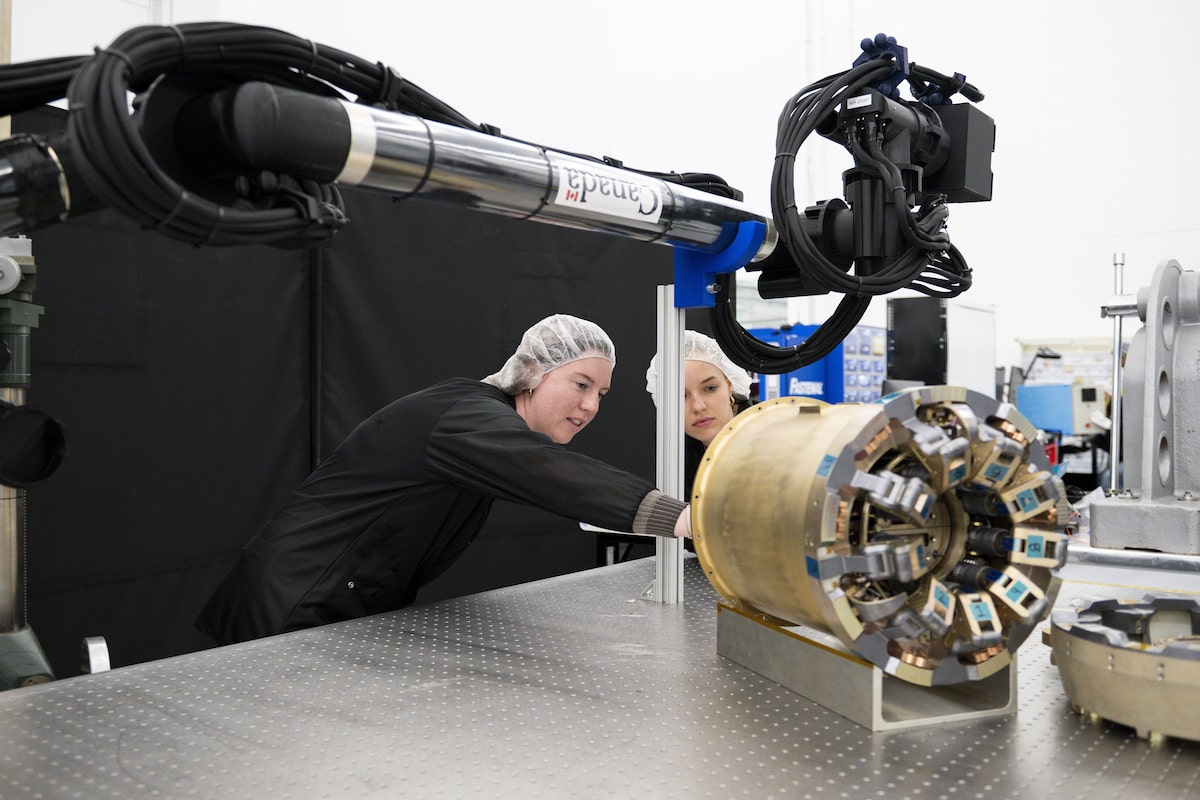
MDA Systems design engineer Beth Lymer, left, and electrical lead Nadia Hiebert gather around Canadarm3 technology in Brampton, Ont., in June, 2024.Christopher Katsarov/The Globe and Mail
NASA is dropping its plans to build an orbiting space station around the moon, a change that leaves Canada’s main contribution to the lunar program – a next generation robotic arm – without an obvious role.
The change was announced Tuesday by NASA administrator Jared Isaacman during an event held at the U.S. space agency’s Washington headquarters.
As part of an effort to accelerate the construction of a lunar base on the moon’s surface, Mr. Isaacman said that the orbiting station, known as Gateway, was no longer a priority for NASA’s Artemis program, which aims to develop a long-term U.S. presence on the moon.
“It should not really surprise anyone that we are pausing Gateway in its current form and focusing on infrastructure that supports sustained operations on the lunar surface,” Mr. Isaacman said.
The change presents a dilemma for the Canadian Space Agency, which is slated to provide hardware for Gateway, including a $1-billion-plus AI-enabled robotic arm currently being built by MDA Space in Brampton, Ont.
NASA hauls repaired Artemis II back to pad for early April launch
The arm is Canada’s signature component intended for Artemis, as per a treaty signed with the U.S. in late 2020. In exchange for the arm and other pieces, the agreement provides Canada with seats on two missions to the moon.
The first of those, assigned to Canadian astronaut Jeremy Hansen together with three NASA crewmates, is set to launch from the Kennedy Space Center in Florida as early as April 1.
Canada is not the only international partner involved with Gateway. The European Space Agency, Japan and the United Arab Emirates all have commitments to the station, which was intended to circle the moon and provide a transfer point for surface expeditions as well as a platform for deep space research far beyond the International Space Station now orbiting Earth.
In his remarks, Mr. Isaacman suggested that equipment and commitments from international partners could be redirected to the lunar surface “despite some of the very real hardware and schedule challenges.”
He added that the shift in priority did not preclude revisiting the concept of an orbital lunar outpost in the future.
NASA declares Artemis II ready for flight
The idea of repurposing Gateway components for the lunar surface does not automatically answer the question of what becomes of Canadarm3. While there will undoubtedly be robotics required for a lunar base, MDA’s arm is designed to operate in the weightless vacuum of space, rather than the dusty lunar environment at one-sixth Earth’s gravity.
MDA’s share price dipped by 11 per cent in response to the news that Gateway was cancelled. The price later partly recovered.
The company issued a statement noting that its contract to build Canadarm3 is with the Canadian Space Agency, not with NASA. It is also marketing the technology to private space companies, including some that are looking to build private-sector space stations that will presumably need on-board robotics to assist with a range of tasks.
“We remain fully focused on executing our existing contracts and advancing our commercial opportunities to expand further,” the company said.
Thanos Moschopoulos, an analyst who covers the technology sector for BMO Capital Markets, noted in a statement issued Tuesday afternoon that despite the change, MDA was still likely to retain its role in Artemis, even if in modified form.
“We expect most of the program and funding to be preserved, given the applicability of the technology for other use cases,” he said.
However, the change is likely to alter the look for Canada’s contribution to Artemis, which could also open new opportunities for Canadian companies developing technology for use on the lunar surface.