
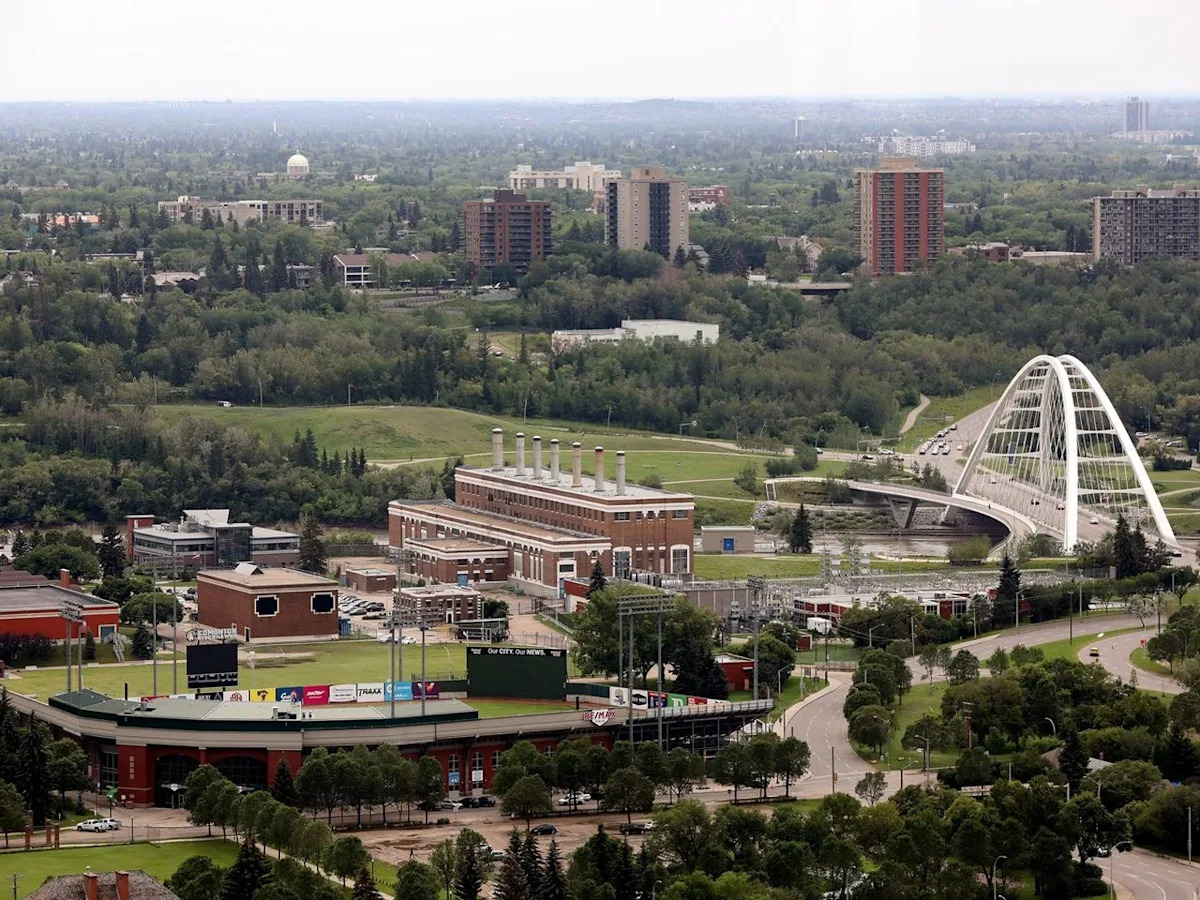
Ross Flats, or Rossdale, is on city council’s March agenda. The city is on the cusp of selling land in the river valley, beginning with a 3.7-acre parcel, now used as parking for Re/Max Field. Council is being asked to approve a $15-million expenditure to put in roads and utilities to service future mid- and highrise buildings on the land.
This is just Phase 1 of the city’s River Crossing plan to sell even more river valley land in Rossdale and to insert 2,500 housing units onto a part of Edmonton valued for its natural and historical properties.
This 3.7-acre parcel has never had a permanent structure built on it, a remarkable coincidence for a area with a long history of human use, beginning with First Nations who left behind many signs of their presence. When Fort Edmonton was built in the early 1800s, it was a campsite for Nations trading furs for European goods. Perhaps it was also a garden for fort residents growing potatoes and barley. Later, the land was a recreation ground for Hudson’s Bay Company employees, a speed skating oval in the 1930s, and a site for tennis courts. The city formally acquired the land in 1954.
Across the street, where Re/Max Field is now, was once the home of the city’s exhibition grounds and racetrack, which moved to Northlands in 1909.
One city commissioner wrote in 1910, “It is open to question whether the city should at any time dispose of any of this land which is so close to what must be in time be a very congested part of the city.” The city was then approached by Edmonton Concrete Ltd., who were interested in buying the land. The commissioners came out against the sale, saying the land might be needed for “park purposes.” Now, it’s a ball diamond.
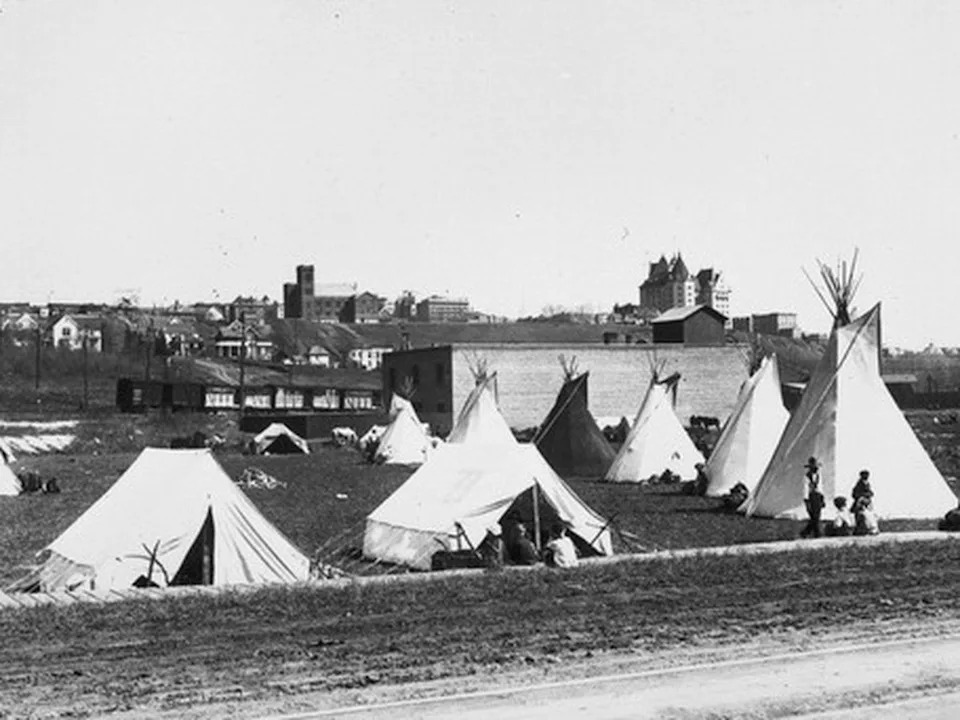
Dated in 1919, tents and teepees set up in Rossdale next to the Hudson’s Bay Company barns; buildings visible in the background include the Macdonald Hotel, McDougall Church, Blowey Henry building, Edmonton Club as well as the E.Y. & P. Railway. People and horses are also near the tents and teepees. Supplied Photo/City of Edmonton Archives
Central Edmonton did become congested. According to the 2021 census, Edmonton’s downtown has 13,000 residents. 55 per cent of those residents are between 25 and 39 years old — an age cohort that prizes recreation.
Where do apartment dwellers go to recreate? Ironically, the most heavily used river valley trail in the city is the paved trail between Rossdale and the Groat Bridge where runners, walkers, cyclists and inline skaters compete for air and space with 50,000 automobiles per day. The ballpark is fenced, and some of the old exhibition lands are now part of the water treatment plant. One sees young people after work, walking from downtown towards the river, crossing busy roads, in search of open space.
The 3.7-acre parcel and other city-owned Rossdale lands could solve this problem for residents of downtown towers. With planning, Rossdale could house a central river valley park. The city also needs these Rossdale lands to explore and honour its history as a gathering place. Rossdale is a node in the formation of Alberta’s Métis Nation who staffed Fort Edmonton in the 1800s, and also the birthplace of modern Edmonton.
In the early 2000s, in connection with the traditional burial grounds there, the city commissioned a history of the district. The authors conclude: “when the area’s natural and human history are considered together, a strong case can be made for regarding the Rossdale flats and nearby terraces as a regionally significant, if not nationally significant, place.”
Cognizant of Indigenous attachment to that land, in 2022 city council tasked administration with outlining a “potential governance structure that empowers [Indigenous] partners … to provide direct input into the implementation of River Crossing … and future developments in Rossdale.”
Early feedback from Indigenous groups indicated they were interested in “providing input in the use of land.” Yet, in 2023, city administration’s report on the council directive states, “the report does not propose a governance model.”
The city’s current vision for Rossdale Flats includes a relatively small interpretive park squeezed between two busy roads (105 Street and Rossdale Road) and overlooked by midrise apartments.
Ideas for affordable housing in Rossdale benefiting Indigenous people have been floated — an important goal — but so far there’s been no public discussion about what this might entail or how much open space in Rossdale would be required.
The project is directed by the city’s real estate department whose main goal is to make it an economic success. Recently, the department applied to bump the height of highrises in Rossdale from 12 to 15 storeys.
Edmonton has an enviable river valley because it was stewarded by First Nations for thousands of years, and for more than a century, civic leaders like the commissioners have worked to preserve the river valley as a park system for the enjoyment of all. The city’s 1954 purchase of the 3.7 acres, and its other land acquisitions in Rossdale from the 1950s to the 1980s is a testament to the belief in this work.
Such acts have been fortuitous — there’s greater interest in Indigenous ways. This has helped current generations to view the river valley as the spine of Edmonton’s ecological network, a corridor for birds and animals to pass through the city. Rossdale is a link in that chain of greenery.
The city’s land purchases from yesteryear afford a rare opportunity to rethink River Crossing — and instead create a central river valley park that combines Indigenous well-being with needed recreation space, and a functioning wildlife corridor.
Keeping the valley green has always been a safe approach. In its March deliberations, may city council take guidance from history.
Eric Gormley is a board member for Edmonton River Valley Conservation Coalition, a past board member for the Edmonton Heritage Council from 2012-2018, and sat on the Community Advisory Committee for the River Crossing Business Plan from 2016-2018.
Letters welcome
We invite you to write letters to the editor. A maximum of 150 words is preferred. Letters must carry a first and last name, or two initials and a last name, and include an address and daytime telephone number. All letters are subject to editing. We don’t publish letters addressed to others or sent to other publications. Email: letters@edmontonjournal.com
Bookmark our website and support our journalism: Don’t miss the news you need to know — add EdmontonJournal.com and EdmontonSun.com to your bookmarks and sign up for our newsletters here.
You can also support our journalism by becoming a digital subscriber. Subscribers gain unlimited access to The Edmonton Journal, Edmonton Sun, National Post and 13 other Canadian news sites. Support us by subscribing today: The Edmonton Journal |The Edmonton Sun.