
Breadcrumb Trail Links
It helps free up hospital beds at Health Sciences North, which normally has more patients than beds
Published Mar 24, 2026 • Last updated 20 hours ago • 4 minute read
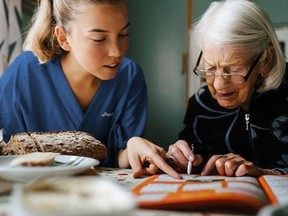 This photo illustrates Health Sciences North’s Hospital to Home program. Supplied photoArticle content
After three weeks in the hospital, recovering from a broken back, Marlene Keefe returned home in severe pain, using mobility aids and facing the reality of recovering alone.
Advertisement 2
This advertisement has not loaded yet, but your article continues below.
Article content
Fiercely independent and hesitant to accept help, she wasn’t sure she wanted anyone coming into her home. That is, until she worked with her care team at Health Sciences North to enroll in the province’s Hospital to Home (H2H) program.
Article content
Recommended Videos
Article content
“I didn’t think it was for me,” she said in a release. “I like to do things myself.”
Now, she says enrolling was one of the best decisions she made during her recovery. Marlene is one of hundreds of patients benefiting from H2H, a provincial transitional care program that helps patients who no longer require acute hospital care continue their recovery safely at home.
Following discharge, Keefe received an in-home assessment within 24 hours and a personalized care plan tailored to her needs. Through the program, she received regular physiotherapy and personal support in her own home. H2H care is designed to rebuild confidence, as well as strength.
Sudbury Star Morning Briefing
Thanks for signing up!
Article content
Advertisement 3
This advertisement has not loaded yet, but your article continues below.
Article content
“Hospital to Home allows us to meet patients where they are, both physically and emotionally,” said Christie Jefferies, co-ordinator of the H2H program at HSN. “By enabling patients to return home sooner, the program helps them heal with dignity and independence, surrounded by the routines, comforts and sense of normalcy that are so important to physical healing and emotional well-being, while avoiding lengthy hospital stays.”
When a secondary leg injury temporarily set her back, Keefe became discouraged. The care team adjusted her plan and focused on reassurance as much as rehabilitation.
“We reassess and adapt care continuously,” Jefferies said. “If a patient has a setback, we adjust. If they’re progressing well, supports taper. That flexibility is critical to safe recovery.”
Advertisement 4
This advertisement has not loaded yet, but your article continues below.
Article content
Living alone, Keefe said the consistency of care made a profound difference.
“They weren’t just workers,” she said. “They felt like friends. I looked forward to them coming.”
Today, she continues her exercises, uses mobility supports safely and is gradually returning to daily activities. While her recovery is ongoing, she credits Hospital to Home with helping her heal at home with dignity and confidence.
“I was very reluctant at first,” she said. “But I’m so glad I did it.”
As of December 2025, the program had delivered care to 361 patients. Staff had conducted 14,763 home visits and delivered 1,025 patient touch-points (meaning any interaction, point of contact, or engagement with a patient.)
So far, the program has been successful, hospital officials say. Reporting indicates a 99 per cent patient satisfaction rate. Approximately 55 per cent of patients were discharged to independent self-care.
Advertisement 5
This advertisement has not loaded yet, but your article continues below.
Article content
Within three months of implementation, alternate-level-of-care (ALC) volumes dropped from 125 to 92; patients waiting for long-term care decreased from 73 to 30; and patients waiting for inpatient rehabilitation fell from 43 to 21. ALC patients are hospital patients who no longer require acute, intensive care but remain in a hospital bed while waiting for a more appropriate placement, such as long-term care, rehabilitation, or home care.
Supporting patients and strengthening system flow, H2H was developed in response to sustained capacity pressures across provincial hospitals. At Health Sciences North, daily occupancy often exceeds 110 per cent, with an average of 644 patients cared for in a hospital with 526 inpatient beds.
Advertisement 6
This advertisement has not loaded yet, but your article continues below.
Article content
The H2H program enables safe, timely discharge for patients who would otherwise remain in acute care beds while waiting for rehabilitation or community services.
“Hospital to Home has changed how we support discharge and recovery,” said Meghan Forestell, a manager with H2H. “It provides a clinically appropriate option for patients who no longer need acute care, but aren’t ready to recover independently. By transitioning patients home with structured, time-limited supports, we’re reducing ALC pressures, improving access to inpatient beds and strengthening hospital flow.”
Hospital to Home provides short-term, intensive transitional care, including a 72-hour post-discharge care plan, an in-home assessment within 24 hours, and bundled services through eight- or 16-week care streams, depending on patient needs.
Advertisement 7
This advertisement has not loaded yet, but your article continues below.
Article content
The program continues to evolve, including the introduction of a four-week intensive rehab bundle to further reduce pressure on inpatient rehab beds. Part of a provincial shift, hospital officials say H2H reflects a broader transformation underway across Ontario, with a provincial commitment of more than $1.1 billion.
“HSN has received funding from the provincial government to support the Hospital to Home program, and we greatly appreciate that support,” said David McNeil, president and CEO. “We often have 120 to 130 patients in hallways and unconventional spaces everyday. Our hospital has been built too small and needs to grow to meet current and future needs for health care in the region. So the support for H2H is very much needed for HSN and the patients and families from the northeast who rely on us for care.”
For Keefe, the impact is simple and deeply personal.
“I didn’t want the help at first,” she said. “But it helped me heal, and it helped me feel like myself again.”
Bluesky: @sudburystar.bsky.social
X: @SudburyStar
Article content
Share this article in your social network