
WASHINGTON — NASA, concerned about slow development of commercial markets, is considering revamping its strategy for supporting the creation of commercial space stations to succeed the International Space Station.
At its March 24 “Ignition” event where NASA outlined sweeping changes to its exploration strategy, including redirecting work on the Gateway towards a lunar base and flying a nuclear propulsion demonstration mission to Mars as soon as 2028, the agency said it is weighing an alternative approach to help establish commercial ISS successors.
NASA’s current strategy, under its Commercial Low Earth Orbit Destinations, or CLD, program, has been to fund initial work by several companies on their designs. Those companies have been awaiting a call for proposals for the second phase of the CLD program, where NASA would provide additional funding for development and demonstration of those stations ahead of purchasing services from them.
The intent of the CLD program was for NASA to be one customer of many for those stations, with companies and other space agencies also using those facilities. But at the Ignition event, agency officials said they were increasingly concerned that the business case for those stations was not closing.
“Though we have seen investor interest, there’s no independently verifiable market research indicating the economic viability of a commercial station that is only partially funded by NASA,” Dana Weigel, NASA ISS program manager, said in a presentation.
The projected market, she said later, has not emerged as fast as originally projected.
“Many years ago, when we started this program, the data we had was that we’re 10 years away from a mature market,” she said. “As we’ve watched over time, these independent market research surveys continue to tell us it’s about that far out.”
Another concern is the lack of resources by the companies to handle the “incredibly complicated” logistics and operations of a space station, argued NASA Associate Administrator Amit Kshatriya.
“Right now, the current industry that we have that’s proposing to build destinations does not have direct experience with that, or the resources,” he said.
A constrained budget, he added, makes it impossible for NASA to provide greater support to companies under the current approach. “In the absence of a mature market, and then in the current budget we’ve been allocated, we cannot fund a path of two stations. It’s a challenge even fund one,” he said.
“The original path that we had laid out is fraught with a lot of high risks,” Weigel said.
NASA plans to seek input from industry on two approaches. One would continue the agency’s current plans with CLD, but the other would involve NASA taking a larger role in supporting development of a commercial space station.
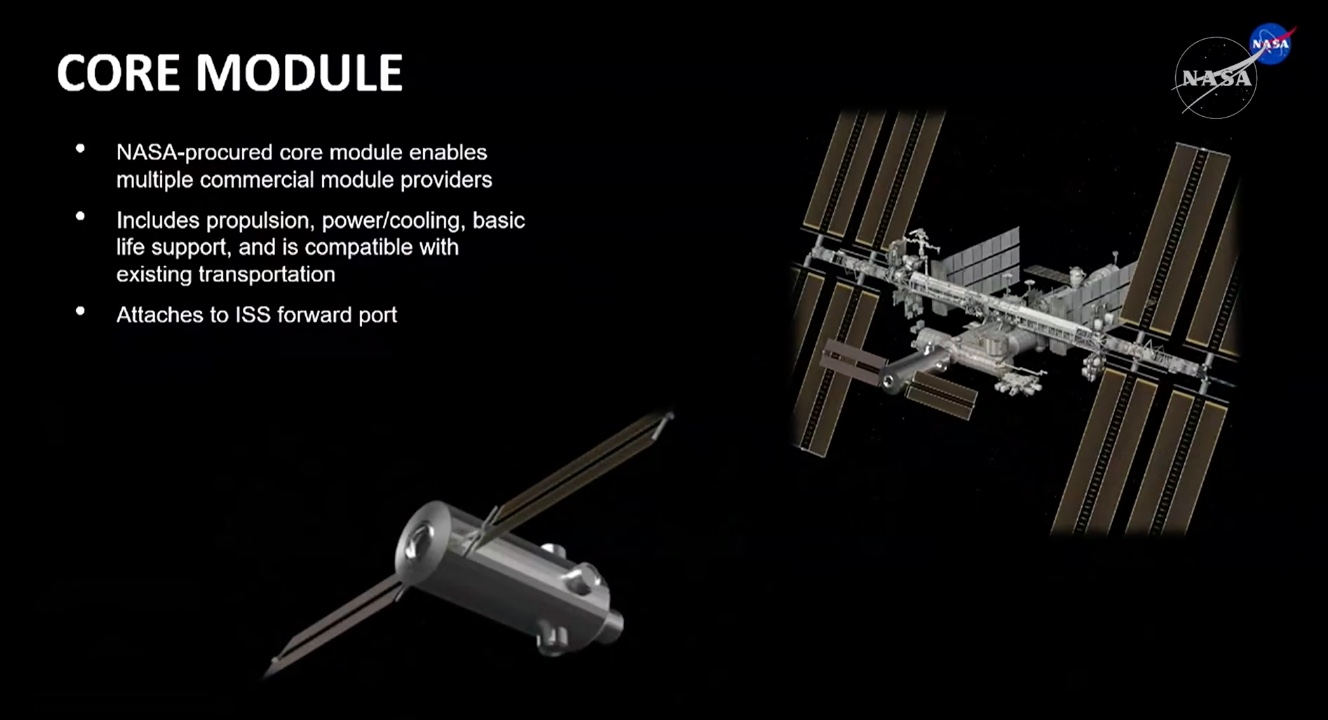
In the latter approach, NASA would procure a core module that would be attached to the ISS. It would provide basic services such as power, propulsion and life support, as well as several docking ports. Additional commercial modules could be attached to those ports.
Ultimately, that core module and commercial modules would detach from the ISS as a standalone commercial station, potentially taking with it some ISS modules.
“A NASA-procured core would serve as a hub for commercial module expansion, allowing for maturation of industry and continued demand growth after the station detaches from ISS,” Weigel said.
A decade ago, NASA said it would offer an ISS port for use by a commercial module as a precursor to a standalone space station. NASA awarded that docking port to Axiom Space in 2020, which plans to use it for a core module it is developing for its own commercial space station.
Weigel said the core module NASA is proposing is “not aligned with any one vendor” like Axiom Space. “My hope is that there’s a lot of broad interest in the core module overall, and I think there are a lot of capabilities that are in design, on their way, and are applicable.”
The agency wants to move quickly on that alternative approach. Based on feedback NASA gets from the request for information, a draft request for proposals for the core module could be ready in a few months, she said.
NASA would supplement that core module with other efforts to stimulate commercial demand. That includes increasing the number of private astronaut missions to the ISS from one to two per year and allowing companies to sell the seat currently reserved for the mission’s commander. That could include selling the seat to NASA for an agency astronaut to fly on such missions.
Officials made clear they had no intent to extend the life of the ISS indefinitely. NASA’s current plans call for the ISS to be retired in 2030 and deorbited, although a Senate NASA authorization bill would extend the station’s life to 2032.
“It is still our job to pivot and go move to transitioning to space stations that are commercially owned and commercial operated in 2030,” Weigel said. “Our overall goal has not changed at all. We are just trying to change the approach to an incremental one.”
“No one here is trying to make the case of keeping ISS up until the end of time,” said NASA Administrator Jared Isaacman. “The idea is to make the transition the right way, and we have to put everything out on the table on this one right now.”
Related