Dymphna Cordova usually spends her Thursday mornings deep in meeting mode to untangle work priorities with her team or manage complex employee issues at her company.
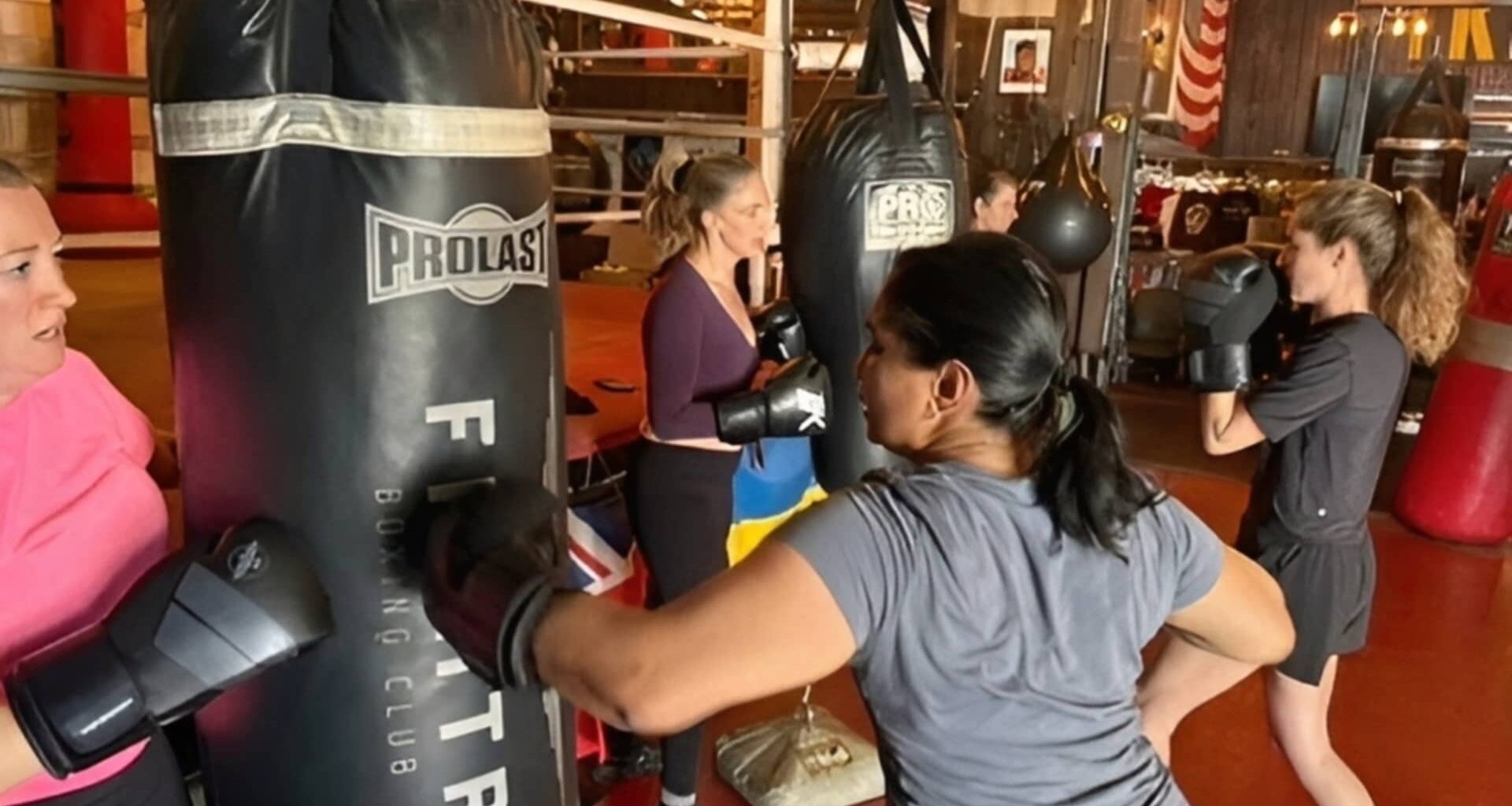
But on this particular Thursday morning, Cordova, 57, is at LA’s Trinity Boxing Club breaking a sweat. The chief people officer of Squire, a business management platform, has never so much as tried on boxing gloves before, but now she’s on her second day of learning how to string together punches into basic combinations.
Elsewhere in the gym, about a dozen other women are shadow boxing, while some face off with punching bags. The women, ranging in age from their 30s to 50s, make up the second cohort of a retreat series from Fight Co.Lab, a program that aims to marry boxing training with leadership strategy for executive-level women across the U.S.
The retreat is happening at a complex time for professional women, even at the highest levels.
Women remain underrepresented at every level of the leadership pipeline. Just 93 women are promoted to manager roles for every 100 men, according to Lean In and McKinsey & Company’s latest Women in the Workplace report, and only 29% of C-suite roles are held by women. Six in 10 senior-level women report frequently feeling burned out, according to McKinsey.
Lean In founder and former Meta chief operating officer Sheryl Sandberg told CNBC in December that today’s corporate climate is “one of the worst” she’s ever seen as companies backslide on their commitments to leveling the career playing field for women. The trend is fueling a growing ambition gap between men and women.
For some senior-level women, a program that offers to help them reframe and fight the challenges they’re experiencing in corporate America is especially appealing.
Fight Co.Lab is the brainchild of Erin Renzas, 41, a tech executive turned consultant and amateur boxer who splits her time between LA and Amsterdam, and Shea O’Neil, 49, a Boston-based somatic psychotherapist and executive coach.
In 2021, Renzas says she was reaching her breaking point. She’d climbed to what she calls the “highest echelon” of her corporate career, including serving as marketing lead during Square’s IPO and operating partner at one of the world’s largest tech investment firms. But she says she was feeling burned out and unfulfilled.
She felt she’d spent her career trying to “optimize myself into perfection,” but it wasn’t working, she says. She wondered: “If I’m not happy in this version of success, maybe I’m doing it wrong.”
So Renzas says she focused on her health journey, which eventually led her to a gym in Amsterdam, where she’d moved for work, that had a boxing ring in the back. When she got tired of running, she took up boxing.
It transformed her life, she says; she realized she’d been fighting for as long as she could remember, especially in her career, without being taught how to do it properly or sustainably.
Fourteen executive women gathered at LA’s Trinity Boxing Club in March for Fight Co.Lab’s second retreat, which combines boxing training with leadership strategy.
Courtesy of Fight Co.Lab
In the ring, Renzas says, “Often I had my back against the rope and I couldn’t find a way out. And so I would make shots that were never landing, and then I would just be exhausted.”
One of her boxing coaches, Marvin Nimmermeer, taught her strategies to get out of the corner. Rather than freeze or “fight back wildly,” she learned to keep her guard tight and time her counter-shots to be sharp, or put weight on the opponent to stop their rhythm, or pivot out and turn her opponent.
Renzas would translate that to what she was experiencing in her career with O’Neil, her executive coach.
“I saw how so often in my career, I would be pressured into a situation where I felt caught and trying to defend against intense pressure,” she says. “In boxing, I learned to keep my guard up and look for the cleaner shots that would make an impact without me taking damage.”
“Fight strategy is not about violence,” she adds. “It’s about making choices.”
Renzas and O’Neil realized boxing and executive coaching had a lot more in common than people might expect and — over the course of a year with a group of boxing coaches — developed the framework for Fight Co.Lab, which officially launched in 2025.
Fourteen women joined Fight Co.Lab in LA in March, the company’s second run after an inaugural retreat in New York City in November. The three-day program’s full cost was $4,200 with discounted rates for nonprofit leaders. Some women leveraged their employers’ learning and development budgets to sponsor their attendance.
Participants boxed for several hours each morning of the retreat, led by four coaches who flew in with Renzas from Amsterdam, before spending the afternoon in facilitated leadership sessions.
One day, the women focused on form, precision and flow while boxing, then had a discussion connecting those principles to leading under pressure. Another day, they trained to refine rhythm, recovery and focus under stress in the ring, then drew lines to how they sustain their energy and make decisions at work.
Cordova, the San Francisco–based HR exec, says going into the leadership sessions physically depleted meant the women connected on a deeper level much faster. “You’re not posturing, because you’re too tired,” she says. That means getting down to the real issue you’re facing at work or in life, she says: “We’re in workout clothes. We’re not made up. You’re just your raw self.”
Most women who participate in Fight Co.Lab’s retreats, who range in age in their 30s to 50s, say they’ve never boxed before.
Courtesy of Fight Co.Lab
Many of the women were at a point of transition, much like Renzas when she first took up boxing.
“Some people are taking breaks. Some people are looking for the next thing,” says O’Neil, who facilitates the leadership sessions. Other women are thinking about how to manage personal milestones, like getting married or having kids, alongside their demanding jobs.
Sports metaphors are often used to talk about leadership, O’Neil says, but there’s something unique to boxing that hits home for these senior-level women who, according to McKinsey research, often lack mentorship, sponsorship and overall corporate support to thrive.
At work, you often feel like “you’re alone in the ring,” she says. “And it gets lonelier and lonelier” the higher up you go in your career.
In boxing, however, you’re encouraged to think about who’s in your corner, including your coaches and training partners, says Renzas. Even opponents can help you fight at your best.
She sees it this way: Boxing isn’t “about beating up the person in front of you,” just as managing conflict at work isn’t about winning an argument. Instead, sparring with your colleagues, so to speak, can be an “opportunity to get better, and for us to collectively get better so that business is better.”
Redefining success for executive women
With fewer women at the top of corporate spaces, finding others at similar life and career stages makes a difference.
Semonti Stephens, 44, from the Bay Area was drawn to the community aspect of the retreat. “There is the element of women coming together in a really sincere way,” she says. “You knew you would probably go deep in the conversations” with people who get it.
Maybe the ring wasn’t originally built with an executive woman in mind. The corporate boardroom wasn’t exactly built with an executive woman in mind either.
Erin Renzas
co-founder of Fight Co.Lab
Stephens spent her career climbing the ranks in tech and government and in November started a career break to take care of her family, including a son with special needs. She’d looked into other wellness retreats but found nothing really stood out.
Fight Co.Lab isn’t a typical wellness setting absent of conflict or distractions, Renzas says, and that’s intentional. “One of the things we’ve designed deliberately as a part of this program is we want people to feel that chaos” of being in the middle of a fight, or in life dealing with a hectic schedule and work conflicts. “It’s about how you find rest and clarity in the midst of 90,000 things coming at you at the same time.”
As a parent, Stephens says learning how to find stillness in the middle of movement resonated with her.
“One of the coaches told me: Sometimes you need to back up to be able to gain perspective, and sometimes you need to preserve your energy [to] make a big impact,” says Stephens. In her own life, that lesson has helped her realize that stepping back from work affords her more energy to make an impact raising her two sons with her husband and being on the school board to support other families.
Managing both career and caregiving responsibilities is often cited as the top reason women leave the workforce altogether.
Fight Co.Lab’s retreats involves a morning session of boxing training with four coaches, followed by an afternoon of leadership facilitation with co-founder Shea O’Neil.
Courtesy of Fight Co.Lab
Meanwhile, Christina Lang took part in Fight Co.Lab’s November retreat in New York and says it came at a pivotal time in her life. Lang, 40, of Seattle was deciding whether to stay at her former employer or move on.
Through the training, she learned about choosing a “worthy opponent.”
In boxing, that might mean getting matched up by weight class. At work, it could mean identifying which priorities need your attention most: “We’re constantly asked to fight. We’re constantly asked to defend our way of thinking, the strategies we’re building, [and] fight for our teams and ourselves,” Lang says. “The reality is, I was entering every fight” rather than knowing which ones were worth her efforts.
This realization eventually led her to leave her employer. “It was no longer the right challenge,” says Lang, a former marketing executive who’s worked for companies like Mozilla, Twitch and Meta.
As women, she says, “we just spread ourselves so, so thin. And the idea around being able to to be targeted in what I am putting my energy towards has been really powerful for me.” She has since come onboard Fight Co.Lab as an advisor and is exploring what she wants to do in her next career act.
For Renzas — who hopes to expand retreats to Atlanta, Washington, D.C. and New Orleans in addition to more planned for NYC and LA — the goal with Fight Co.Lab is to give senior-level women the chance to redefine what success looks and feels like, rather than holding onto a picture of corporate leadership developed decades ago for men.
In that sense, the corporate career connection to the boxing ring makes all the more sense, she says. “Maybe the ring wasn’t originally built with an executive woman in mind,” she says. “The corporate boardroom wasn’t exactly built with an executive woman in mind either.”
Want to lead with confidence and bring out the best in your team? Take CNBC’s new online course, How To Be A Standout Leader. Expert instructors share practical strategies to help you build trust, communicate clearly and motivate other people to do their best work. Sign up now and use coupon code EARLYBIRD for an introductory discount of 25% off the regular course price of $127 (plus tax). Offer valid March 16 through March 30, 2026. Terms apply.
Take control of your money with CNBC Select
CNBC Select is editorially independent and may earn a commission from affiliate partners on links.