
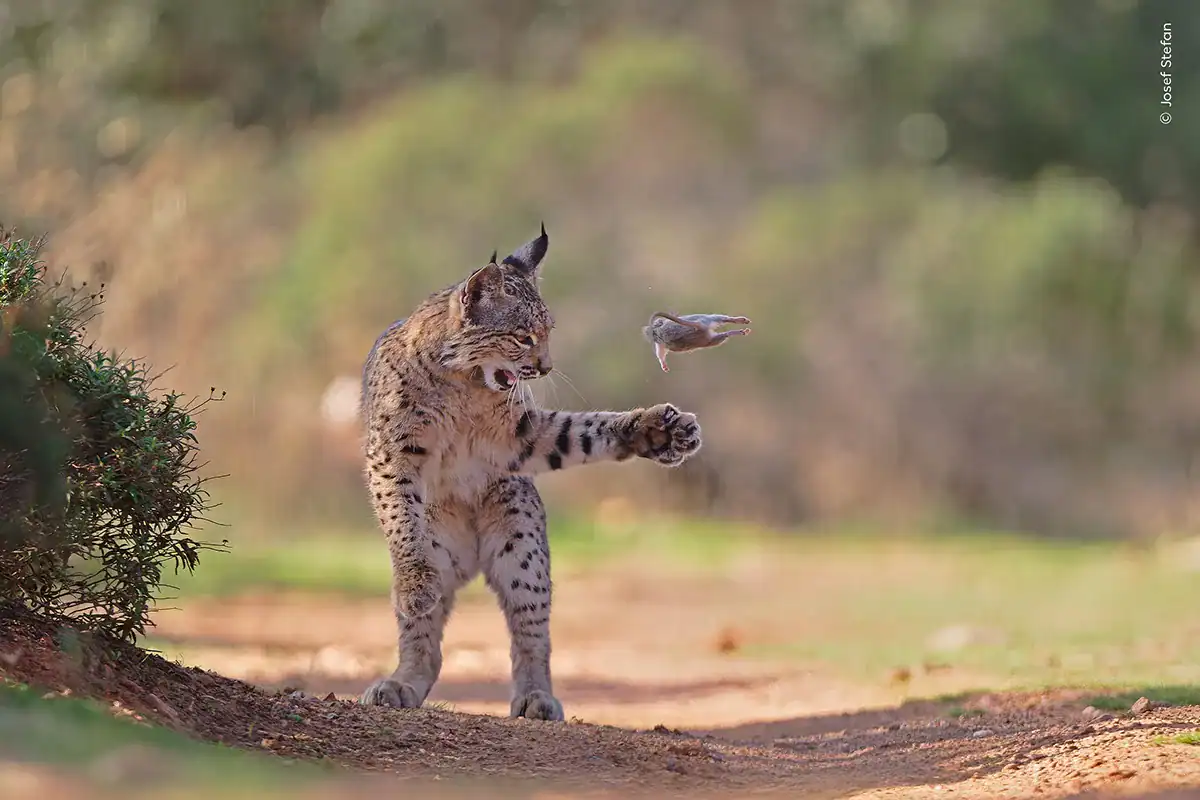
 A young lynx playfully throws a rodent into the air before killing and devouring it. | © Josef Stefan (Austria), winner of the Nuveen People’s Choice Award 2026. Courtesy of Wildlife Photographer of the Year
Somewhere in the sun-drenched brush of Spain’s Ciudad Real province, a young apex predator discovered a thrilling new game.
The young Iberian lynx had just caught a rodent. Instead of eating its meal immediately, the wildcat began throwing the lifeless animal high into the air. It repeatedly snatched the rodent back on the way down.
Austrian photographer Josef Stefan watched this cruel spectacle unfold from a concealed position. He had spent two weeks in the municipality of Torre de Juan Abad, waiting for a glimpse of the elusive cats.
When the lynx finally appeared, Stefan captured a striking mid-air frame. The photograph, aptly titled Flying Rodent, just won the prestigious 2026 Wildlife Photographer of the Year Nuveen People’s Choice Award.
Stefan noted that the animal spent time standing on its “hind legs with its gaze fixed on the rodent.”
“To me, it looked as if the rodent could fly,” Stefan told the BBC.
Eventually, the wildcat grew bored with the juggling act. It carried the battered rodent behind a nearby bush and ate it.
Why Felines Play With Their Food
Why would a hungry animal risk losing its hard-won meal by tossing it around in the dirt?
×
Thank you! One more thing…
Please check your inbox and confirm your subscription.
Young predators often play with their prey to hone vital survival skills. Tossing, pouncing, and batting at small animals sharpens their hand-eye coordination. It builds the precise reflexes they will need to hunt larger, faster prey as adults.
Beyond the fascinating behavioral biology of play, Flying Rodent also invites the public to consider the fate of this endangered predator.
In the early 2000s, the Iberian lynx stood on the absolute brink of extinction. Human encroachment, habitat loss, and a severe crash in rabbit populations nearly wiped the species off the map. At their lowest point, fewer than 100 individuals remained in the wild. They ranked among the rarest wildcats on the planet.
Today, the landscape looks remarkably different. Decades of aggressive, long-term conservation and reintroduction efforts have slowly pulled the species back from the edge. Researchers have successfully stabilized their primary food sources and protected key breeding corridors.
The population has now rebounded to more than 2,000 individuals across the Iberian Peninsula. However, the International Union for Conservation of Nature still classifies the wildcat as a vulnerable species. They remain at risk, and conservationists continue to monitor their numbers closely.
Nature’s Gritty and Beautiful Realities
 A mother polar bear and her three cubs pause peacefully in the summer heat. | © Christopher Paetkau (Canada), courtesy Wildlife Photographer of the Year
The Nuveen People’s Choice Award highlights the wildlife photographs that resonate most deeply with the public. While an international judging panel of science, conservation, and photography experts chose the main competition winners back in the Fall, the public took over from there.
The judges initially sifted through a staggering 60,636 entries submitted from 113 different countries and territories. They narrowed that massive pool down to a shortlist of just 25 images.
 A group of flamingos stands out against a stark industrial backdrop of power lines. | © Alexandre Brisson (Switzerland), courtesy Wildlife Photographer of the Year
From that shortlist, nature fans worldwide cast a record-breaking 85,917 votes to crown Stefan’s juggling lynx the winner. But the public also highly commended four other remarkable runners-up.
 A sika deer carries the interlocked severed head of a rival male that had died after their battle. | © Kohei Nagira (Japan), courtesy Wildlife Photographer of the Year
These four images showcase the stark, sometimes gruesome, reality of the natural world crashing into human environments. Kohei Nagira photographed a sika deer carrying a rival’s severed head. Alexandre Brisson framed a flock of flamingos against industrial power lines. Will Nicholls caught two bear cubs play-fighting on a paved road. And Christopher Paetkau documented a mother polar bear resting with her three cubs.
 A silhouetted pair of young bear cubs rear up and play-fight in the middle of a quiet road. | © Will Nicholls (UK), courtesy Wildlife Photographer of the Year
The Natural History Museum in London runs the Wildlife Photographer of the Year competition. They will display the winning Flying Rodent image alongside the four runners-up on voting screens inside their gallery.
If you want to see the stunning details of the juggling lynx and the severed sika deer head in person, you have a few months left. The museum will host the physical exhibition until it officially closes its doors on Sunday, July 12, 2026.