
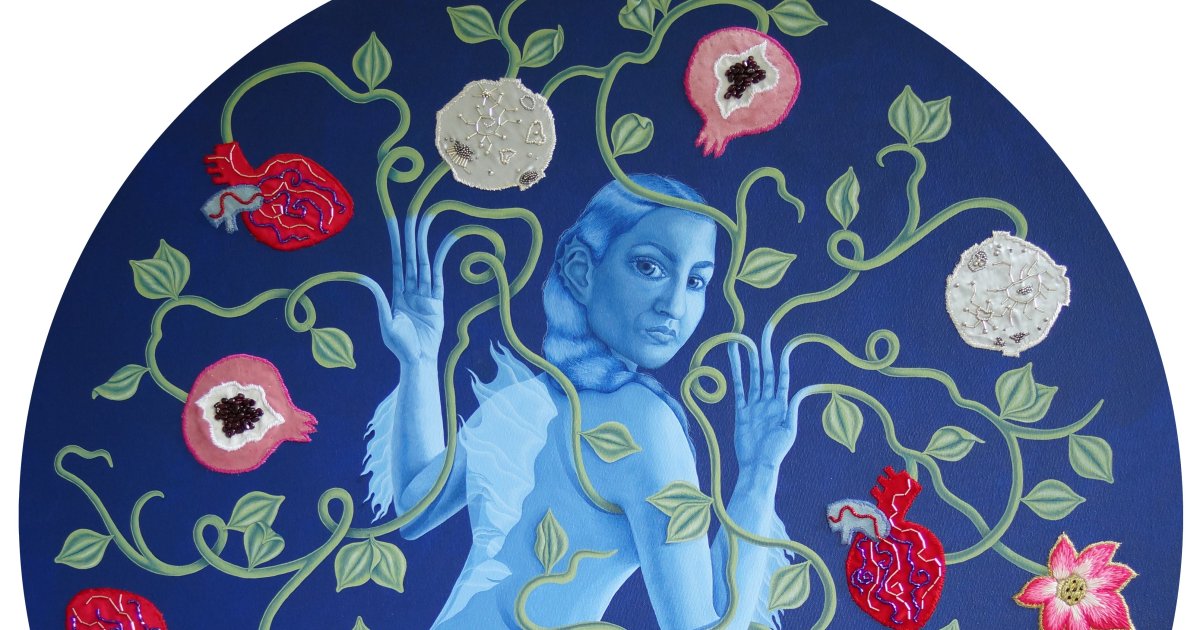
Kaur’s practice unfolds within the lived realities of the South Asian diaspora, where culture is shaped by movement, memory, and re-telling. Working across painting, sculpture, digital media, embroidery, poetry, and performance, Kaur draws from Sikh and broader Indic poetic traditions—ways of thinking and making in which metaphor and image are used to hold ways of living and understanding. Within Sikh culture, such imagery has long offered guidance: poetic forms and natural elements are used to reflect on humility, devotion, balance, and relational responsibility.
If Gardens Could Dream brings together a recurring set of forms that appear across materials and scales. Rather than functioning as fixed symbols, these motifs shift and gather meaning through repetition and change, offering points of reflection rather than instruction. The moon gestures toward cycles of time, discipline, and return, echoing Sikh understandings of attunement to larger rhythms beyond the self. The heart appears as both a bodily organ and a site of feeling and devotion, foregrounding sincerity and inner alignment. The pomegranate, dense with seeds, speaks to abundance and interconnection, resonating with communal values and diasporic networks of care. The lotus, rising from muddy water, reflects principles of humility and steadfastness—remaining grounded while moving through worldly conditions.
Kaur’s interdisciplinary approach emphasizes translation—between mediums, histories, and ways of knowing. As forms move from textile to image, from language to performance, they reveal how cultural memory survives not through preservation alone, but through adaptation and care. Tradition, here, is not static; it is responsive and alive.
If Gardens Could Dream invites viewers into a contemplative space where personal experience and collective history meet. The exhibition offers symbols as open gestures—capable of holding loss and continuity, intimacy and inheritance—and proposes cultural meaning as something continually nurtured, like a garden shaped by time, tending, and return.
Curator: Suvi Bains
Origin of Exhibition: Surrey Art Gallery