
Instant fascination and a touch of incredulity were the two thoughts going through my mind when Ford announced its new Hypercar competing in the 2027 LMDh class would use a Coyote-derived 5.4-liter V-8 engine. Ford’s going back to the Big Leagues at Le Mans! And it’s headed there with a Mustang engine! It almost seems too good to be true.
Cadillac is the only other runner in LMDh that uses a naturally aspirated V-8. The sound alone is enough to make our American hearts warm, as nearly every other Hypercar on the grid races with a turbocharged six- or eight-cylinder. Aston has a V-12 in its Valkyrie, but that car is designed to a different set of regulations.
The optics of Ford arriving with a production-based engine are all the more intriguing, considering most of the competition engineered bespoke powertrains specifically for this series. As I quickly learned, and Ford admitted, there is very little about this Coyote V-8 that you can trace back to what’s under the hood of a Mustang GT.
“I think we’re being generous at calling it a Coyote other than, we started the block with the production casting, but it’s been modified fairly significantly in terms of machining,” Christian Hertrich, Ford Racing’s chief powertrain engineer, tells me.
 Andi Hendrick
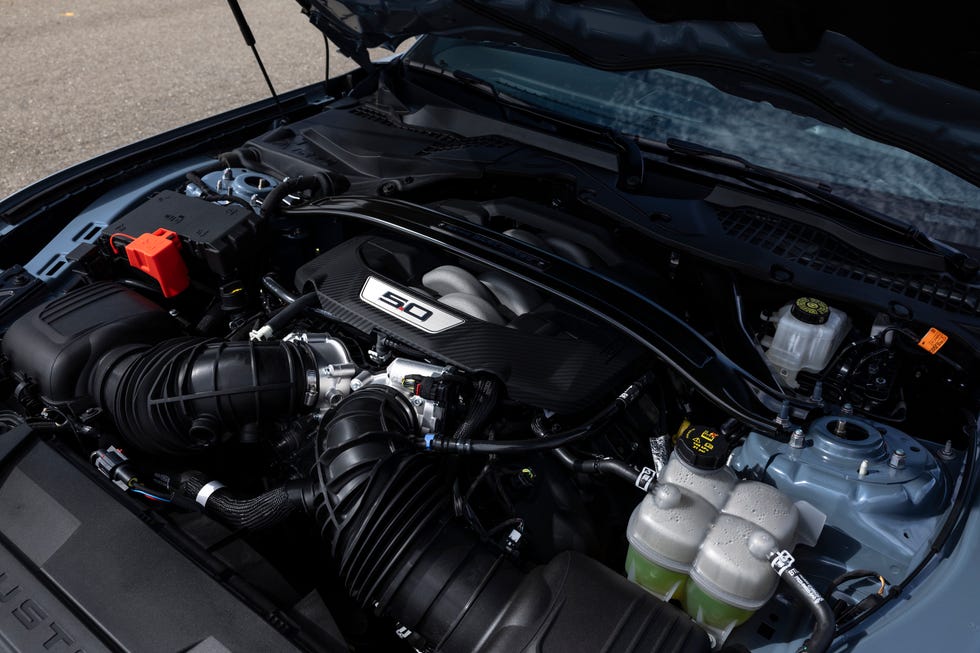
A very different Coyote V-8 in a production Mustang Dark Horse
Obviously, the needs of an endurance racing engine are quite different from those of a production engine in a muscle car. A stock Mustang Dark Horse with the 5.0-liter V-8 produces 500 horsepower. The regulations cap LMDh cars to about 670 horsepower at the wheels, which means Ford is pushing for about 740-750 horses at the crank. There’s the spec hybrid component of the powertrain, too, but like others, Ford is engineering its engine to hit the max power rating without any electric assistance. That means the car won’t fall off the pace even if the battery state of charge is at zero, or there’s a hybrid system failure.
Now knowing that the “Coyote” in this application isn’t much of a Coyote, I asked Hertrich to tell me everything he could about this engine. He obliged, but still kept a few secrets.
Those machining modifications Hertrich alluded to earlier are mainly to do with the lightweighting of the block. Shedding every ounce you can is key to success because this allows for greater freedom elsewhere. Balance of Performance (BoP) can command that ballast be added, and Ford would like to put that ballast wherever it deems best. This, among many other reasons, drew Ford away from simply repurposing the 5.4-liter V-8 in its Mustang GT3 car.
“We had hoped to be able to carry over more of our GT3 engine,” Hertrich started. “But as we got into it, the speeds at which we need to push, the expectations, and really just competition level drove us into a lot of unique architecture and components.”
The best way to get power out of the Coyote engine architecture in a naturally aspirated application is to find more revs, Hertrich states plainly. This is as true for the production engine as it is for racing. For anyone who’s driven a modern Mustang with the 5.0 in it, you’d know that the engine isn’t all that potent down low, requiring you to live in the upper rev ranges to enjoy the plentiful amount of power it packs. Ford wouldn’t give me a maximum number quite yet, but this engine is going to spin to the moon.
 Ford
Ford
A teaser of Ford’s 2027 Le Mans Hypercar
“There’s a fairly large change to the valvetrain, though,” Hertrich said. “So we are going to spin this engine quite fast to get the power. We need to increase it above where we’re at for GT3, so GT3 is homologated at 8250. I won’t tell you the exact speed at the moment, but we definitely have to go much faster than that.”
For comparison, Cadillac’s 5.5-liter V-8 revs to 8800 rpm at full song and sounds biblical doing it. I wouldn’t be surprised to see Ford get this engine above 9000 rpm, approaching the 10,000-rpm regulation limit. If there was ever any doubt as to how good the Ford will sound pounding down the Mulsanne Straight, I think Ford is answering it with revs.
Hertrich points out that the engine’s heads themselves outwardly appear like production Coyote heads. You’ll see it in the bolt spacing, bolt pattern, and bore spacing, but internally, things are not what they appear on the outside. Oil cavities are nothing like those you’d see in a regular Coyote. Ford uses diamond-like carbon [DLC] coatings for the valves. Anywhere it can reduce parasitic loss, Ford is attacking the problem to maximize friction reduction and spin things higher.
Reciprocating mass is reduced as much as possible, which involves lightweighting of the pistons and moving to titanium connecting rods. This, in turn, allows Ford to reduce counterweight size, getting it ever closer to the all-important minimum engine weight of about 397 pounds.
 Ford
Ford
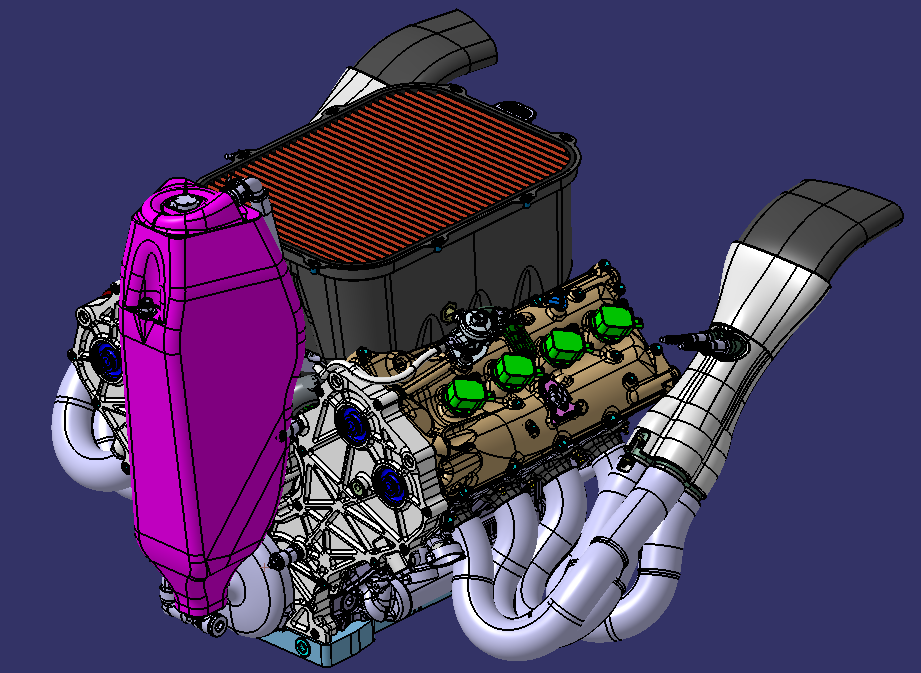
A rendering of the Coyote V-8 going into Ford’s Le Mans Hypercar
One of the most innovative parts of the engine is a newly designed front cover that houses both vital componentry and takes suspension/chassis loads on account of the engine being a stress member. With the increase in engine speeds, the timing drive has proven to be a challenge, but Ford’s solution sounds quite elegant.
“We came up with a very innovative way to manage our timing drive,” Hertrich says. “So it is a mix of a gear drive and a chain drive. We’ve got a production block casting, so there are no features in the block to be able to manage that system. So we’ve been able to basically house it all in the front cover, so our front cover manages all of our timing drive, and then that whole subassembly is introduced to the engine as a subsystem. So it’s pretty innovative. We’re just early in development testing, but it should provide us the capability to get the speeds that we need.”
Another item you’ll find inside that front cover is the water pump, which is an example of what Hertrich says is a real simplification and greater integration of parts.
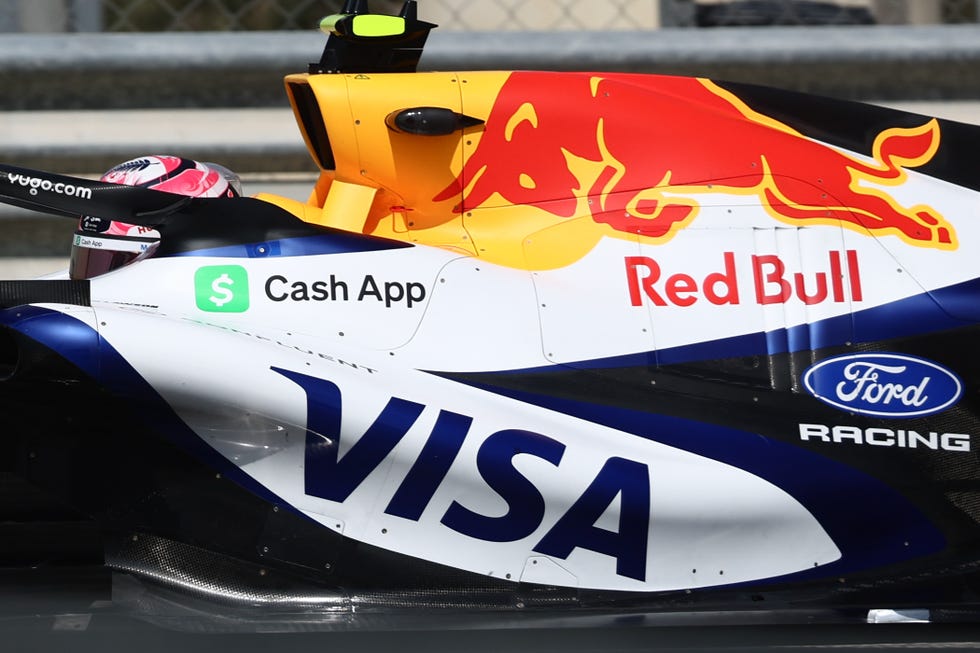
One superpower Ford has going for it is a trick lubrication system that makes use of additive manufacturing, or in other words, very fancy 3-D printing. Ford credits knowledge transfer from its Red Bull Formula 1 efforts for these innovations, with Hertrich claiming some of the ideas they’re implementing were only really possible thanks to F1.
 NurPhoto//Getty Images
A Formula 1 car running a new Ford-partnered Red Bull powertrain
“We’ve released that on the F1 program, we’re doing a lot of additive manufacturing,” Hertrich starts. “So we have taken what we have learned and put in process with the F1 program, and we are producing a lot of our additive parts for the program in-house… we cast in a lot of the passages for oil and water to be able to get them to whatever side of the engine we want without external piping. So we’re able to move water from one side of the engine to the other, via passages that we cast in at the front of the engine in the cylinder heads. Again, that was a strategic move to be able to close-couple heat exchangers, combine water flows and oil flows, reduce piping and joints that could cause us durability concerns.”
You’ll notice the lack of external piping compared to traditional engines as soon as you start poring over the limited photos Ford released of this engine. Hertrich hopes it will give Ford a competitive advantage by reducing the number of failure points.
“I’m a huge fan of not having high pressure oil external to the engine, because if you get a leak, it’s a fire hazard, it’s lots of problems, so if we can keep all of the fluids inside of the engine without lots of external joints, it’s a big design push for our team … the level of integration of this engine is kind of what we’re pretty proud of.”
Benefits from F1 come in the engine’s exhaust system, too. Ford is using its additive manufacturing expertise to produce flanges, collectors, and tips. Thanks to the freedom of 3-D printing, it’s able to produce these parts with some “pretty unique geometries.” Hertrich is already promising the exhaust system will look cool, matching what is sure to be a rather special exhaust note. And don’t worry, induction noise should be just as alluring, as Ford is using individual throttle bodies.
The last question I had for Hertrich was a simple one: Why the Coyote V-8?
“We started the engine way before we ever announced the [LMDh] program, via 1-D (CAD simulation design), and we started it that way because we have a lot of experience with that sort of engine architecture,” Hertrich answered. “So all of our models are correlated. We have confidence in what we’re predicting, and also because most of us are all Americans that are tried and true V-8 fans. So to be able to bring a naturally aspirated V-8 to this, where everybody’s bringing twin-turbo V-6s and V-8s, it kind of keeps to our DNA of who we are.”
Amen to that.

A Michigan-born car nut and racing enthusiast, Zac Palmer is talking about or thinking about cars somewhere. He bought his first when he was still 15, a 2001 Acura Integra GS-R that still resides in the garage today. It’s now joined by a 2004 Porsche Boxster S, and there will be even less practical additions to follow. Palmer worked at both Autoweek and Autoblog before joining R&T.