
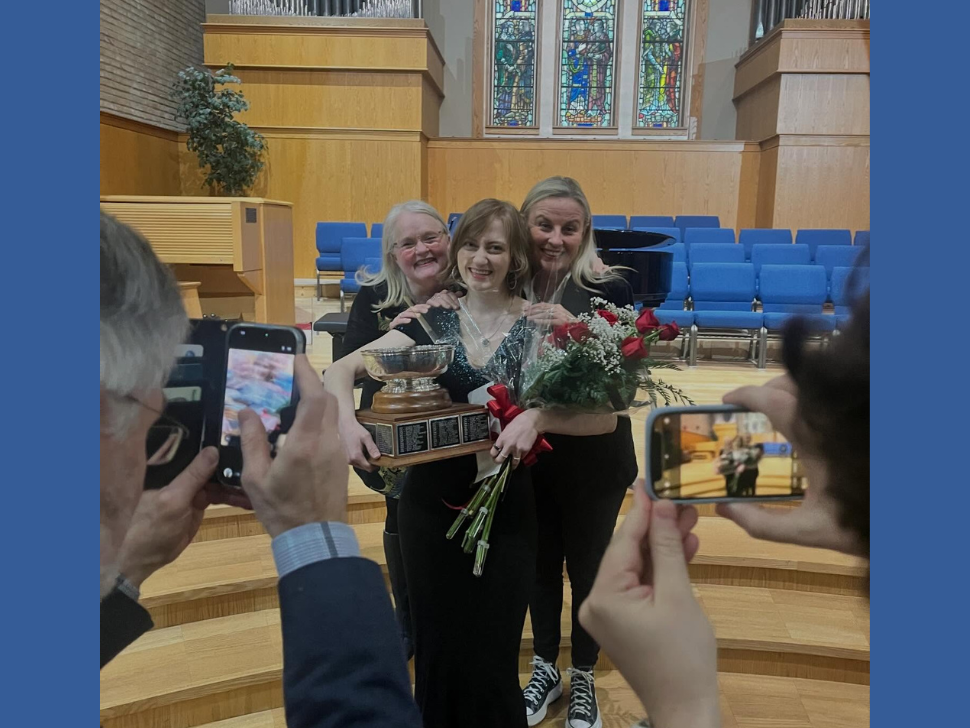
This past weekend, the 108th edition of the Winnipeg Music Festival drew to a close, wrapping up three remarkable weeks of music making across the city. Hundreds of performers took to the stage, gaining invaluable performance experience while receiving expert feedback from some of the finest adjudicators in their respective disciplines.
Among the festival’s most coveted prizes is the Rose Bowl, awarded annually to a Level A singer who delivers the most outstanding overall vocal performance. Its legacy is formidable. Past recipients include luminaries such as Tracy Dahl, Valdine Anderson, Philip Enns, Aaron Hutton, Diane Berger, and Jessica Strong, artists who have gone on to shape Canada’s vocal landscape.
Simply put, the Rose Bowl has long served as a launching pad for some of the country’s most successful vocal careers. In 2026, that distinction belongs to Joanna Loepp Thiessen.
“A Slow Burn”: Processing a Major Win
Despite the magnitude of her achievement, Loepp Thiessen describes her reaction with characteristic humility and introspection.
“Yeah, you know what? I’m a little bit of an internal processor of my successes. So it’s kind of a slow burn. I’m feeling still lots of moments of, wow, I can’t believe that happened. I’m super grateful. And I was quite shocked and very thrilled, of course, to be the recipient of such an honor.”
Currently completing her master’s degree at the University of Manitoba, Loepp Thiessen studies under both Monica Huisman and Tracy Dahl, a pairing she describes as “kind of the best of both worlds.”
With only weeks remaining before her graduate recital, the Rose Bowl win arrives at a pivotal moment—offering both affirmation and momentum.
“Certainly, it does give me a sense of validation,” she explains. “As someone else put it, it’s kind of a guidepost, even though I would have continued to perform, whether I won a competition or not, it’s a really lovely way to feel like, hey, I’m doing the thing that I love to do and other people think so too, that I should be doing that. So it’s lovely in that way.”
Finding Her Voice: From Soprano to Contralto
Loepp Thiessen’s path to this moment has not been entirely straightforward. Like many singers, her vocal identity has evolved over time.
“Yeah, great question. I was a soprano my whole life,” she says. “It’s a bit complicated with the Fach system because there’s so many environmental factors that affect what rep you’re choosing at a given time, health factors, all these different things that sometimes keep our true voice maybe revealed for longer.”
Her transition to contralto came during her graduate studies, following a period of exploration and reassessment.
“In my case, I had taken a hiatus from school after my undergrad, started at U of M, doing a prep year effectively for my master’s… And they asked me to do a prep year because my voice was a little ambiguous as to what I was.”
The turning point came in a lesson with Monica Huisman.
“And so after a sabbatical, one of my teachers, Monica, came back, had her first lesson with me and thought, hmm, I’m hearing not soprano. And so we kind of looked at that, took some of my rep, a few keys down, and then, ta-da, here we are, contralto.”
The result is a voice now fully aligned with repertoire that showcases its depth, colour, and dramatic potential.
A Winning Program: From Contemporary Canada to Early Mozart
Loepp Thiessen’s Rose Bowl-winning performance demonstrated both versatility and artistic insight, pairing a contemporary Canadian work with early Wolfgang Amadeus Mozart.
One of her selections came from a rarely performed opera by Winnipeg composer Neil Weisensel.
“Yeah, this is a very unheard aria from an opera written in 1993, I believe, called The Bachelor Farmers of the Apocalypse, written by Neil Weisenthal with the libretto written by the late Michael Cavanagh.”
She describes the work as dramatically rich and musically demanding:
“Musically, Neil has such a gift of creating these beautiful angular shapes in his music. I would say it’s… It leans towards… more angular, atonal, I would describe it as… I love that it goes quite from extreme to extreme. It has a two octave range within the aria.”
In contrast, her Mozart selection—drawn from Mitridate, re di Ponto, composed when Mozart was still a teenager, offered a different kind of energy.
“My character Farnace was written for a castrato… this rep is like quite alto friendly for me because it jumps around a lot. It’s quite very different than Neil’s music in that it’s quite simple harmonically in kind of a catchy way. I would say that it kind of, it bops along and it never stops and it’s a lot of fun to sing.”
The pairing highlighted not only her technical range but also her ability to navigate contrasting musical styles with confidence and clarity.
Another Triumph: The Doris Lewis Memorial Trophy
As if the Rose Bowl were not enough, Loepp Thiessen also claimed the Doris Lewis Memorial Trophy, awarded for the best performance of an oratorio or Bach aria during the festival.
Her winning piece: “Erbarme dich” from St. Matthew Passion by Johann Sebastian Bach.
“Yes. This award is given for the best performance throughout the week of either an oratorio aria or a Bach aria… I performed my very favorite Bach piece called Er Barmendich from St. Matthew.”
She points to both the technical and emotional demands of the work:
“It’s a piece that is very challenging because of how instrumental Bach writes, but it’s also extremely long phrases… And I also really connect with it on a personal level. I find the music so beautiful and so spiritual.”
Her connection to the piece, combined with prior experience performing it with a Baroque orchestra, proved decisive.
“And the Adjudicator also really connected with my performance. And yeah, I was grateful to receive that award.”
Looking Ahead: A Career Taking Shape
With her studies nearing completion, Loepp Thiessen stands at the threshold of a professional career, energized by recent successes and focused on what lies ahead.
“Yeah, I am really excited about the future. It’s really validating that these sorts of awards really give people energy around your career and support you in the risk that is a performance career.”
She anticipates a shift from academic preparation to professional auditions, alongside continued teaching and performance opportunities.
“I am… looking at a very large amount of time that is open because I’ve been in school for a really long time. So I’m excited to continue auditioning… I enjoy teaching as well and helping the next group of young singers prepare for things like festival and university auditions.”
While specific engagements remain under wraps, her summer promises to be active.
“But this summer I have several concert and opera performances coming up that I’m not able to share about just yet but I’m… really looking forward to delving into that.”
As she continues to refine her artistry and define her place within the classical music world, one thing is clear: Joanna Loepp Thiessen’s Rose Bowl win is not simply a culmination—it is a beginning.