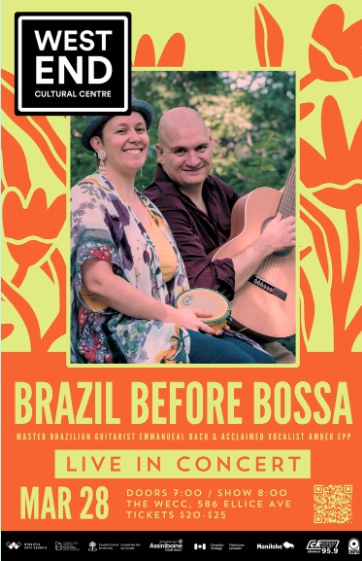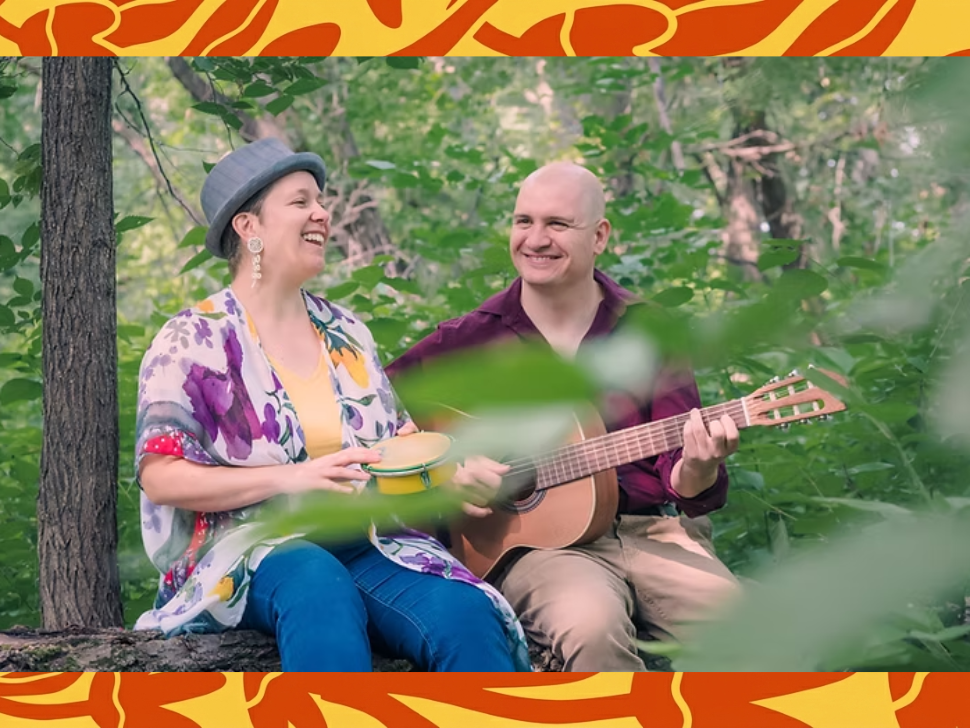
This Saturday night, March 28th at the West End Cultural Centre, audiences will be transported across continents and decades, tracing the roots of one of the world’s most beloved musical traditions. Jazz singer and pianist Amber Epp joins Brazilian guitar virtuoso Emmanuel Bach for Brazil Before Bossa Nova, a concert experience that blends performance with storytelling, offering insight into the rich musical traditions that shaped Brazil’s sonic identity long before bossa nova captivated global audiences.
Beginning at 8 p.m., with doors opening at 7, the evening promises more than just a concert, a journey deep into the heart of Brazil and back in time to the rich sounds of the early and mid-20th century.”
The Origins of a Musical Exploration
The idea for Brazil Before Bossa Nova was born out of a period of stillness during the COVID-19 pandemic. For Bach, the absence of live performance created an opportunity for deep reflection and study.
“Well, the idea for this concert… during COVID, I started doing more research about Brazilian music history just because musicians didn’t have gigs, right?” he explained. “So I spent a lot of time at the house and thinking, how do I not go crazy? I have to find something to occupy my mind a little bit.”
What began as a personal exploration quickly grew into something more structured during his graduate studies. “During my Masters degree, I was taking a musicology class, which is a lot of this like social aspects connected to music, right?” he said. “And I remember my professor came to us and said, Look, you have to find a way to incorporate musicology into your performance.”
That challenge became the foundation for the concert. “And then I started to think, oh, that actually would work very nice with the bossa nova and history, because I could, you know, with all the stuff that I’ve been reading, I could put together a set that kind of helps to tell that story with music.”
Beyond the Label: Rethinking Bossa Nova
While bossa nova is often treated as a distinct genre, Bach challenges that assumption, offering a more nuanced perspective rooted in history and culture.
“For me, they’re the same thing,” he said when asked to compare samba and bossa nova. “Here’s the thing. Bossa Nova is a commercial label [something created by the record labels], in my opinion.”
He elaborated further: “Because what is Bossa Nova… it is mixing the jazz with the samba, right? Well, guess what? There were people doing that before Jobim and João Gilberto, you know? So Bossa Nova existed before the label Bossa Nova existed.”
This idea lies at the heart of the concert’s concept. “That’s why we call the show Brazil Before the Bossa,” he explained. “But the show actually shows that Bossa Nova existed before the label Bossa Nova existed.”
Bach also highlighted the political dimensions behind the genre’s global rise. “What happens, is that the Brazilian government wants a type of Brazilian culture to be exported to the United States,” he said. “And they wanted a certain look to be attached with that music.”
“They want this predominantly white and middle-class people that look nice in the pictures for them, to be the face advertised outside the country, and that’s what the Bossa Nova That label is for that.”
Rhythm, Harmony, and Misconceptions
A central theme of the performance, and the discussion leading up to it, is the complexity of Brazilian rhythm and harmony. While audiences often simplify the differences between samba and bossa nova, the reality is far more intricate.
“The rhythm, there’s not really like that much difference,” Bach explained. “There’s no rhythmic difference between the Bossa Nova and the Samba.”
Instead, the distinction lies more in harmonic language. “The harmony, yes, jazz harmony with samba. That’s what bossa nova is,” he said.
Choro and the Emotional Core of Brazilian Music
Another key element of the program is choro, a foundational yet often misunderstood aspect of Brazilian music.
“Well, choro is not like, and the thing that people get confused often is that choro it is not a style of its own. choro is a way to play,” Bach explained. “Choro in Portuguese means to cry.”
This emotional quality defines the style. “So when you play in a mournful way the instrument, like you’re moaning when you’re playing the instrument,” he said.
Choro encompasses a wide range of influences. “There’s polkas, there’s mazurkas, you know, there’s like some African rhythms like lundu,” Bach noted. “There’s even like Cuban habaneras on it, you know, so it’s a mixture of different styles.”
Despite its diversity, choro remains central to Brazil’s musical evolution. “Choro is a very complex music. It’s very rich,” he said. “And is the basis of all the Brazilian music, like the modern Brazilian music is all based on choro.”
A Concert Experience Rooted in Storytelling
For Epp and Bach, Brazil Before Bossa Nova is not just about performance, it’s about context, connection, and discovery.
“Yeah, so we’re sort of going back in time and sharing some of the songs and the stories that go with them,” Epp said.
The program will include works by influential but sometimes overlooked figures. Bach highlighted one in particular: “Playing Johnny Alf’s music a little bit, because he’s considered by many the father of Bossa Nova.”
He added, “But because he was black and homosexual, he was left out of the Bossa Nova movement a little bit. So I always love playing his music and giving people the opportunity to know this amazing composer.”
Epp also looks forward to moments of audience connection. “There’s some songs that I didn’t know were so popular,” she said. “And then when I sing it, if there’s any Brazilians there, they stand up, they’re crying, they’re really into it.”
One such piece is especially meaningful: “There’s one called Carinhoso, which is very well-loved around Brazil. So if there’s any Brazilians there, I’m going to look for their faces. I want to see how they react.”
Language, Culture, and Community
Performing this repertoire comes with unique challenges, particularly when it comes to language. For Epp, singing in Portuguese is both rewarding and demanding.
“For me, Portuguese is newer, so it’s still a challenge,” she said. “I’ve been singing in Spanish for like 20 years, so there’s a lot of similarities. They’re like language cousins.”
Still, the nuances require careful attention. “Portuguese is a bit like English in a way, where you have the rule if it’s this kind of word, but if it’s here or in this context, you change it,” she explained. “Doing my best to learn, trying not to swear by accident, and doing my best.”
Her preparation includes collaboration and community. “I also have a friend from Brazil who’s a linguist,” she said. “So I meet up with her once in a while when I have a big show… and then she helps me.”
More Than Music: A Cultural Celebration
Ultimately, both artists hope audiences leave with more than just an appreciation for the music.
“They will understand more about what Brazilian culture is, and some of the politics that are attached with the music,” Bach said. “So you’re not going to only listen to music but you’re also going to learn a lot of things about music.”
For Epp, the concert is also a celebration of Winnipeg’s cultural diversity. “Something personally that’s important to me is to celebrate the cultures of people that have moved to Winnipeg,” she said. “So this is one way we can do it.”
The evening will even extend beyond the stage. “We’ve invited a lady to come sell her Brazilian food at the event… some more ways to share and celebrate,” she added.
As the city gathers for this unique event, Brazil Before Bossa Nova promises to be exactly what its creators intend: “an evening of rhythm, history, and irresistible energy,” and a vivid reminder that music is not just something we hear, it’s something we learn from, connect through, and carry forward.
Don’t miss the chance to experience Brazil Before Bossa Nova, a concert that is as enlightening as it is electrifying, blending masterful musicianship, rich storytelling, and the vibrant rhythms of Brazil into one unforgettable evening. Whether you’re a longtime lover of Latin music or simply curious to explore something new, this performance promises to move you, teach you, and leave you inspired. Brazil Before Bossa Nova takes place this Saturday at 8 p.m. at the West End Cultural Centre, with doors opening at 7 p.m. Arrive early, soak in the atmosphere, and get ready to be transported.