
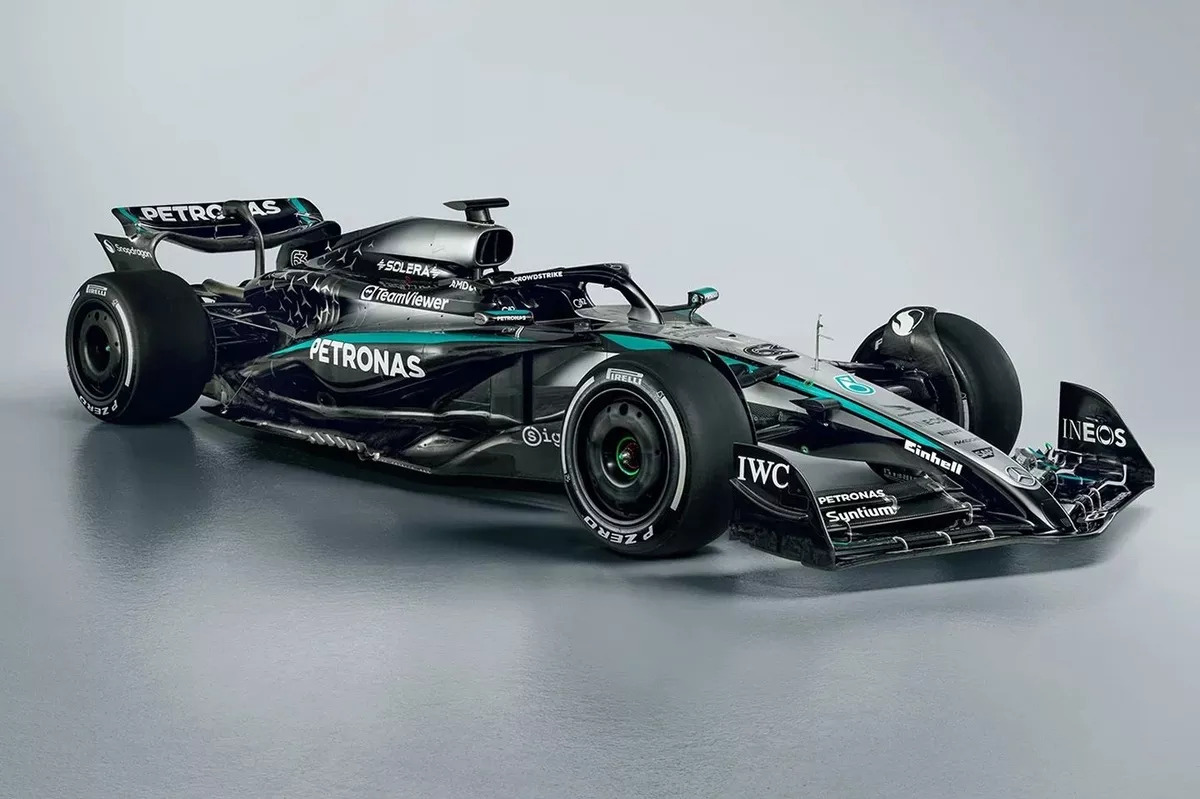
Formula 1 is staring down its first major technical scandal of the 2026 season, and it’s centered around one of the sport’s biggest teams. The FIA has officially launched an investigation into Mercedes following mounting concerns over a potentially illegal front wing system on the W17, just days before the Japanese Grand Prix.
What started as quiet speculation has now escalated into a full-blown paddock controversy. Video footage, rival team scrutiny, and technical analysis have all pointed toward one question: did Mercedes find a loophole in the new active aero rules, or cross a line the FIA won’t tolerate?
Advertisement
The Suspicion That Sparked It All
The issue centers around the front wing flap closing time, a key part of the 2026 active aerodynamics regulations. Under the rules, movable aerodynamic elements must complete their transition within 400 milliseconds, with the FIA’s standard ECU monitoring the process in real time.
But footage of the Mercedes W17 appears to show something very different.
Multiple clips circulating within the paddock suggest the wing takes closer to 800 milliseconds to fully close. That’s double the legal limit, and in a sport where margins are measured in thousandths of a second, that difference matters.
Advertisement
At first glance, that should be impossible. The FIA’s control systems are designed specifically to catch any delayed or manipulated aero movement. So how could Mercedes be operating outside the limit without triggering an immediate violation?
That’s where the controversy intensifies.
Ferrari—and Others—Start Asking Questions
Following Mercedes’ dominant 1-2 finish at the Chinese Grand Prix, attention shifted quickly from performance to legality. Rival teams began digging deeper into the W17’s design, and soon after, a formal request for clarification was submitted to the FIA.
While early reports suggested Ferrari led the charge, the team has since denied being the source. That leaves another competitor in the paddock as the likely instigator, raising the stakes even further.
Advertisement
This wasn’t just curiosity. It was a direct challenge.
In Formula 1, teams don’t raise questions like this unless they believe something meaningful is at play. The timing, coming immediately after Mercedes reasserted itself at the front of the grid, only added fuel to the fire.
The “Two-Phase” Wing Theory
According to technical analysts and information circulating within the paddock, Mercedes may have developed a two-phase or bi-phase closing system for its front wing.
The concept is as clever as it is controversial.
Instead of closing the wing in one continuous motion, the system allegedly splits the action into two distinct stages. The first phase happens rapidly, completing within the legal 400-millisecond window. That initial movement is enough to satisfy the FIA’s sensors, which register the transition as complete.
Advertisement
Then comes the second phase.
A slower, delayed mechanical adjustment follows, allowing the wing to settle into its final aerodynamic position after the monitoring window has effectively ended. If accurate, this would mean the wing is technically “legal” during inspection, but functionally operating outside the intended rules.
It’s not a blatant violation. It’s something far more dangerous in Formula 1: a potential loophole.
Why It Matters on Track
This isn’t just a technical detail buried in engineering jargon. The performance implications are significant.
When an F1 car brakes at high speed, weight shifts aggressively toward the front of the car. That sudden transfer can destabilize the rear, making the car more difficult to control during corner entry.
Advertisement
By controlling how quickly the front wing loads up aerodynamically, Mercedes may have found a way to smooth that transition.
A staggered closing process allows the car to build front downforce progressively, rather than all at once. The result is greater stability under braking, improved tire management, and more predictable handling into corners.
In simple terms, it could be the difference between attacking a corner with confidence or fighting the car on entry.
And in modern Formula 1, that difference can decide races.
FIA Steps In
With mounting evidence and growing pressure from rival teams, the FIA has now stepped in to investigate the system.
Advertisement
The matter is being handled by the governing body’s technical department, led by single-seater director Nikolas Tombazis. Their job is to determine whether Mercedes’ design complies not just with the letter of the regulations, but with their intent.
That distinction is critical.
Formula 1 has always lived in the gray area between innovation and rule-breaking. Teams are constantly searching for advantages, and history is full of examples where clever engineering pushed boundaries right up to the edge of legality.
The question now is whether Mercedes has done exactly that, or gone too far.
Suzuka Weekend Set for Showdown
The timing of the investigation couldn’t be more dramatic.
Advertisement
With the Japanese Grand Prix weekend about to begin, the FIA faces pressure to reach a decision quickly. Allowing the controversy to linger risks undermining the competitive integrity of the championship, especially if Mercedes continues to benefit from a system under scrutiny.
If the governing body rules against the design, it could issue a Technical Directive forcing Mercedes to modify or remove the system immediately.
That would not just impact one race. It could reshape the competitive order heading into the early part of the season.
On the other hand, if the system is deemed legal, it could open the door for other teams to develop similar solutions, triggering a new wave of innovation—and controversy.
Advertisement
A Familiar Formula 1 Story
Situations like this are nothing new in Formula 1, but they never lose their impact.
The sport thrives on innovation, but it also depends on trust in the rules. When a team appears to gain an edge through interpretation rather than outright performance, the entire paddock takes notice.
Right now, Mercedes is at the center of that storm.
What happens next will depend on how the FIA chooses to interpret one of the most technical and nuanced areas of the new regulations. But one thing is already clear: this is no longer just about a front wing.
It’s about where Formula 1 draws the line between ingenuity and advantage—and whether Mercedes has just forced the sport to redraw it.