
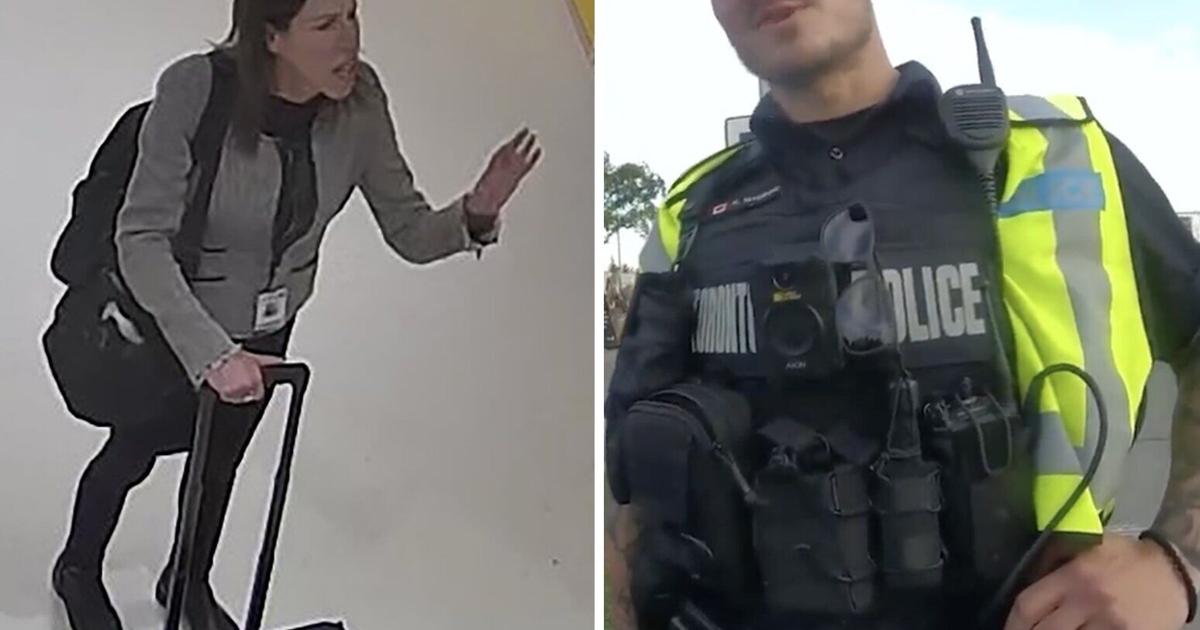
A veteran Crown attorney is being accused of berating a Toronto police officer while suggesting he should have given “false evidence” on the stand.
The explosive allegation involves a tense encounter between prosecutor Marnie Goldenberg and Const. Edin Hasanbasic in January, during which she admonished the officer in the hallway of the Toronto provincial courthouse at 10 Armoury St. — within earshot of several witnesses — about his testimony at the trial of a man accused of intentionally hitting another officer with a motorcycle.
Hasanbasic, who was called as a witness by the defence, had just told the court it didn’t look like a head-on collision and that the other officer “seemed like he was fine” and was not seriously injured; it was testimony that risked hurting the Crown’s case.
In his notes about the hallway encounter, Hasanbasic wrote that the prosecutor was yelling and swearing about his testimony.
He wrote that he told Goldenberg, “What am I supposed to do? Lie?”
“She responded with, ‘We protect our own,’” he wrote.
Goldenberg, a prosecutor of 22 years whose husband is a police officer, has acknowledged she confronted Hasanbasic, but adamantly denies saying those words — “Police officers are not my own, and it is not my job to protect them.”
She instead pointed the finger at Hasanbasic for approaching his obligations as a witness with a “lack of seriousness,” saying she confronted him with a “slightly elevated” voice because his testimony deviated from what he had said about the motorcycle incident in his notes and statement at the scene. She said she wanted to remind him of the importance of making accurate notes and standing firm when testifying.
“I would never tell a witness to lie,” Goldenberg says. “Ever.”
It will be up to Ontario Court Justice Mara Greene to sift through the conflicting statements in search of the truth. The drama inside the courthouse, caught on camera but without sound, is detailed in an application by the accused, Khalid Patrick Idris, to have his charges thrown out due to abuse of process. The defence is pushing for a stay of proceedings not just because of the interaction between Goldenberg and Hasanbasic, but because she chose not to call him to testify when the defence argues his evidence could have helped clear Idris.
Behind the hallway confrontation
Idris, 36, is accused of intentionally driving into Toronto police Sgt. Blain Young with a motorcycle on the evening of Aug. 7, 2024, while Young was directing traffic on Lakeshore Boulevard. Young sustained a cut on his leg.
The Crown alleged that after fleeing the scene, Idris attempted to sell the motorcycle. He’s charged with dangerous driving causing bodily harm, leaving the scene of an accident and obstruction of justice.
Defence lawyer Elham Ellen Jamshidi, who handled the trial in January, called Hasanbasic to the stand. While the Crown argued that Idris deliberately struck the sergeant, Hasanbasic testified that it looked like the bike was going to pull over and that while it made contact with the officer, it was not a head-on collision.
Young “seemed like he was fine,” Hasanbasic testified in January. “I know that he completed his shift, which means he wasn’t injured seriously enough.”
After his testimony was over, Hasanbasic wrote that Goldenberg confronted him by “telling me that is the most embarrassing, pathetic testimony she has heard in 37 years.”
“I respond with, ‘I’m not sure what you want me to do, I was just telling the truth.’”

An excerpt from Hasanbasic’s handwritten notes.
Ontario Court of Justice exhibit
He wrote that Goldenberg said her husband is a cop, and twice told him, “we protect our own,” including after he asked if he was supposed to lie. He then returned to a meeting room, telling Jamshidi and another officer, “The Crown just tore me a new one for being honest.”
Det. Const. Eloi Silva, the officer in charge of Idris’s case, wrote in a brief “observational note” that he saw Goldenberg confront Hasanbasic, but Silva didn’t note Goldenberg saying, “we protect our own,” or that Hasanbasic asked if he was supposed to lie.
“She was speaking quickly and appeared visibly irritated,” Silva wrote.
Meanwhile, Idris was sitting around the corner — “I was just trying to eavesdrop on the conversation, to be honest with you,” he testified.
He wrote down what he overheard and later swore an affidavit detailing his recollection. He said he heard Goldenberg say, “Where is this cop?” after emerging from the courtroom. When Goldenberg confronted Hasanbasic, Idris said in his affidavit he heard her raise her voice and say, “I can’t believe you f—-ing testified against a sergeant of 30 years.”
He then overheard her say: “You’re a young copper and you have many years ahead of you. If you continue this way, you won’t have a lengthy or easy career.”
Idris said he heard the officer say, “I’m sorry, I was called to tell the truth. I was just saying what I had seen that day. I was not taking sides,” and that Goldenberg responded: “It’s disgusting what you did today. I’ve never witnessed something like this.”
Hasanbasic takes the stand
Hasanbasic took the stand again this week during the hearing for the stay application. He said he was “taken aback” by the encounter with Goldenberg, and especially because it was in public.
“I’d never been spoken to before by a Crown like that,” he said, describing the encounter as unprofessional.
While he wrote in his notes that Goldenberg told him, “we protect our own,” he testified that it may not have been those exact words, but rather “along those lines.”
Defence lawyer Peter Thorning, who is representing Idris for the stay application, pressed the officer on what he believed Goldenberg was trying to convey. “That maybe my testimony didn’t go the way she wanted it to go,” Hasanbasic replied.
Thorning continued: “In your mind, was the Crown suggesting you should not tell the truth?”
That was possible, the officer responded, “because that’s what it felt like.”
He agreed under cross-examination by Crown attorney Simon Heeney, the head prosecutor for downtown Toronto, that he made several mistakes when testifying about the motorcycle incident, then also agreed it would be fair for a lawyer to be disappointed about that.
Ultimately, Heeney put to Hasanbasic that he “exaggerated” what Goldenberg said to him because, by his own account, he was surprised and embarrassed to be “chastised” in a public hallway.
“Maybe to make yourself look better,” Heeney suggested to Hasanbasic.
The officer disagreed, saying if someone has a problem with his testimony, there’s a process in place that involves notifying his superior, “and then they would speak to me and it would be handled in an in-house sort of way.”
Goldenberg’s version
When Goldenberg took the stand, it was the second time this month that the longtime Crown attorney found herself in the witness box — she also testified just last week as the victim in an antisemitic threat trial, in which the accused woman was convicted.
She said she didn’t call any of the police eyewitnesses to testify because she felt she already had the best evidence to prove the case — Young’s body-worn camera footage of the incident. But she did promptly make arrangements for Hasanbasic to be at court in January after Jamshidi, the defence lawyer, requested that he be there.
Goldenberg denied using words like embarrassing, pathetic or disgusting in her encounter with Hasanbasic. And she highlighted an obvious inaccuracy in his notes: she has not been a Crown attorney for 37 years, pointing out she would have been a teenager 37 years ago.
She testified she spoke with Hasanbasic because she was disappointed that he would testify “in such an inaccurate fashion.” She emphasized that officer notes “are very important,” as they form part of the Crown’s decision as to whether to pursue criminal charges.
“I’ve been doing this job for 22 years, and I have never, ever, seen an officer testify like that,” she testified. “He was like butter. He melted under pressure. He would have said anything.”
In an affidavit, Goldenberg wrote that she approached Hasanbasic after his testimony by saying something like, “What was that? That was disappointing,” and Hasanbasic responded with, “That was uncomfortable,” in a tone Goldenberg perceived as “flippant”; she admits that irritated her.
“It just didn’t seem he cared,” Goldenberg testified.
She said she outlined for him the inconsistencies in his testimony, including that he had said in his statement at the scene that the motorcyclist “rode right into the sergeant.” In his testimony, he said it was more of a “side swipe” or a “graze.”
While Hasanbasic testified that Young wasn’t seriously injured, since he finished his shift, Goldenberg said she told him in the hallway that’s because Young is a “38-year copper and that’s what they do,” going on to say that her husband is a “37-year copper” and would have also completed his shift.
“I find recently that younger officers, or even more senior officers, they get a cut to their finger and they take off for months,” she testified. “It’s just this mindset now of some officers who take advantage of the system, and Sgt. Young was clearly not one of them.”
Why the confrontation is at the centre of a court hearing
Goldenberg’s actions are “blatantly inconsistent with conduct expected of a Crown, or any lawyer, and no remedy other than a stay of proceedings is appropriate,” wrote defence lawyers Thorning and Alexa Banister-Thompson in the stay application.
“When asked a direct question by the officer about whether he should have not told the truth under oath, the Crown advised him that it would have been better had he provided false evidence in support of a fellow officer and the Crown theory.”
The defence arguments are based on a “fundamentally flawed account of the facts,” says a response filed by Crown attorneys Heeney and David Quayat.
They point out that Goldenberg spoke to Hasanbasic after he had already finished his testimony, and argue that the claim that she suggested he should have lied is “completely unsupported” by the evidence.
“I’ve been doing this job for a long time, and I’ve been called every name in the book, but never anything about my religion.”
“I’ve been doing this job for a long time, and I’ve been called every name in the book, but never anything about my religion.”
In her affidavit, Goldenberg says she did not yell or swear at Hasanbasic, and certainly wouldn’t do so in a public courthouse hallway.
“I would save that for upstairs in the Crown’s office,” she testified.
Goldenberg became emotional on the stand, explaining that after raising the sergeant’s injury to Hasanbasic, she suddenly pictured her husband, who had had heart surgery a few years earlier, lying on a hospital bed. She said she also told Hasanbasic that she was becoming emotional, and ended the conversation by walking to the elevator.
During cross-examination, Thorning suggested to Goldenberg that she was focused on getting a conviction at all costs, even if that meant not presenting evidence that could have contradicted the Crown’s theory.
“You chose a side early on in this case, and that side was Sgt. Young’s, because Sgt. Young reminds you maybe of your husband: he’s a senior officer, he’s a tough guy, he’s completing his shift,” Thorning put to Goldenberg, who disagreed.
She said her goal is never to secure a conviction, but rather to present the case “as I see it.”
“The only thing that mattered to you in this case was putting Mr. Idris in jail,” Thorning said, as he pointed to his client sitting next to him. “You were prepared to do and say whatever it took.”
At this, Goldenberg leaned into the witness box microphone: “You can make that suggestion all you like, but it is 100 per cent false.”
While Goldenberg maintains she never said “we protect our own,” she did offer up a suggestion in her affidavit as to how those words might have inadvertently ended up in Hasanbasic’s notes.
In early January, Silva, the officer in charge of Idris’s case, had sent a reminder email to officers, including Hasanbasic, about coming to court, writing: “Please remember that this was one of our own that got hurt in this collision.”