
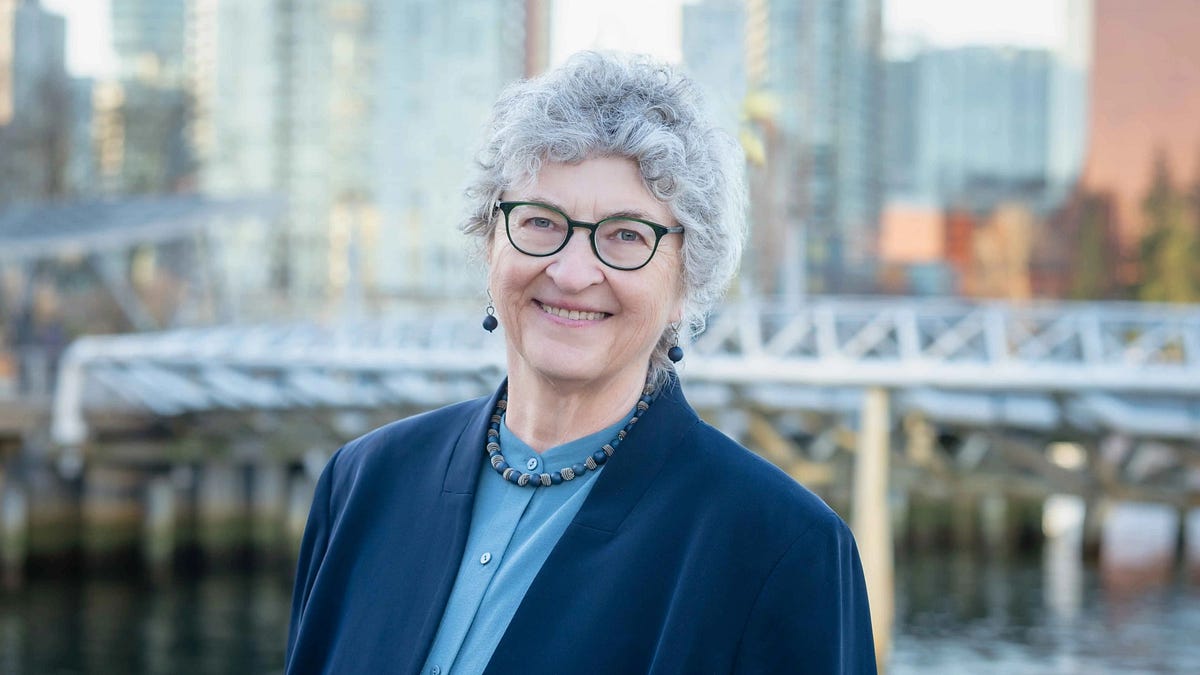
 Frances Bula. (OneCity Vancouver)
If you’re reading this, you probably already know who Frances Bula is. She’s been a journalist in Vancouver for 43 years, primarily at the Vancouver Sun and then The Globe and Mail, and has covered urban issues and politics for most of that time.
Earlier this month, however, she surprised many with an announcement that she was running for Vancouver City Council with OneCity Vancouver, whose ranks include Minister of Housing Christine Boyle, current councillor Lucy Maloney, and mayoral candiate William Azaroff.
There’s a lot of overlap between what Frances has covered and what I cover, so I thought it’d make for an interesting conversation to talk to her about her career, the decision to enter politics, and some of the issues that we both cover.
[Full disclosure: Frances was a freelance contributor at Storeys when I was there, but this was actually the first time we had ever talked. I’m also a long-time Burnaby resident so have no skin in the Vancouver municipal election.]
After such a long journalism career, what made you want to give politics a try? I’ve seen some comments online, in good fun I think, about you being radicalized from your experience building a laneway home. Any truth to that?
People always come up with these 2 + 2 = 18. It’s funny, because it’s not that at all. I really just felt like I’ve had an incredibly wonderful run as a journalist and wanted to do something that was kind of more direct. But people are always thinking someone’s doing something because they’re mad or cranky or whatever. Ten years ago, they could’ve tore down every house around me and I still wouldn’t have considered politics because I still felt like I had a lot to do in journalism. But I’m at the point where this is going to be a capstone project, it’s going to be a wild new adventure, and I wanted to have one wild new adventure before, you know, the end.
How did your family, friends, and colleagues take the news and how has the transition been for you?
It’s been way better than I thought. I got a ream of positive comments. It’s been really good in some ways, but there are things that are happening that are very predictable. There’s a couple of commenters saying, “Oh, she’s just a developer shill.” Then there’s another little group of commenters — not in the mainstream, but more in the peripheral — saying “Oh, she’s just a fake progressive pretending that she’s pro-housing, but is actually a NIMBY.” So to one of them I said “Can you two groups get together and have a vote on which kind of evil you think I am?”
But generally it’s been really good. I’ve been telling people I’m enjoying this because most of my journalism career I was always out in a crowd and meeting people and going to the fundraisers for the different political parties and making a note of who was there, talking to people, and I was just out a lot. But journalism has become… there’s not as much time or space for that. It’s been much more me being on the phone and my laptop, so this has been kind of fun, because now I’m out meeting people and talking to everybody in the world again, which was always my ambition as a journalist — to get into every single living room I could and ask people what they’re life story was.
It’s a learning process. My brain sort of feels like it’s on fire, like you do when you travel to a country you’ve never been to before and you’re trying to figure out everything at once. But I have to say OneCity feels like a big, huge supportive team, and so that makes it a lot easier. I looked into running as an independent and every single political person with any experience said you can’t win as an independent, so then I had to choose, and I feel like it’s working out with what I chose, because I really have the sense of a big strong team that has some professional backup.
So it sounds like there really wasn’t a second party option for you besides OneCity?
I did talk to Kareem [Allam, of the Vancouver Liberals] a bit, but I just felt like I couldn’t ultimately predict where his group might end up and who might be on the team with me and whether I’d be comfortable with them.
You hinted at it earlier, but do you think there are any transferrable skills between being a reporter and being a politician?
Oh, totally. I mean, I feel like I have this huge advantage because I’m used to phoning people up, point blank, and asking them questions, so now I’m asking them to join the party. Articulating what’s going on while being mindful of all the different voices that there are out there. Just that ability to talk to people, approach them, listen to them — like really listen to them, which is hard. There’s a thing that we all have as humans where we’re in a conversation, but really we’re just waiting to say our piece. So really listening to people is a huge skill you develop in journalism and it’s equally applicable here, because I don’t claim to know everything.
You mentioned the advantage of your journalism background. Do you think there are any disadvantages?
I can see the disadvantages for me personally. I’m well-known so I have a certain amount of brand-name recognition, although I have to say I ran into a young person recently at a campaign thing and told them, “My name is Frances Bula, I’m a former journalist, I’m now running for office” and he was like, “Oh, you’re a journalist? Have you ever written anything about local politics?”
But I’ve been out there reporting on things, so there’s certain people who don’t like a particular piece of information I’ve included in a story or they thought they were treated unfairly, or they think I have it in for them, for some reason that I can’t always figure out.
So there’s lots of positive recognition, but if you’re a journalist for 40 years, inevitably you have people who don’t like something you did, so I guess I’m getting more attention than some other people who are running as candidates because of that. It’s positive attention, but also negative attention.
Compared to the 2022 municipal election, do you think housing is a bigger issue now or have other issues overtaken it, in terms of what’s top-of-mind for voters?
Well, you know even better than most of the public that the housing situation has changed so much since 2022, right? At that point, things were still going up and up, and people were building and selling and there were some issues with interest rates and the costs of construction, but generally the development industry was functioning kind of the way it always had.
Now, as you know way better than anybody, people are saying the presale market is almost frozen, rental proformas aren’t working. I hear some people saying, “Oh, well actually the vacancy rate is going up, the population of BC is leveling off, and we don’t really need to have all that development anymore.” And, of course, everybody knows that in a couple years, that’s probably going to change. The federal government will loosen up on immigration a little bit. They might increase the cap for international students and if no one builds anything, we’ll be back to where we were, which is too many people playing musical chairs in Vancouver, which is what leads to price increases. So the problem of constantly escalating prices is not what’s happening right now, it’s something different. So clearly the housing issue will have to be talked about in a different way in this election, but I still think it’s top of mind.
OneCity is very interesting. It’s got a very young membership base. I really noticed that when I went out to a couple of meetings, and those people are feeling really shut out of the city because it’s so expensive for them to live. So I think it’s very top-of-mind for OneCity members for sure.
But I also think the City and the Province went peak-YIMBY about two years ago, maybe three, when Ravi Kahlon was doing everything. Obviously some people think there’s too much development being approved, but I think, in general, the pro-housing people feel like there was a certain battle that was won. The Overton Window of talking about housing really shifted and there was a huge move by cities and the Province to explore whatever they could to try to create more housing.
Now I think people are feeling like, “We still want a lot of housing, but maybe we can put a little more thought and nuance into it.” Maybe some of these kind of big blanket zoning changes…Maybe we need to refine that a little bit or think a bit more carefully about it, maybe there could be a little more refinement of how new development is going to be inserted into the city and especially in older neighborhoods. But that’s a big conversation because everyone has a different idea about what should be available between single-family homes and large concrete towers. It’s going to be an interesting conversation in this election how people articulate what kind of options they want in between those two.
Outside of housing, there are other important issues as well. What do you think those other top issues are and where do you stand on them?
I think that people have a sense that some general stuff in the city has been neglected because there’s been this preoccupation by this council with more peripheral issues like getting rid of the Park Board or Bitcoin or the attempt to get rid of the natural gas provisions in the Vancouver Building Code and stuff like that.
I feel a little bit that way too, like I have a tree that came down in front of my house, one of those big old chestnut trees, like almost two years ago. It hasn’t been grounded up and there seems to be no move to plant another tree and when I phoned 311, they were like, “You’re on a long list, we don’t know when we’re going to get to it.” I think everyone has a bit of an experience like that. When I talk to people, somebody will say, well, they took out all the garbage cans in my area, or the sidewalks are a mess, or my park hasn’t been taken care of. I think there’s a sense by a lot of people that this council kind of got distracted. The basic things that people want, that makes the city functional, it doesn’t seem like they were putting all their effort into that.
I know another issue for people is just the yo-yo budgeting that’s happened in the last three years with ABC. 12% tax increase the first year, a dozen the second year, and finally they kind of get close to inflation in the third year, and then in the fourth year they go, “Oh my god! We ate too much! Now we have to get rid of it and they do this kind of very performative “Zero Means Zero” business. I think people would like to see more steadiness. I don’t hear the public saying, “Let’s do math and cutbacks.”
And I have stuff in my little mini-platform, like I love small independence businesses. My goal is to eat at every little restaurant along Kingsway and up Victoria and I’m forever out shopping and supporting small independent business, supporting the arts, and making sure that people have whatever mode of transportation that they can use to get around the city and feel that it’s easy.
Another weird thing to happen when you run and you’re well-known is people will say things like, “Oh I heard you’re anti-bike lane” and I’m like, “Are you kidding me?” My whole family rides bikes to get around. I drive a lot because I never have less than 15 places to go in the day. I’m usually pro-bike lane because every person that’s on a bike is not a car taking up space on the street in front of me, so that makes me want everybody on bikes.
There are other things in the platform, I’m sure, but would it be fair to say that housing is the top issue for OneCity?
I think it is. I think it’s housing and living in a city that feels like it’s working for the average person. We don’t need super fancy stuff. Fix up the community centres and schools and parks and make sure the libraries are open as much as you can and make it easy for me to get around. We’re all living incredibly stressful, busy lives, from what I can tell, and people don’t need anything to make that any harder.
It sounds like you don’t feel like Mayor Ken Sim has done a great job these last four years?
It doesn’t feel like it. From what I’ve seen, it just doesn’t seen to have been a priority. It’s not talked about a lot and everybody I talk to seems to have some little story about like, “Why is the City pulling out the garbage cans in my area? Why aren’t they planting more trees? Why is there a swamp in the middle of my park? There’s just a sense that somebody took their eye off the ball as they were trying to do these more ambitious things.
Oftentimes, new councils that are elected will spend some time walking back some things the previous council did. Is there anything we’ve seen these last four years that you’d be interested in taking another look at?
Yeah, I think people think that no-net-new supportive housing wasn’t the best signal to send. I’m positive that OneCity plans to rescind that and probably other parties would say the same. There were a few things they did, I’m just not thinking of them.
I’ll rattle some off for you. The Broadway Plan.
Yes, I’ve been out in public saying I think the Broadway Plan needs some fixes, so that’s for sure. Along with that, sort of in general, an approach to planning for new housing that is a little bit more sensitive and complementary to neighbourhoods without getting back into Vancouver’s thing of “Oh my god, we can’t build this because three neighbours came out and complained about it.” That’s not what anybody wants to go back to. Just a little bit more sensitivity and thought.”
Also, the Broadway Plan, as it’s currently structured, a lot of tenants are going to be displaced because the only people who get mitigated are people who are on an official lease. So on my street where one of the first towers is going up, a couple of those at least were communal houses. I don’t know for sure, but I would guess that only one person was on the lease, so only one person gets mitigated not the whole household. There are things to look at. It was passed at a time when people were panicking like we’re in a crisis, rents are going up every minute, we desperately need to create more rental housing. We’ve got a little bit of breathing room right now and we can go back and sort of reexamine some things and think “Can we do this a bit better?”
Big picture, looking back at your long career covering these issues, do you have any big takeaways or philosophical observations?
One of the things that I point out is some issues you can take quick action on and it really helps the people see immediate positive benefits. One that I cite often is the New York City congestion tax. It immediately generated a lot of positive reaction because commuters were finding that they could get into the city faster and people who live in New York felt like there was less traffic and less noise and it was easier for people to walk around.
Some things can be done really quickly and other things take a long time and housing is one of them. I keep saying it took 30 years to totally wreck our housing system, after the Conservatives kind of ended the federal social housing program. We kind of all glided along in that airplane for a while and didn’t realize it was running out of gas until it crashed. Various governments sort of thought it would fix itself and they didn’t have to do too much. But working on that 1774576999, that takes a long time.
There’s stuff that Gregor Robertson announced in 2018, new housing projects, that haven’t been built yet. I know everyone would love it if we’d all go back to 2001 housing prices, but it’s just hard to imagine that happening, so what needs to happen is more types of housing being made available for people. Maybe not everyone gets a single-family house, but maybe every family that needs one gets a three-bedroom townhouse at a not-too-insane price. But that takes a long time to make that change.
That was all the questions I had. Was there anything you else you wanted to comment on?
Well I have to say, this is the craziest job application process I’ve ever been through. I’ve quit all my journalism work, obviously, so now I get to spend six full months just trying to apply for this job and phoning every person I’ve ever known since kindergarten and asking if they’ll join the party, support me in the internal nomination, then support me in the general election — and a lot of people don’t realize there’s an intermediate step.
People think, “Oh, politics is so easy, they just fail up and then they start collecting their gigantic salary” and I’m like “Oh my god, no, I’m going through a six-freaking-month job interview with a panel of 5,000 people and not even certain that in the end I’m going to get to where I want to go.
The public, I think, doesn’t realize the work it takes for people to run for office. And in this climate, you come in for a lot of criticism that you have to be able to withstand. I don’t know how things are going with your journalism, but inevitably you make people angry about something, right? I bet you’re getting some calls from people about what a “piece of shit” you are, something like that, especially the difficult area you’re covering where people are in serious financial trouble.
In general, this is so much like journalism and I love it in the sense that I get to go out and listen to people talk about their stories and what they’d like from the city, and people are much more positive and kinder than social media sometimes makes it look.