
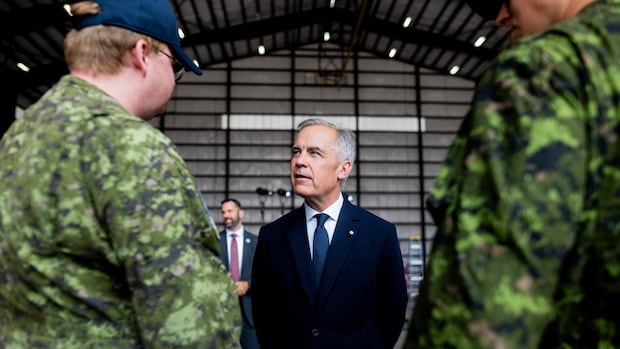
Canada crossed the politically significant threshold of meeting NATO’s defence spending benchmark of two per cent of gross domestic product, according to the Western alliance’s annual secretary general’s report and compilation of statistics released on Thursday.
It is the first time since the late 1980s — toward the end of the Cold War — that the country has met the target, which has in recent years taken on enormous political and symbolic significance.
The Liberal government achieved the goal with an injection of an additional $9.3 billion into the Department of National Defence’s budget last June — bringing the overall defence expenditures to just over $61 billion.
Despite the huge expenditure, the NATO report showed that Canada had crossed the line by the skin of its teeth, registering an estimated two per cent of GDP. It was still in the bottom one-third of the alliance in terms of defence spending, along with Belgium, Spain, Albania and Portugal.
The top spenders in terms of percentage of GDP included Poland (4.3), Lithuania (4.0), Latvia (3.74) Estonia (3.42) and Denmark (3.34). The United States ranked seventh overall (3.19).
Hitting the two per cent benchmark by the end of the fiscal year, on March 31, was a promise Prime Minister Mark Carney made in the face of long-standing pressure from allies, including the United States.
“This is the first time since the fall of the Berlin Wall that Canada will be spending two per cent of GDP on defence,” Carney said at an event in the naval dockyard in Halifax, noting that interest in the military and recruiting is up since his government made the commitment.
“Canadians are responding to our renewed commitment and the call to serve.”
The achievement represents a dramatic turnaround from not quite two years ago when former prime minister Justin Trudeau referred to the two per cent goal as a “crass mathematical calculation,” one that he had reportedly told allies Canada would never meet.
“We’ve pushed very, very, very hard to be able to execute on this plan,” said Defence Minister David McGuinty in an interview with CBC News just prior to the release of the NATO report. “It’s a big day for us.”
The country arrives at the threshold months after NATO leaders vowed to increase defence spending even higher over the next decade to five per cent of GDP (3.5 per cent on direct military spending and 1.5 on defence infrastructure).
WATCH | Carney says Canada has reached NATO defence spending threshold: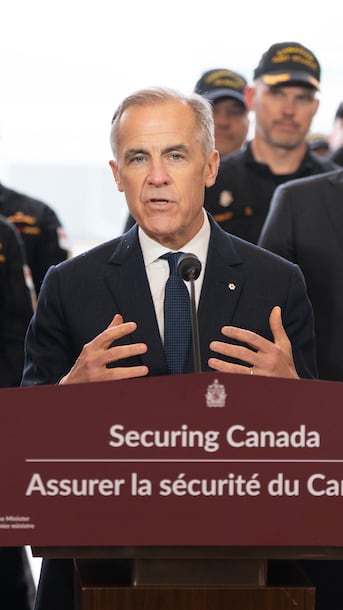
Canada fulfils ‘ambitious promise,’ reaching NATO’s 2% defence spending target, Carney says
Prime Minister Mark Carney announced Canada crossed NATO’s defence spending benchmark of two per cent of gross domestic product in Halifax on Thursday. ‘That’s the highest level of defence spending relative to the size of our economy since the fall of the Berlin Wall,’ Carney said.
Getting to the two per cent goal was never assured because, over many years, the Defence Department has not had the institutional capacity to spend all of its appropriation. It has often had to return unspent billions of dollars to the federal Treasury.
McGuinty acknowledged that there were many skeptics, but with the political backing of the prime minister the goal was met.
“We were disciplined. We were strategic. We were focused,” McGuinty said. “We pulled together a very detailed plan very, very quickly. It was done within about 60 days. Then we went to the Treasury Board and said, you need to execute on this plan.”
He said federal officials had told him — and other ministers — that the spending plan would take longer than the stated goal of March 31. “We said, ‘No, that’s not on. You’ve got 100 days. So, get it done in 100 days. And they got it done in 101 days.”
The benchmark was partly achieved by an internal reorganization of the federal government, which has seen some agencies, such as the Canadian Coast Guard, moved under the auspices of the Defence Department and therefore counted toward the NATO target. It was also achieved through a substantial pay raise for members of the military and by pouring money into base infrastructure and overhaul.
Conservative defence critic James Bezan questioned how substantive the accomplishment was for the military itself.
“We know that through creative accounting, that government spending in national defence has increased by over $10 billion. That hasn’t actually resulted in increased capabilities for the Canadian Armed Forces,” Bezan said.
WATCH | Tracking the ramp-up in defence spending: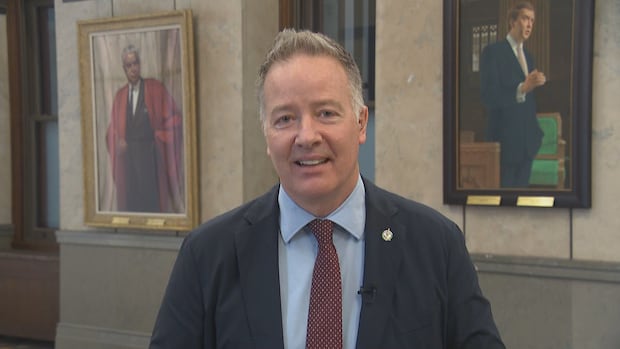
Is Canada moving quickly enough to equip its Armed Forces?
The federal government is spending $307 million for 30,000 new made-in-Canada rifles. These will replace the 35-year-old rifles the military is currently using. Secretary of state for defence procurement Stephen Fuhr joins Power & Politics to discuss the government’s efforts to ramp up defence spending.
Speaking to a conference in Calgary, Canada’s military representative was more focused on how statistics — such as two per cent — can be turned into troops and equipment.
“Happy two per cent day. Apparently we’ve achieved it,” said Lt.-Gen. Greg Smith at the event at the University of Calgary.
“We gotta keep moving. We need capability. “
While the prime minister deserves credit for making defence spending a priority, defence analyst Dave Perry says there’s been an emerging agreement across the political spectrum that the investment was necessary.
WATCH | Conservatives react to NATO target being met: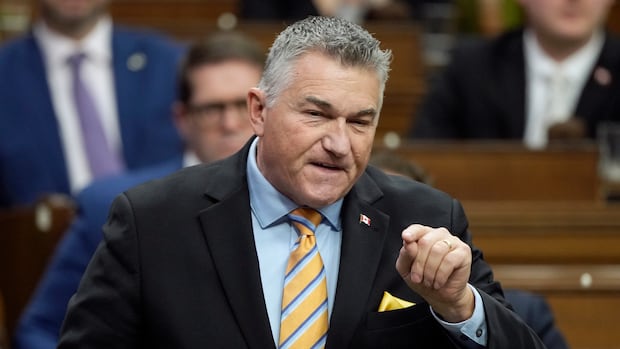
Reaching NATO’s 2% target doesn’t mean ‘Canada’s any stronger,’ says Conservative defence critic
Conservative MP James Bezan responded to Prime Minister Mark Carney’s announcement that Canada crossed NATO’s defence spending benchmark of two per cent of gross domestic product. Bezan said the government’s increased defence spending is an accounting ‘illusion.’
“It hasn’t been just Mr. Carney,” said Perry, president of the Canadian Global Affairs Institute. “In the last federal election every party committed to spending two per cent of GDP on defence. It is a completely different political consensus on defence than the one that we had had for the previous decade where they were all in agreement that didn’t need to hit.”
Perry said that changed a year ago.
Defence spending announcements
Over the last month, the Liberal government has announced more than $42 billion in defence-related spending — much of it planned for future years and programs, such as Arctic infrastructure.
Among the more immediate spending announcements made last week was the first phase purchasing new rifles for the army. It will cost taxpayers $307 million, but the Defence Department, the Defence Investment Agency and the country’s procurement services department all refused to release detailed breakdown of the elements that make up the overall project budget.
The two per cent target has been a political powder keg in recent years, with U.S. President Donald Trump at one point in his 2024 re-election bid pledging not to protect allies who failed to meet the goal.
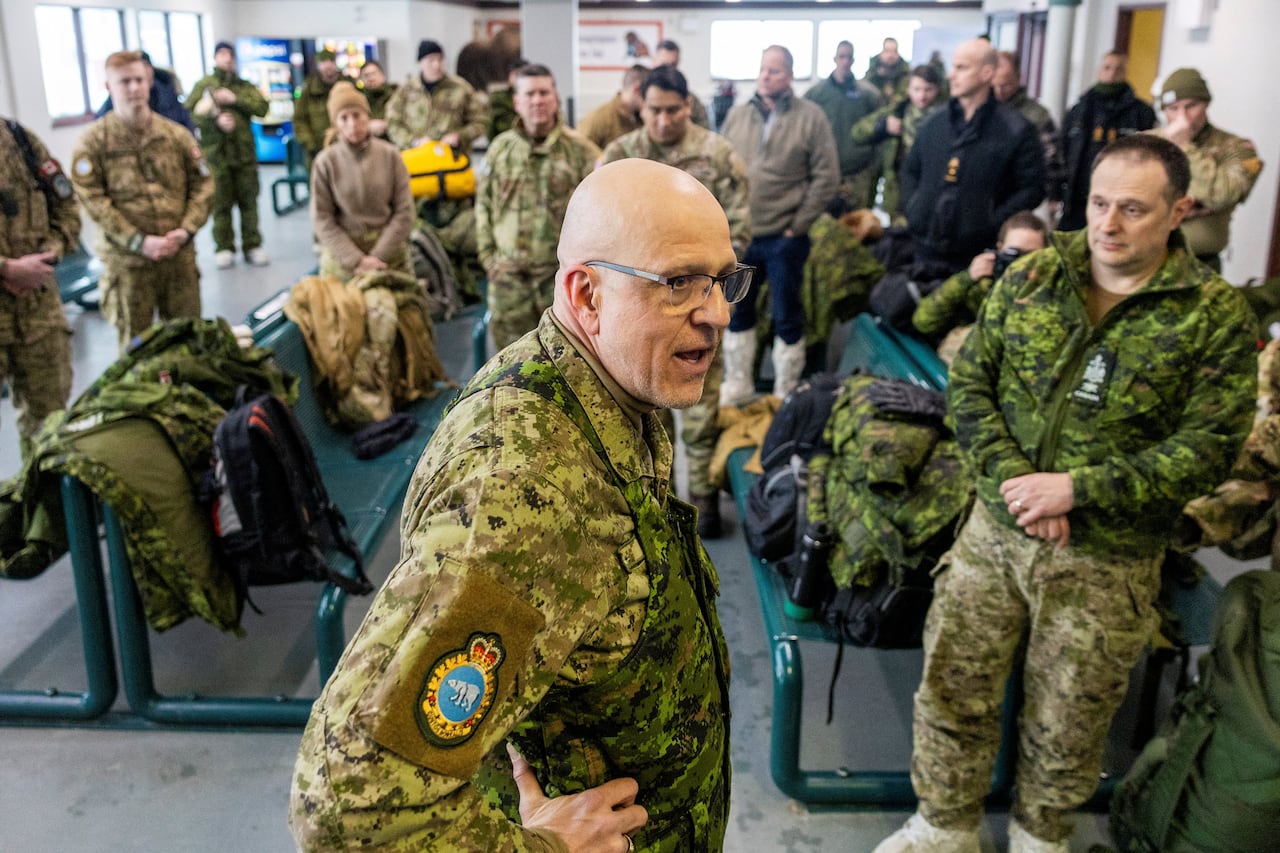 Brig.-Gen. Daniel Riviere of the Joint Task Force (North) addreses members from the Canadian Armed Forces, NATO allies and other government departments in Cambridge Bay, Nunavut, on Feb. 19. (Carlos Osorio/Reuters)
The threshold had its political origins in November 2002 as part of the Prague Capabilities Commitment (PCC), so named for the city where NATO leaders agreed to set down a budget benchmark for member states.
The administration of then U.S. president George W. Bush tried to make the target mandatory, but failed, according to a research paper written for Germany’s federal security academy in 2019.
Consequently, the two per cent target was, throughout most of its existence, more of a suggestion than an actual target. Many countries, Canada included, largely ignored it until Russia annexed Crimea in 2014.
Additionally, NATO hasn’t always tracked member nations’ defence spending as a percentage of their economies. The practice only began in 1974, according to data in the alliance archives.
At that time, Canada’s military spending compared to its economic output was at 2.7 per cent of GDP. It declined during the late 1970s as detente took hold — only to reverse in the 1980s as tensions with the former Soviet Union peaked.