
Breadcrumb Trail Links
Calls are growing for the Ontario government to slow down its plan to overhaul the province’s conservation authority system.
Published Mar 26, 2026 • Last updated 8 hours ago • 3 minute read
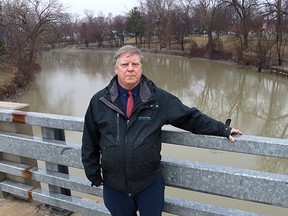 Mark Peacock, chief administrator and secretary-treasurer of the Lower Thames Valley Conservation Authority, is seen here on Chatham’s Fifth Street Bridge that spans the Thames River. Peacock has concerns the province’s plan to consolidate 36 conservation authorities into nine will impact communication with residents who work in partnership on projects. (Ellwood Shreve/Chatham Daily News)Article content
Calls are growing for the Ontario government to slow down its plan to overhaul the province’s conservation authority system.
Advertisement 2
This advertisement has not loaded yet, but your article continues below.
Article content
The plan is to consolidate Ontario’s 36 conservation authorities into nine, overseen by the newly created Ontario Provincial Conservation Agency.
Article content
Recommended Videos
Article content
Mark Peacock, CEO and secretary-treasurer of the Lower Thames Valley Conservation Authority, which manages part of the Thames River watershed, isn’t even sure how the consolidation is going to roll out.
“We’ve been told that we will be forming a transition committee to make it happen, but other than that, we really don’t know,” he said.
The province wants the consolidation done quickly by Feb. 1, 2027, he said.
“I just don’t see it happening,” Peacock said.
At Queen’s Park Wednesday, a delegation representing water professionals, municipal leaders, farmers, cottagers and environmental organizations also called on the province to tap the brakes and consult more with stakeholders.
Advertisement 3
This advertisement has not loaded yet, but your article continues below.
Article content
“If the goal is efficiency, then work with us. Identify the gaps, set standards, streamline processes and, most importantly, consult meaningfully with those who understand these systems,” said former Goulbourn Township mayor Janet Stavinga, representing the newly created Watershed Conservation Coalition.
Peacock sees the province’s consolidation plan as taking a local conservation authority and making it regional.
“That’s not what a conservation authority is all about,” he said.
The province doesn’t understand Southwestern Ontario is very different than the rest of Ontario, Peacock said. He added the Thames River, with all the diking it has, makes the area even different from nearby Essex County.
Advertisement 4
This advertisement has not loaded yet, but your article continues below.
Article content
Peacock said partnerships with local residents have been key to the work conservation authorities do to get projects done.
“We work with 250 people a year doing projects on their land,” he said.
Noting this involves talking to people one-on-one; Peacock has serious doubts about these projects happening if that local communication is not there under a large consolidated authority.
He said there is 40,500 hectares (100,000 acres) of cover crops funded by the LTVCA in the watershed to help reduce phosphorus from farm fields getting into Lake Erie. This has only happened through having one-to-one meetings with landowners, he said.
“You can’t do this as a region, you have to be local.”
Farmers worry the proposed changes to conservation authorities will “override local voices” decreasing effectiveness of services on which the agriculture industry relies, said Claire Perttula, treasurer of the National Farmers Union in Ontario.
Advertisement 5
This advertisement has not loaded yet, but your article continues below.
Article content
“Local knowledge of flood plains and infrastructure, as currently available through the 36 conservation authorities, helps prevent increasingly likely losses (caused by flooding),” Perttula said. “These sweeping changes will threaten not just the livelihoods and conservation efforts of farmers, but of all Ontarians.”
Stavinga also voiced concern Ontario may use amalgamation to sell environmentally sensitive land currently owned and protected by conservation authorities.
“Conservation authorities are Ontario’s second-largest landowner, and it is extremely disconcerting that this opens the door to the province pressuring these massive regional conservation authorities to dispose of these lands for uses that they were never intended for,” she said.
Advertisement 6
This advertisement has not loaded yet, but your article continues below.
Article content
When asked if the LTVCA owns land the province could eye for housing, Peacock said, “We don’t believe so.”
However, he added he doesn’t know what the government thinks about the more than 810 ha (2,000 acres) owned by the LTVCA.
Peacock said some of that land includes memorial forests in which trees have been planted for many years in memory of loved ones. He added a lot of the LTVCA’s property is open for people to use, such as conservation areas with trails.
Environment Minister Todd McCarthy, however, said Wednesday the province already has done plenty of consultations on the plans, and there is a “consensus for the amalgamation and the strengthening of conservation authorities.”
“Six regional workshops we were involved in, hearing from municipal leaders and conservation authority participants,” said McCarthy during question period.
“We listened and acted.”
When asked if the LTVCA is in limbo waiting for the consolidation to happen, Peacock said, “We’re doing what we always do, which is working to try to make this watershed better.”
He said the LTVCA doesn’t have any control over what the province does.
“But, what we do have control over is what we do with the community and we’re still doing it.”
Article content
Share this article in your social network