
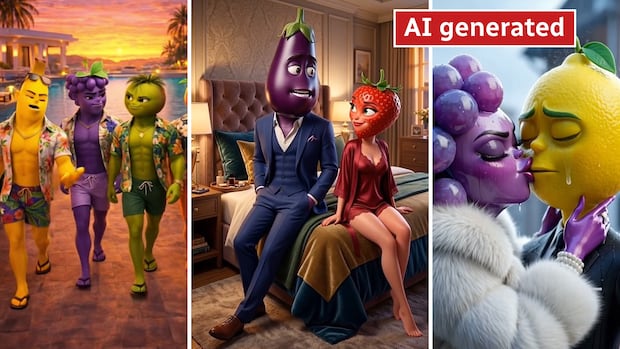
Before you make your morning smoothie, picture this: A woman with a cherry for a head tells her similarly cherry-headed husband that she’s pregnant.
Cut to the hospital delivery room. The baby is born … and it’s a zucchini.
“He looks just like your boss,” the man exclaims.
This dramatic scene, playing out in a 60-second Pixar-style animated video, ends with the husband in tears as he grapples with his wife’s infidelity.
It’s a typical example of AI “fruit slop,” a genre that’s racking up millions of views on TikTok and Instagram, generating reaction and parody videos from users hooked on the juicy storylines centred around romance and betrayal.
Think of it like soap operas for smartphones, only the stars are lustful, anthropomorphic strawberries and bananas, with names like Strawberrina and Bananito.
“I’m embarrassed I’m this invested,” one user commented on a TikTok video.
“[This shit] making me cry [for real],” another wrote.
‘Perfect formula’
Fana Yohannes says it’s the “perfect formula” for social media right now.
“It’s absurd, it’s brain rot, it is a contagious format,” said the California-based trend curator and digital strategist.
An all-fruit AI version of reality TV show Love Island by user @ai.cinema021 is the latest hit, with the account accruing 3.3 million TikTok followers. One “episode” has more than 39 million views.
As for the human mastermind behind it, well, that part is unclear. The most popular AI fruit slop videos are posted by anonymous, faceless accounts. Technically, they could be made by just about anyone.
 Trend curator and digital strategist Fana Yohannes says ‘fruit slop’ videos have found the perfect formula for social media consumption. (Shameika Ejiasi www.meikaejiasi.com)
She says the trend appears to have originated from Object Talk, a ChatGPT feature developed by AI Century that generates scripts that can then be plugged into an AI video generator.
Yohannes says she first saw this style of video late last year in the form of educational tutorials — for example, a talking drop of water travelling through a human body, explaining the importance of hydration. By late February, they had evolved into whatever … this is.
“It went from tutorials to raunchy microdramas, and those microdramas have now shifted into reality TV,” she said.
The videos often recycle storylines, changing little other than the fruits — or vegetables —involved.
But some dip into more unsettling territory, including domestic violence, sexual assault and murder. In one video, a cucumber child is picked up by a bearded banana man and taken in a boat to “Bananastein Island.”
Some are flipping the trend and making their own live-action versions. Instagram user @shlatfish_ acts them out wearing fuzzy fruit costumes, while user @lasting.lemons did a voiceover video, drawing faces on fruits with sharpies.
Even major brands have gotten in on the action. Walmart Canada posted a banana on a pile of apples in the produce section last week with the caption, “Just spotted Bananito with Applelina. Poor Strawberrina.”
‘Funny because it’s bad’
There has been plenty of backlash.
When pop star Zara Larsson posted about about fruit slop to her nine million TikTok followers last week, with the caption “Sorry I can’t hang out today, I gotta see what’s happening with choclatina and strawberto,” some fans were upset with her for, in their view, promoting generative AI. Her video appears to have been taken down.
Some users have posted their human takes on the drama, sometimes with an undercurrent of guilt for the impact on the environment that AI data centres have.
Adam Aleksic, a New York-based linguist and content creator who studies AI slop, says people shouldn’t necessarily feel bad for enjoying the pulpy drama.
In contrast to AI clips that try to trick people by seeming real, he says people watching fruit slop understand the videos’ artificial quality and campiness.
“It’s funny because it’s bad,” he said.
“Yes, there is an innate, like, drama to it that does captivate people, but we are all aware on the meta level that this is just shitty content, and that extra added awareness is part of how you look at these videos.”
WATCH | Microdramas becoming big business:
Got sucked into a vertical microdrama? You are not alone
Microdramas — outlandish stories served up in one- to two-minute chunks in a vertical aspect ratio — are delivering melodramatic content straight to peoples’ social feeds, and they’re proving to be big business.
Aleksic says people have been “watching slop forever,” from pulp magazines to soap operas to reality TV, and that people are drawn to classic storylines of love and cheating even when the “human element” is removed.
He says it’s important to place fruit slop in context with its predecessors, like “orange cat” videos that follow the absurd adventures of domestic AI cats, or the “Italian brainrot” trend that featured characters like Ballerina Cappuccina, who had a full coffee cup for a head.
‘They just need your attention’
But there is a dark side to the slop, Aleksic says.
He says AI slop creators he’s talked to tend to focus solely on finding the right formulas to go viral, even if that veers into rage bait — which can be especially problematic when the creators are anonymous.
“They’re trying to do something quickly that gets views. They don’t have a strong moral code,” he said.
Noting homophobic content in one of the fruit Love Island episodes, he says these AI trends tend to degrade before they disappear, as creators try to hang on by making increasingly extreme and offensive content to keep the paycheques coming.
Anatoliy Gruzd, a professor and co-director of Toronto Metropolitan University’s Social Media Lab, worries that AI slop trends are also “polluting” people’s social media feeds, leaving less space for content that might be educational or otherwise useful.
But, he notes, even the haters are driving engagement for the slop purveyors.
“They need for you to hit that ‘like’ button, for you to comment on it, to either try to discredit or try to say how cool it is,” he said, of the creators of fruit slop.
“It doesn’t matter. They just need your attention.”