
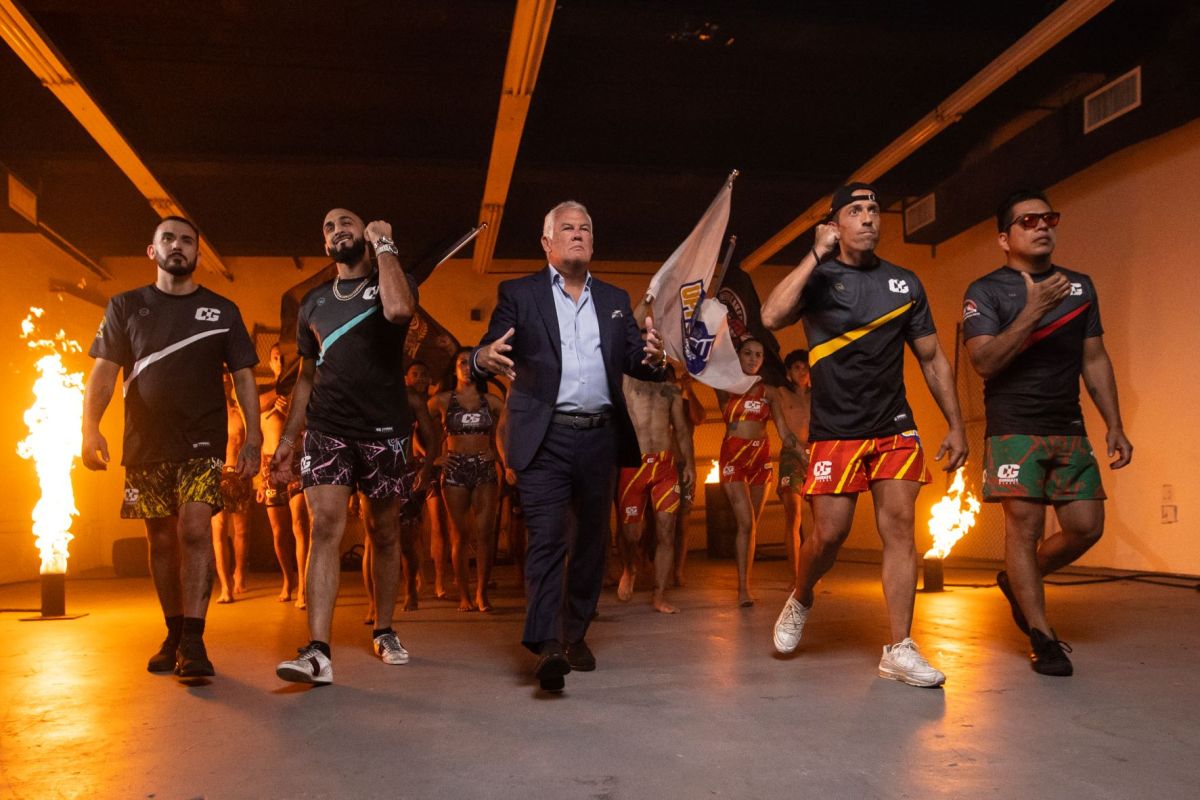
The world of mixed martial arts would not be in the place that it currently is without the efforts of Campbell McLaren, who helped put forth the plan to create a Mortal Kombat-style combat spectacle on television. That spectacle became known as the UFC (Ultimate Fighting Championship) and is now one of the biggest sports entities on the planet.
Though UFC President Dana White is essentially a household name now, McLaren was the brainchild behind bringing in the ultra-violent sport to a national audience, which cascaded into a now-global juggernaut of sports entertainment. Through the UFC, McLaren’s ideas didn’t stop because he had a simple question that he asked of March Ratner, the Vice President of Regulatory Affairs with the Ultimate Fighting Championship:
“How many Mexican fighters do you have?”
Ratner told McLaren that the UFC had only five Mexican fighters, which clearly did not make sense to the entrepreneur, who understood that there are well over 100 million people in Mexico alone, and there has been a longstanding tradition of strong boxers and fighters from the Hispanic heritage. When taking into account legendary boxers like Julio César Chávez, Sr., Oscar De La Hoya, and Canelo Alvarez, it’s easy to understand why McLaren saw a steep discrepancy.
Through the idea of capitalizing on showcasing talent from a multitude of Hispanic countries, McLaren devised a way to bring together Mexico, Puerto Rico, Brazil, and many more.
“I am on to something here,” McLaren said “You’ve got a group of folks that have the most proud boxing tradition, right? And Puerto Rico too, but that’s such a great matchup, Puerto Rico, Mexico. So you have this, this tremendous fighting spirit, a tremendous connection to combat sports.”
Even more interesting is that McLaren revealed that the Korean government had sent senseis to Mexico in the 70s, fostering the teaching of Taekwondo and Jiu Jitsu, which created the thirst to have MMA.
“The Korean government sent their top senseis to Mexico to train for Taekwondo in the 70s. So you got boxing, Taekwondo, and some Jiu-Jitsu. And I go, Where do the Mexican fighters go? If they’re not in the UFC, where do they go?”
McLaren teamed up with White and Lorenzo Fertitta to begin the first event for Combate, which he coined as Combate Americas, and eventually took the company to South America, Lima, Peru, and Mexico, and featured a country versus country style, similar in nature to the World Cup.
With a “soccer style” way of bringing in a deeper sense of national and country pride, Combate Global has continued to rise. McLaren saw the proverbial writing on the wall and struck a deal with Univision to broadcast events live to the growing Spanish-speaking crowds that answered in kind with thousands of viewers.
In a release posted to Combate Global in August of 2001, the Nielsen Ratings revealed the MMA organization was doing massive numbers for a lesser-known fight promotion.
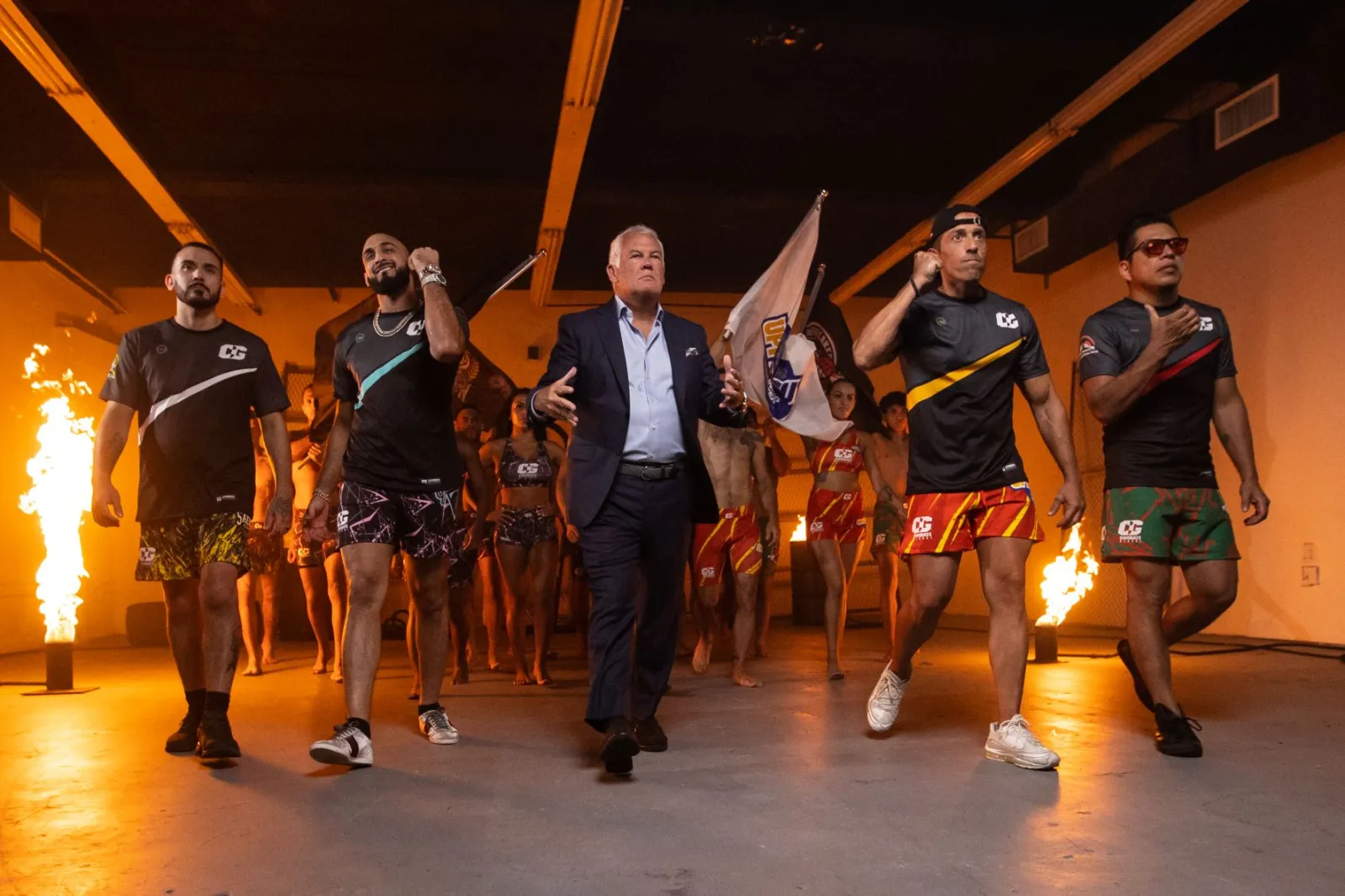
“In a midnight ET/9 p.m. PT time slot on August 1, Combate Global’s tentpole event averaged 946,000 P2+ viewers on Univision, including 464,000 viewers in the coveted A1849 demographic,” the release states.
McLaren also struck a partnership with Samsung TV and found a way to tap into the younger crowds that favor the digital space, as Combate Global has a strong viewership on YouTube as well.
“We’re also on Samsung TV, English and Spanish, 24-hour channels. Our first show was two weeks ago, and we had 560,000 people watching across all our platforms. That’s a real number.”
McLaren chose to make the bold move to shift Combate Global from the East Coast to the West Coast, where the live events are held and streamed to a massive audience at a studio in Burbank, California. There, the CEO allowed me to see the production, the crowd, and experience what he describes as “flavor and style.”
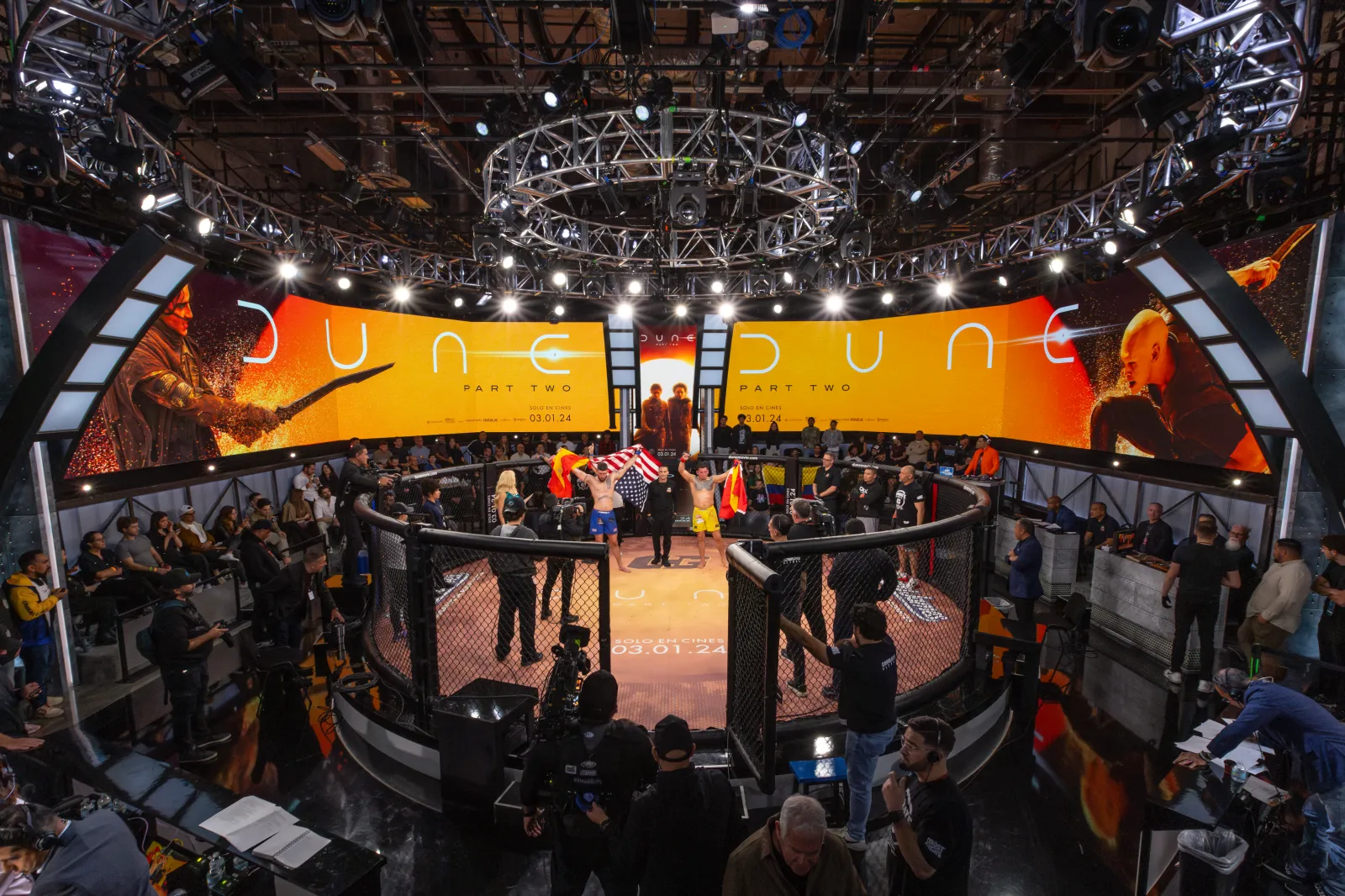
The studio was created in a similar nature as The Apex that the UFC has in Las Vegas, Nevada, and holds about 200 to 300 seats for fans, families of fighters, and more to watch. McLaren also indicated to me that the area can be expanded should the need for more seats arise.
Despite limited seating at first glance, McLaren indicated that the arena actually holds over 500,000 patrons.
“Our arena holds 560,000 people, because we are doing this for the viewer. Right now, tonight, you’ll see 200-300 people. And as we grow, we have the ability to turn this into a 1000 seater like the UFC Apex, right? So, have you been to the Apex? Okay, you see this black table. This is what the Apex looks like. It’s like all black, and the octagon is lit. That’s it. But we have sabor. We have mass sabor look. We got flavor, yeah, we got style, right? So that’s a very important part of this.”
The arena itself has already been coined “El Sphero,” which McLaren found to be quite ideal.

The Combate Copa trophy sits at the top where the fighters make their entrances, seemingly so they can take a look at what their hard work can lead to. The entrances of every fighter are similar to those of WWE and the UFC, with one major distinction: the fighter’s country is proudly displayed next to their name
Each fighter also dons their country’s colors and flags on their fight gear, contributing to the sense of national pride.
“I think there’s a lot of new fans who have been brought into this sport by Combate, and they’re unaware of all the different changes in the sport over the past 33 years, right? They don’t care. They just want to see mucho más acción, right? They just want to see fun fights. They just want to see good-looking, aggressive young fighters representing countries fighting for pride, right? Because their abuela is at home watching, right? They’re fighting for their country.”
That chants of national pride echoed through El Sphero, as fighters from the United States were greeted with chants of “USA,” while Mexican fighters heard their fans and family members screaming “Vamos Mexico” as they made their walk to the octagon. Those chants reverberated throughout each round, making it a bit hard to hear the corner coaches guiding their fighters in the small space.
What McLaren has built and the understanding of capitalizing on culture, pride, and a need to put on great fights for the Hispanic community was deeply seen and felt.
Understanding how to build an organization is one thing, but to go toe-to-toe with the UFC is not something that McLaren wanted to do, even though he created the organization. Trying to understand how the viewership has blown up, the Combate Global creator explained that doing something different is the simplest and most effective way not to fall into the pitfalls of the other MMA organizations that have trailed and failed to go against the UFC.
“If you’re not different, you really don’t have a chance, right? You’re not going to beat the NFL. You’re not going to beat the UFC. You have to do something different … We focused on digital reach and viewership rather than live event sales. What we found before we moved into a studio. We were selling 5000 and 6000 tickets when we were on the road. Not a bad number, yeah, but that’s a break-even number. So you’ve got to sell 6000 tickets to break even if you’re doing a real show. So that’s a business we don’t want to be in.”
Separating Combate Global to capitalize on the digital space was one thing, but McLaren also found that while most sponsors and promoters may not like or want to work with a violent sport like MMA, there are those who find a lot of value in the younger audience that the organization brings.
“There are brands and advertisers and sponsors that don’t like MMA, right? And you know, Coca-Cola is one. American Airlines is one, Toyota is one. They’re not advertising on MMA, so you’re not getting past that, but there are a number of sponsors in that understand the power of this demographic … there have been sponsors that came to us and said, ‘You’ve got a really different audience. You got a great audience. It’s young.’ Some of our shows are 50% female, so it’s not all male. So I think the sponsors that understand the power of the Hispanic consumer get this as long as they’re not anti-MMA, yeah, right. But like AutoZone, huge, we’ve also done a lot with the movie business. When Dune came out, we turned our studio into our Arrakis.”
Those sponsors’ understanding of the youth of the Combate Global audience makes sense, as the YouTube channel shows a great deal of retention in an age when TikTok videos run rampant, and having more than five minutes of watch time is a miracle. For McLaren, he found a sweeping way to bring in the Gen-Z audience who remain on social media to watch the fights when seemingly no other MMA organization has done so in the same manner.
“Yes, we have the young … I can show you, Nielsen. I can show you the research. We have the youngest audience in MMA, but here’s what I think is interesting. Everyone goes Gen-Z or the alphas or whatever’s next, right? No attention span. But on YouTube, our average watch time is 24 minutes … I think if you watch our show, you get the vibe, you get the flavor, you hear the music, you see this, but we go, boom, boom, boom, boom, boom. We don’t f*** around. It’s like action action action action wrapped in this great wrapper, right? And that’s how I think you have to do it.”
When asked what the next evolution of Combate Global is, McLaren says he wants to dominate the MMA space for the Hispanic countries, similar to moving pieces strategically in an area on the world domination board game of Risk.
“We’re good in the US and Mexico. Our ratings are good. We started as Combate Americas, and that ‘S’ confused every non-Spanish person; they were like, ‘There’s only one America. There’s just one America.’ You go, ‘No, there’s North America, South America, Latin America. There’s, like, a lot of Americas.’ I think we’ve done great viewership in Chile. We’re starting to do good in Colombia and Argentina. I want the whole hemisphere. I want to lock on that, and I want us to be the organization, not that eclipses the UFC because I don’t think that will happen, but I want to be thought of as a place for Spanish fans and Spanish-speaking athletes. You know, did you ever play Risk? Yes, all right, that’s what I want. All my pieces in North America and South America, so nobody else can come in.”
Dominating the Hispanic countries isn’t all that McLaren has planned. Creating a space for a younger and digital-based audience has been achieved, but McLaren is taking that aspect a step further as he also partnered with one of the largest Hispanic comedy platforms in Foos Gone Wild, which will present the Foos Fighting Championship in April. This partnership will give amateur fighters a chance to potentially be signed by Combate Global.
“Mr. E sent me a screen grab from three years ago when I reached out to him on Instagram, and when I finally got together with him. He has a great sense of humor. He represents the community. What I suggested to him is that we create an amateur division, Foos Fighting Championships. And you may remember the old Tough Man series, right? Tough Man is an organization in Las Vegas called Tough Enough, and it’s a feeder system. Potentially, it’s a chance for tough guys to step up. Maybe they beat up everybody on the block. Now they’re gonna get a chance. So it’s amateur fighters. We will match them. It will be under the California State Athletic League, the amateur division, and those that show promise, we’re gonna sign to Combate.”
When all is said and done, McLaren has one goal in mind for what audiences will say about Combate Global 10 years from now.
“It’s the most fun, entertaining MMA organization on the planet.”
For more MMA news, head to Newsweek Sports.