

Listen to this article
Estimated 5 minutes
The audio version of this article is generated by AI-based technology. Mispronunciations can occur. We are working with our partners to continually review and improve the results.
An advocacy group for people with disabilities is challenging Elections Canada’s changes to the ballot in the upcoming byelection in Terrebonne, Que.
Regroupement des activistes pour l’inclusion au Québec (RAPLIQ) says the decision to use ballots that require the voter to write in the candidate’s name themselves constitutes a violation of the fundamental principle of universal accessibility.
“While this measure may address certain administrative constraints, it nonetheless results in concrete and worrying consequences for many citizens, particularly people with disabilities,” wrote general manager Steven Laperrière in a letter to Elections Canada.
In an interview with CBC, he said voting should be as easy as possible. But write-in ballots create a barrier to people with disabilities, including mobility, vision or literacy struggles.
The byelection is planned for April 13 and has 48 candidates.
It comes after a mail-in gaffe during last year’s federal election led to that riding’s results — the Liberals winning by a single vote — being nullified by the Supreme Court of Canada.
The Longest Ballot Committee, an electoral reform advocacy group, has flooded Terrebonne with dozens of candidates. In the past, Elections Canada has printed ballots that were nearly a metre long — confounding voters and causing counting delays.
Earlier this month, the head of Elections Canada said voters will have to write in their pick in next month’s byelection in the off-island Montreal suburb due to the long list of protest candidates.
Chief Electoral Officer Stéphane Perrault told a committee of MPs on Tuesday that the write-in option worked well the last time candidates associated with the group known as the Longest Ballot Committee flooded a riding with dozens of candidates.
“We had very few complaints about the use of that ballot, so we felt this was a better experience for the voters in general,” Perrault told the committee.
This week, the federal government proposed major changes to the Canada Elections Act with Bill C-25, which would, among other things, make efforts to organize long ballots harder.
WATCH | Why some say write-in ballots are a bad idea: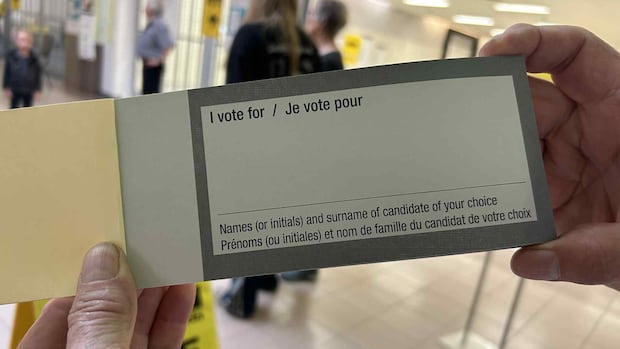
Byelection in Terrebonne, Que., will use write-in ballots. Some say it’s a bad idea
Nearly 50 candidates are running in the upcoming federal byelection in Terrebonne, Que. Elections Canada says it’s found a solution to avoid lengthy ballots at the polls, but one disability advocacy group says the move hurts accessibility.‘You should not need help to go and vote’
In the Terrebonne byelection, every vote counts considering the riding was decided by the slimmest of margins during last year’s federal election, and the result could help the Liberals secure a majority at the House of Commons.
Liberal candidate Tatiana Auguste will again be facing off against the Bloc Québécois’s Nathalie Sinclair-Desgagné and more than 45 other candidates.
But just looking at those two top names, Laperrière said they aren’t easy to spell for anybody, let alone those who have certain disabilities.
Returning to traditional ballots is really the only solution aside from mail-in voting which, he said, didn’t go so well the last time. Plus, he added, it takes away from the experience.
“A mail-in ballot is never the same as going to the polling station and voting yourself,” Laperrière said, and even if Elections Canada has people on site to help, “it should not be that way. You should not need help to go and vote. You should be able to go and vote yourself, without anyone.”
Voting with a stranger’s assistance is not what people want, he said.
Byelections are also being held in the Toronto ridings of University-Rosedale and Scarborough Southwest.
Write-in ballots the best option, Elections Canada says
In a statement, Elections Canada told CBC News they “take the concerns raised by RAPLIQ seriously.”
“When deciding on how to proceed with the ballot in Terrebonne, these and other accessibility concerns were carefully considered.”
The decision to use the adapted blank ballot, which will be used in the Terrebonne byelection, was made after reviewing recent past elections in other ridings with a “higher-than-usual number of candidates over the past two years,” Elections Canada spokesperson Matthew McKenna explained in an email.
That review included a survey of voters who used this ballot, as well as consultation with the Advisory Group for Disability Issues.
“After analyzing the feedback we have gathered … and carefully considering the kinds of concerns that RAPLIQ raises, we determined that the adapted ballot posed fewer accessibility issues, overall,” McKenna wrote.
For voters who may still have difficulty filling in their ballot papers, there will be measures put in place to assist them – such as additional training for poll workers, a printed list of candidates at each voting table, and the ability to be accompanied by someone who can help the individual vote.