
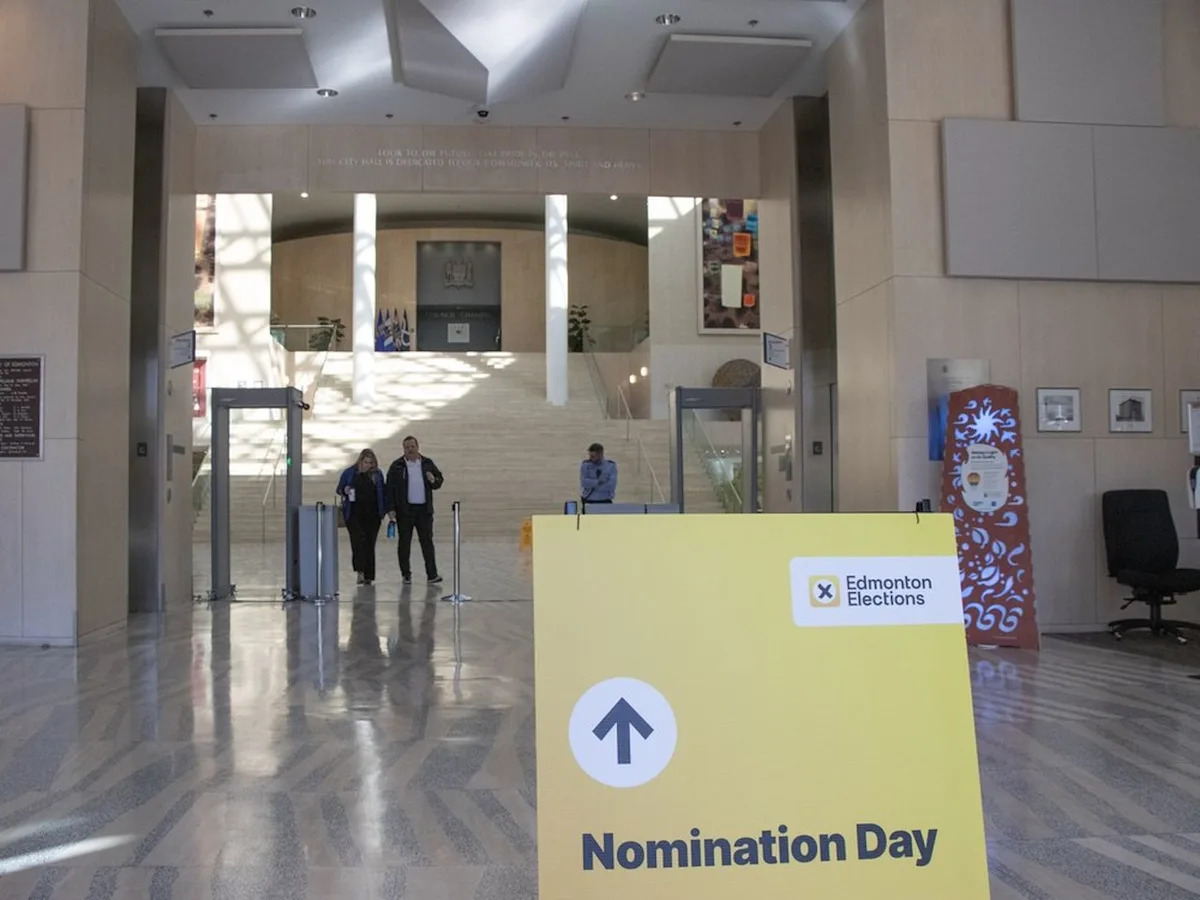
How much does it cost to win a vote in a municipal election?
In Edmonton’s 2025 mayoral race, that question can be answered — at least in part — by combining official vote totals with finance disclosures filed with the City of Edmonton. The result is a simple but revealing metric — dollars spent per vote.
The calculation itself is straightforward. Each candidate is required to report total expenses in their disclosure filings. Dividing that number by the total votes they received produces a cost-per-vote figure, allowing for a direct comparison between campaigns of very different sizes.
The results show a wide gap between the four leading candidates and underline that spending more money does not necessarily translate into more efficient results at the ballot box.
Based on official results, Andrew Knack led the race with 78,519 votes, followed by Tim Cartmell at 61,668. Michael Walters received 24, 596 votes, while Omar Mohammad finished with 20,505.
Using final reported expenses, Cartmell ran the most expensive drive by a wide margin, spending $812,472 in 2025. That works out to roughly $13 per vote, the highest in the field. Despite that level of spending, he finished second.
Outside that base 2025 number, Cartmell also conducted significant fundraising both personally and through his political organization, Better Edmonton. Across 2024 and 2025, he raised approximately $1.07 million and spent $948.472. In 2024 alone, he spent $136,000, leaving a $322,000 surplus that carried into the 2025 campaign period.
In addition, Better Edmonton raised $370,700 — including $231,700 in donations and $139,000 from fundraising events — and spent $530,000, including $106,500 in “unpaid” expenses. Taken together, Cartmell and his party accounted for roughly $1.48 million in expenditures, which increases the combined cost per vote to approximately $22.
Knack, who received the most votes, spent $240,770 — or about $3 per vote, making his campaign by far the most cost-efficient among the leading candidates.
Walters spent $346,166, translating to roughly $14 per vote, slightly higher than Cartmell’s 2025 amount, on a per-vote basis, despite operating at a smaller overall scale.
Mohammad, meanwhile, reported $199,000 in expenses, or about $10 per vote, placing him between the high-spending campaigns and the race’s most efficient operation.
The cost of a vote
Higher spending often ends with a higher cost per vote. That’s partly because early spending tends to go toward broad voter awareness — signage, advertising, and outreach that reaches large numbers of people relatively efficiently. But as spending increases, operations move into more targeted and persuasive efforts, where each additional vote is harder and more expensive to secure. The result is diminishing returns.
The gap between Knack and the rest of the field is particularly striking. He spent less than one-third of Cartmell’s total, yet produced more votes at a fraction of the cost per voter. By contrast, both Cartmell and Walters appear less efficient on this metric, with higher spending translating into comparatively fewer votes per dollar.
At the same time, cost per vote has clear limits as a measure of performance. Lower spending can appear highly efficient simply because they operate on a smaller scale, relying on targeted outreach or existing networks rather than city-wide advertising. That efficiency does not necessarily mean they were more competitive overall.
There are also structural factors specific to the 2025 election. Edmonton’s first campaign cycle with more organized slates means some political activity — including volunteer co-ordination or aligned messaging — may not be fully captured in a candidate’s official expenses. Candidates are also allowed to contribute to their own efforts, which can inflate spending totals without directly affecting vote counts.
Even with those caveats, the comparison offers a clear takeaway — money matters in municipal elections, but it does not translate neatly into votes. Campaigns can spend heavily and still pay a high price for each vote, while others achieve broader support with far fewer resources.
As Stephen Carter, president, Decide Campaigns and host of The Strategists Podcast argues, limited funding in municipal elections makes it difficult to generate voter interest, leaving campaigns to focus first on simply getting people to participate — an effort that often falls short and contributes to low turnout.
“There is not nearly enough money in municipal politics to engender an interest in the outcome and to promote voter turnout,” he said. “With the limited funds available, the first job of any campaign is to get people to care enough to actually vote, a task that was not effectively completed. Instead, primarily due to a lack of funds from all campaigns, voter turnout remains low.”
He contends that the Cartmell campaign stood out by prioritizing voter engagement early and building a strong team to promote participation, and that evaluating by a “cost per vote” misses the more important goal of increasing overall voter participation.
“When you look at the work that the Cartmell campaign did with spending, we were the campaign that actually worked to drive turnout,” adds Carter, who worked with the Better Edmonton party during the campaign.
In Edmonton’s 2025 mayoral race, the cost of a vote ranged from roughly $3 to $14 — a reminder that how candidates spend can matter as much as how much they spend. According to official City of Edmonton results, voter turnout in the 2025 municipal election was approximately 30.4 per cent of eligible voters with 206,799 ballots cast.
This range also highlights how municipal elections operate differently from larger provincial contests. Smaller electorates and more localized campaigns mean that factors such as volunteer support, community connections, and targeted outreach can play a significant role alongside financial resources. While dollars per vote provides a clear way to compare campaigns, it is just one lens for understanding campaign dynamics, offering insight into the scale of spending required to reach voters without assigning a value judgment on overall campaign success.
Related
Bookmark our website and support our journalism: Don’t miss the news you need to know — add EdmontonJournal.com and EdmontonSun.com to your bookmarks and sign up for our newsletters here.
You can also support our journalism by becoming a digital subscriber. Subscribers gain unlimited access to The Edmonton Journal, Edmonton Sun, National Post and 13 other Canadian news sites. Support us by subscribing today: The Edmonton Journal | The Edmonton Sun.