
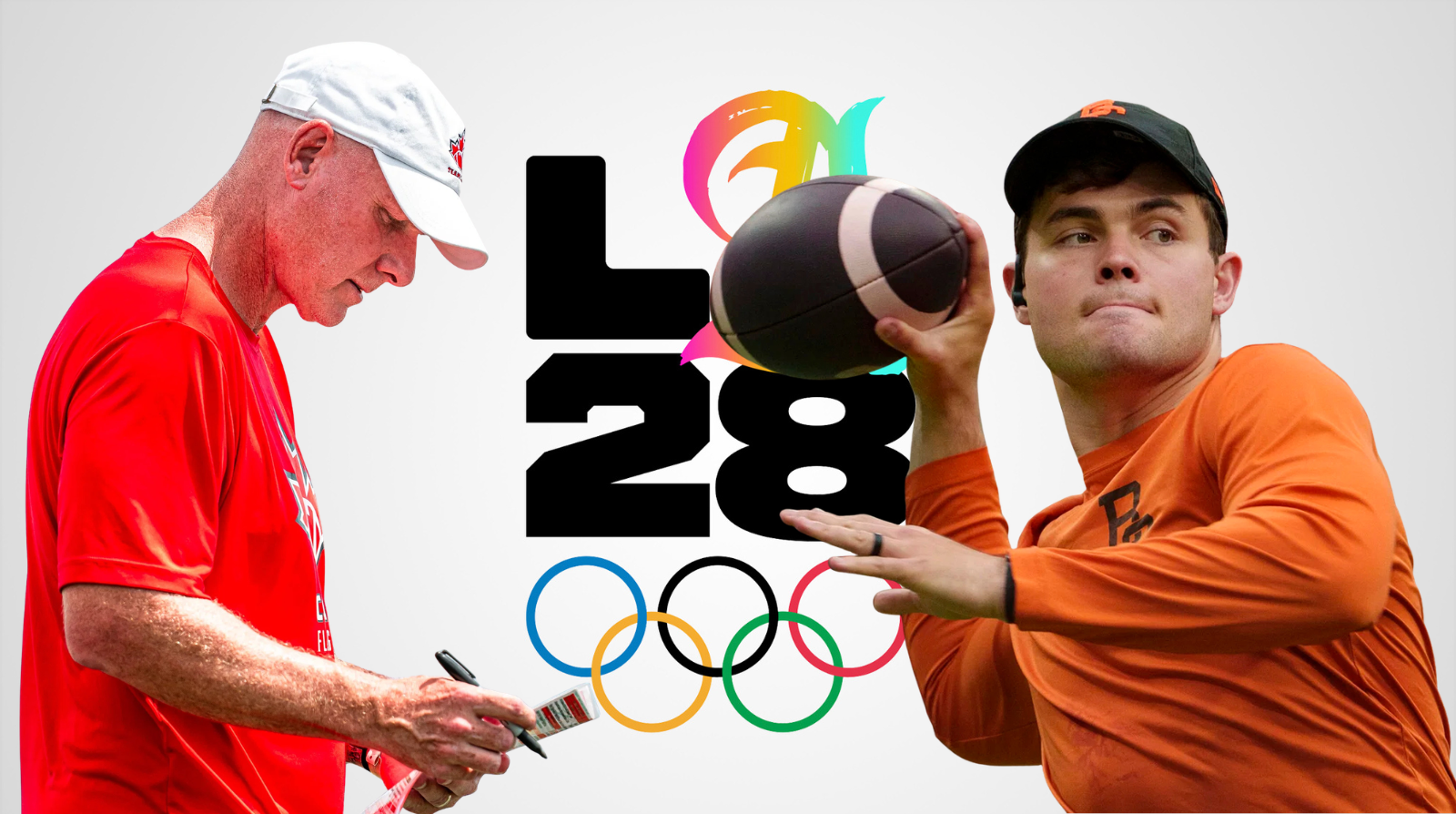
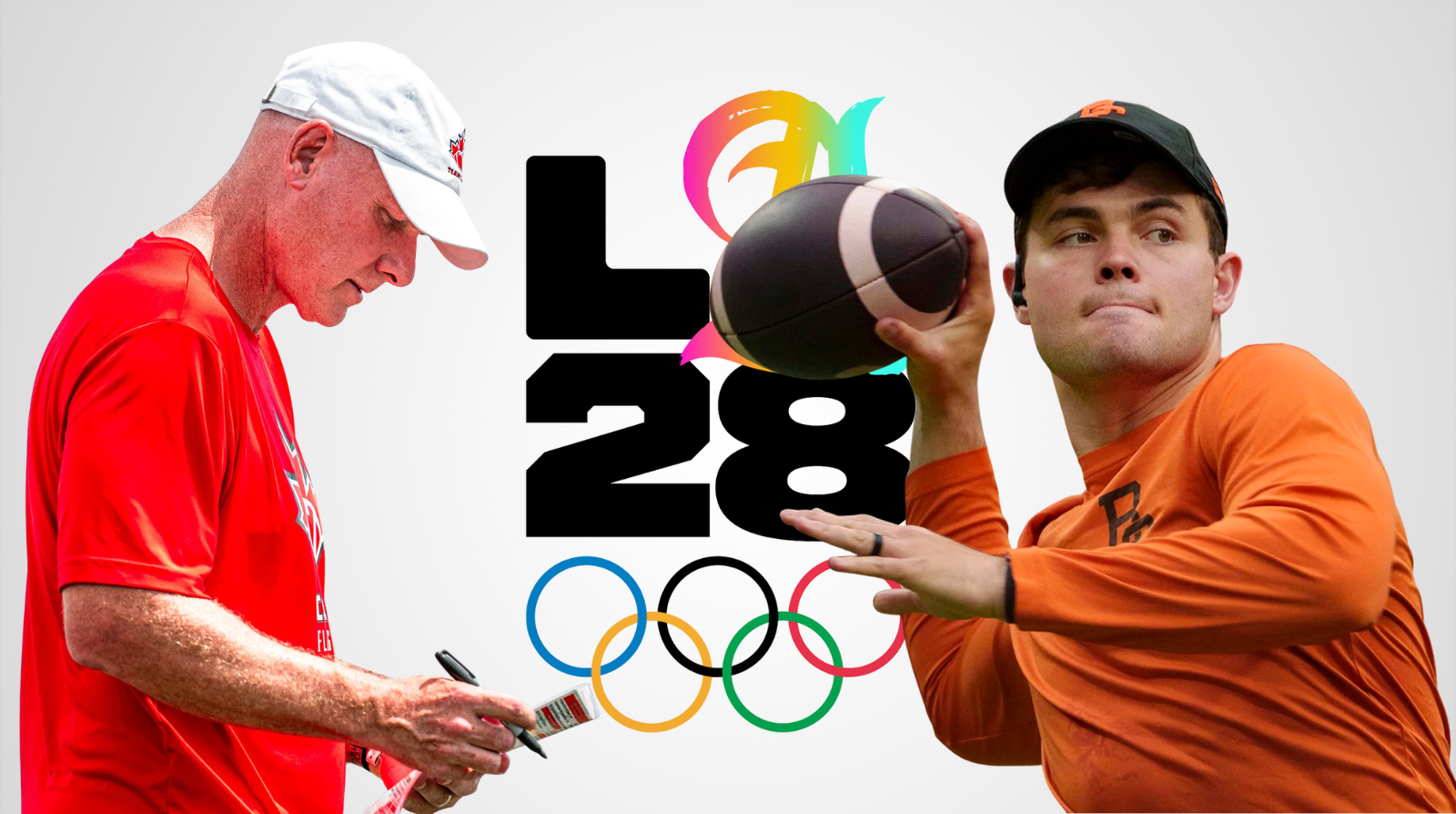
 Graphic: 3DownNation (Photos: Matt Johnson/Football Canada | Jeff Vinnick/B.C. Lions)
CFL players have been granted permission to participate in the 2028 Summer Olympics, but it remains to be seen how many — if any — will crack Team Canada’s flag football roster.
“The competition is tight. We’re not handing any jobs to CFL football players or NFL football players. Those players would absolutely have to earn their responsibilities,” men’s head coach Paul LaPolice told the media via videoconference on Wednesday.
“I don’t care if you’re on our roster right now, or in the Canadian Football League or in the NFL, the spots are tight. There’s not going to be as many opportunities as people think.”
Flag football will make its Olympic debut in Los Angeles in 2028 with a six-team tournament playing five-on-five. Rosters will be capped at 10 active players per team with two alternates, meaning just 12 players will be invited to rep the Maple Leaf if Canada successfully qualifies.
That roster will need to include a defensive rusher, four defensive backs, a quarterback, and four receivers. At least one of those pass catchers will need to be able to snap the ball, while another will ideally have the ability to throw it as well. With as many as 40 players from across the NFL, CFL, and the current flag football landscape expected to be invited to Team Canada’s eventual selection camp, it will be an uphill climb for anyone to make the cut.
“There are going to be some outstanding, amazing Canadian Football League players that may not fit what we need to do offensively or defensively,” LaPolice acknowledged.
“There are also a lot of talented players, CFL-wise, that may suit our game that may not suit the NFL game. You may have some guys who are fast twitch, but are small, which the NFL may not touch, but might be perfect for the flag world.”
One CFL player who would appear to have a leg up on making the Olympic team is quarterback Nathan Rourke. The league’s reigning Most Outstanding Player and Most Outstanding Canadian has been vocal about his interest in representing the country and has already received permission from the B.C. Lions to pursue that goal, despite the fact that the Olympic tournament could cause him to miss CFL games.
“Obviously, it’s pretty early to tell, but out of all the Canadian quarterbacks we’re going to look at, he’s certainly been the most successful to this point,” LaPolice said.
“He’s going to have to compete like anybody else, but certainly he’ll be in the top tier of guys, because he’s been one of the most successful Canadian quarterbacks we’ve had.”
Rourke is already going the extra mile. He made headlines last week when he signed up to play in an adult recreational flag football league in B.C. in order to familiarize himself with the nuances of the game.
LaPolice praised the 27-year-old for taking that initiative and said that anyone hoping to make Team Canada will have to show a similar commitment to the flag discipline. Interested players will be provided with a specialized training program and will need to properly balance it with their CFL or NFL responsibilities.
“(Rourke) wants to have an understanding of what it looks like, so there’s an eagerness to learn. That’s a pretty amazing thing for a professional to do,” the coach shared.
“The biggest thing I want on my end is that it has to be an all-in thing. I’ll use my contacts with the CFL, and also use my experience to make sure I protect their ability to earn a living. But they’ve got to be committed. If you’ve got to represent Canada at the highest level at the Olympics, you better be committed to doing your best.”
Despite Rourke’s accolades and investment, even he will face considerable competition. Other quarterbacks who could vie for the position include his brother, Kurtis, currently of the San Francisco 49ers, as well as Hec Crighton Trophy winner Taylor Elgersma.
“There’s about five or six guys we’ll target from the quarterback position and get experience. And Tre Ford could be somebody in a role that the United States plays, which is what’s called the 2Q — a guy who can play quarterback as well as receiver,” LaPolice explained. “Our process through that is just making sure they kind of fit the game well, because mobility is not the most important thing for the starting quarterback, but if you can move as the starting quarterback, it gives you plenty of options.”
Also in the mix will be Rourke’s former backup, Michael O’Connor, who currently serves as Canada’s starting quarterback. The UBC product led the team to a bronze medal at the 2025 IFAF Americas Continental Championship in Panama in September, where he established himself as one of the world’s best.
While popular perception continues to be that the team’s current roster of flag-only athletes is merely a tool for getting to the Olympics, at which point they’ll be swapped out for NFL and CFL players, the reality is more complex. Team USA’s flag football squad recently embarrassed a laundry list of current and former NFL stars in a televised showcase event, proving just how different the non-contact version of the sport is.
When it comes to assembling a team that can compete for Olympic gold, professional resumes will not be the most important factor.
“The players declare who plays. Coaches don’t care where this guy played,” LaPolice said. “We’ve had guys who came from the CFL who tried out for our team in the last couple of months, and they couldn’t play at the level that they could earn a spot. It really doesn’t matter where they come from. They’ve just got to be ready to compete.”
Canada will compete at the 2026 World Championships in Düsseldorf, Germany, this August, where two of the five remaining Olympic qualifying spots will be up for grabs. Should they fail to secure a berth, LaPolice and company will have to go the long way through the 2027 IFAF Americas Continental Championship and Olympic Qualifier Series before they even get a chance to consider adding CFL players to their team.