
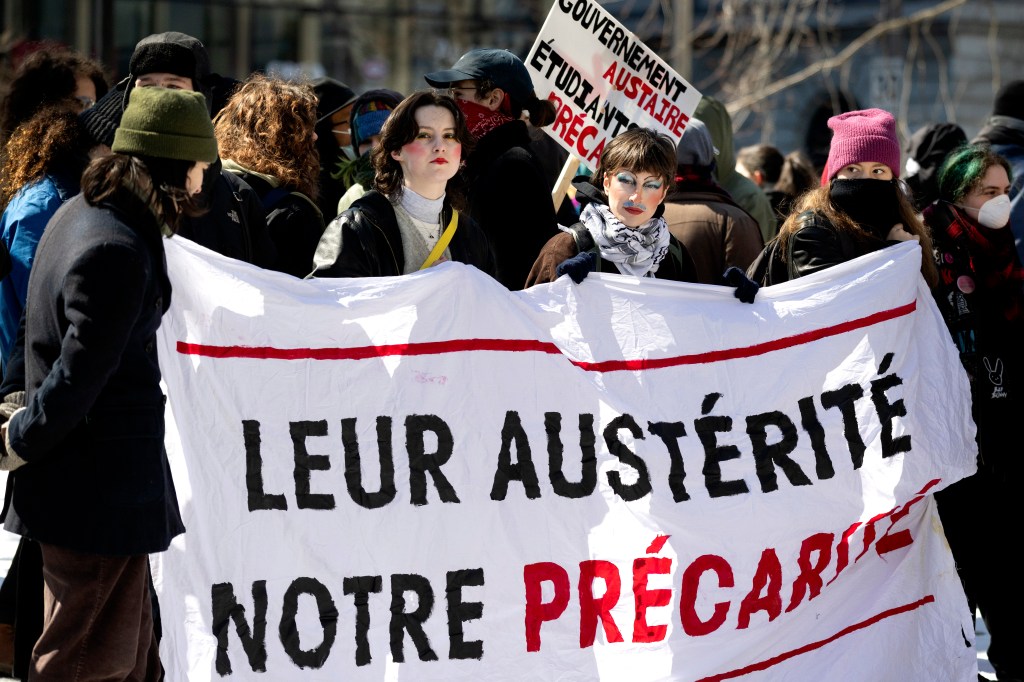
More than 1,000 striking post-secondary students flooded downtown Montreal on Friday, marching in protest after the Quebec government slashed financial aid and demanding it boost funding for their CEGEPs and universities.
The demonstration was part of a weeklong strike involving more than 65,000 students across Quebec, organized by the student union Coalition de résistance pour l’unité étudiante syndicale (CRUES). Protesters are pushing the provincial government to restore student financial aid, which was cut by $25 million in Quebec’s 2026-2027 budget.
“It’s going to become increasingly inaccessible. Only the most privileged people will have access to education. Is that really what the government wants?” said Elki Mercier, a spokesperson for CRUES.
 Students are joined by other groups in a protest rally in downtown Montreal on Friday, March 27, 2026. Dave Sidaway / Montreal Gazette
It’s the latest blow to Quebec’s higher education system under the Legault government, which has also introduced a cap on international students and a 33-per-cent tuition hike for out-of-province students, both of which have contributed to a drop in enrolment.
Mercier, who is in her first year at l’Université du Québec à Montréal, is relying on loans to pursue her studies.
“Often, that’s not enough to feed myself — and for many (students), it often means having to choose between housing and food,” she said.
The protesters gathered at Dorchester Square around 1 p.m. Friday before marching east along René-Lévesque Blvd. and then turning onto Robert-Bourassa Blvd.
Many pinned red felt squares to their jackets and bags, which protester Nour El-Hage from Cégep de Saint-Laurent said was “inspired” by the red square symbol used in the 2012 Maple Spring student strikes.
“I think it’s a colour that in the history of Quebec student movements has a lot of meaning,” El-Hage said.
Teachers from Dawson College stood alongside the students, warning the social costs of these cuts “are going to be greater than any savings they could possibly justify.”
“The budget cuts have decimated a large part of our school. We’ve lost employees. We’ve lost jobs. We have trouble keeping our staff,” said Emilie Richer, who teaches in the mathematics department.
Dawson teacher Antonia Fikkert said education is an investment for the future of the province and worries about the long-term impacts of the cuts on both her students and her own children.
“We’re really, really worried about the ability of our population in the future to think critically about the government, to live in a society that’s diverse, multicultural. To be smart and critical about AI, about all of these challenges around the world,” she said. “The government is completely emaciating our ability to do that.”
The Gazette reached out to the Ministry of Higher Education for comment, but did not get a reply in time for publication.