

Experts published a lifelike face reconstruction of a Mycenaean-era royal woman who lived 3,500 years ago in the same area as Homer’s heroes. Credit: Juanjo Ortega G. / AVIF, open-source royalty free
A fascinating lifelike face reconstruction of a young Mycenaean-era royal woman who lived over 3,500 years ago was recently published by digital artist Juanjo Ortega G., commissioned by historian Emily Hauser.
The mysterious woman’s burial was uncovered in the 1950s at the site of a royal cemetery in the ruins of the ancient Greek metropolis of Mycenae, the legendary seat of King Agamemnon.
However, the woman, who appears to have died in her mid-thirties, lived several centuries even before the reign of Agamemnon and the Trojan War, the events of which were described in Homer’s epics.
“For the first time, we are looking into the face of a woman from a kingdom associated with Helen of Troy,” Hauser, who is a Senior Lecturer in Classics at the University of Exeter, told The Observer few days ahead of the launch of her book Mythica: A New History of Homer’s World, Through the Women Written Out of It.
“We can – for the first time – peer back into the eyes of the past,” she stressed.
Royal woman of late Bronze Age Mycenae
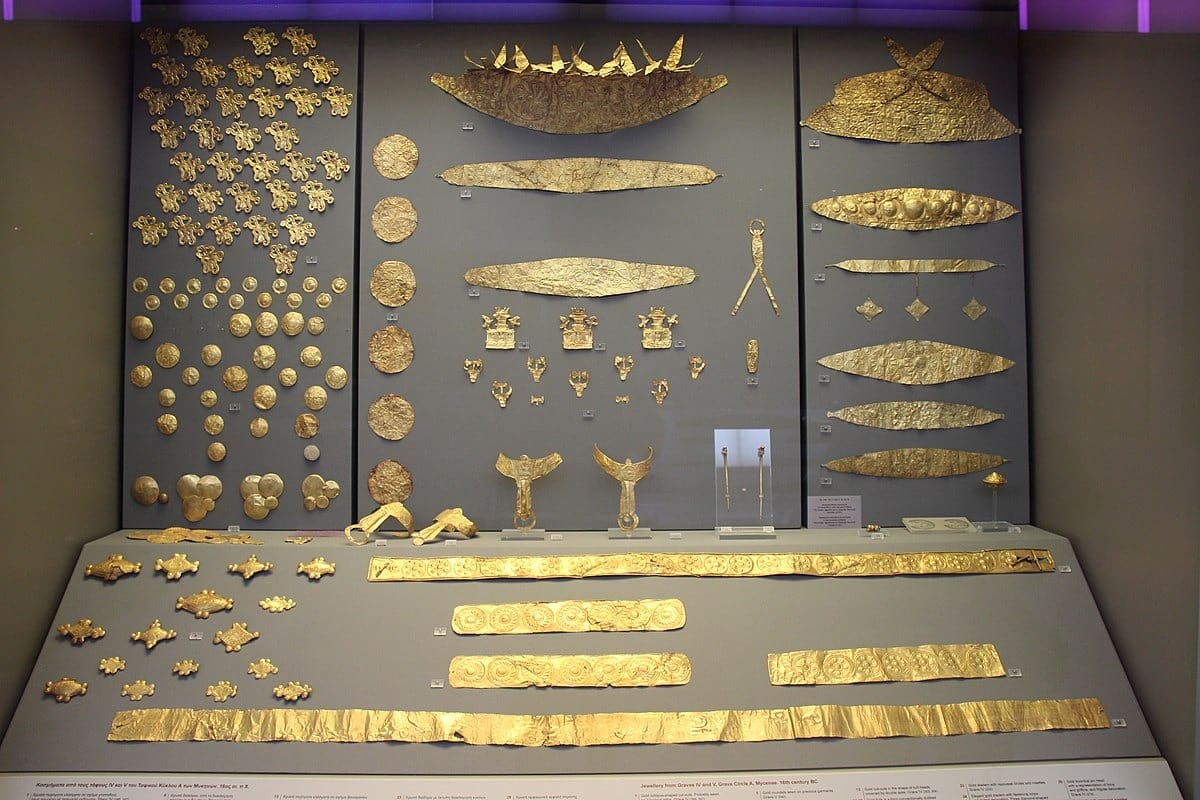
Mycenaean gold ornaments. Credit: Gary Todd / CC0 / Wikimedia Commons
The Mycenaean-era woman whose real-life face we can look at today thanks to digital technology and forensics, had been buried with an electrum face mask and a warrior kit of weapons, next to a royal man.
Contrary to what is assumed by modern common belief about women of her time, she was likely more closely associated with warfare.
DNA analysis revealed that the woman received a royal burial as she was noble by birth, not by marriage, like initially believed. The man buried next to her was a relative and not a husband, and the three swords found in the tomb are thought to have belonged to her.
According to Hauser, new data suggest that far more of what archaeologists call warrior kits are associated with women than with men in such late Bronze Age burials, “which is completely overturning our assumptions of how women are associated with war.”
The creation of the Mycenaean royal woman’s digital image by Juanjo Ortega G. was based on a clay reconstruction of her that was made in the 1980s by Manchester University, pioneers of one of the major methods in facial reconstruction.
Mycenaean era woman’s forensic analysis proves Homer’s writings
Although the unidentified Mycenaean royal woman lived hundreds of years earlier than the Trojan War, further forensic analysis of her remains prove right specific aspects of Homer’s descriptions of Mycenaean society.
The condition of the woman’s bones suggests that she suffered from arthritis in her vertebrae and hands, perhaps evidence of repeated weaving, a common and physically wearing activity among women of the Mycenaean era, Hauser comments.
Homer has repeatedly described noble women weaving in his epics; Helen in the Iliad, and Penelope in the Odyssey.