
GREEN BEAT LANGLEY: Miracles bloom in the desert
Published 6:00 pm Saturday, March 28, 2026
My wife and I heard a rumour the poppies were blooming near the base of the Organ Mountains.
The Organ Mountains are named for their resemblance to organ pipes and stretch majestically across the eastern skyline of Las Cruces – where we are living for a few months, as I pursue my sabbatical research.
When we reached the vicinity where we thought we might find them and didn’t see any, a woman told us, “no, I think we need some rain before the poppies appear.”
So we drove on, disappointed, thinking the rumours might be untrue.
However, a few minutes later, there right by the road the poppies were blooming – living miracles in this desperately dry desert.
Thinking back a few days, we realized it had, in fact, rained.
We’d been amused when the channel 7 weatherman, Dave Speelan (affectionately known as “Doppler Dave”) announced that Las Cruces was to receive a small fraction of an inch of rain.
Our rainfall for the whole month of March, so far, is in fact 1.7 mm, received on March 10. That’s it.
Meanwhile, British Columbia’s Fraser Valley is once again receiving way too much rain, I know.
At the same time, here in New Mexico we are breaking temperature records, seeing temperatures above 90 °F (32 °C), a few months earlier than normal.
However, it is that very combination that the poppies seem to love – a little rain, a lot of heat and “boom” they bloom!
After photographing the roadside poppies, I looked across the road to see a sea of brilliant yellow poppies buoyantly waving at me.
In fact, the desert is rife with colour now.
My son Luke and his wife Alivia were visiting from Prince George this past week and were impressed by the myriad of desert blooms – the yellow-topped Fishhook Barrel Cactus, the delicate red flowers on the Octillo, and the devastatingly beautiful scarlet flowers on the Scarlet Hedgehog Cactus, to name a few.
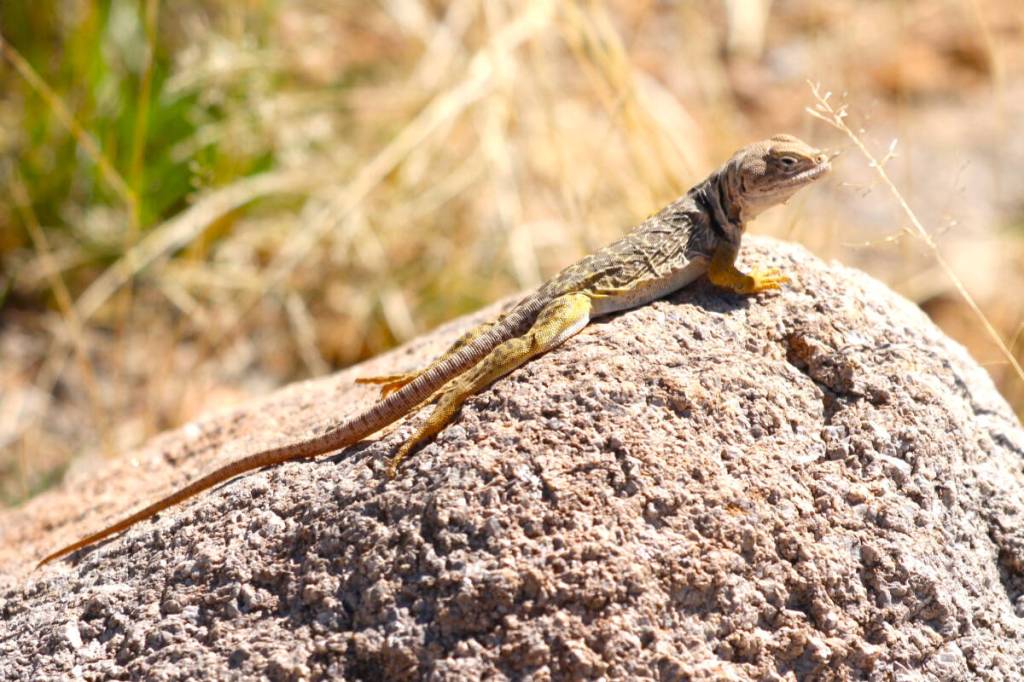
Along with the flowers, the butterflies, the birds, and the lizards were out in force, and at one point on a hiking trail through a canyon we were surrounded on all sides by a small herd of Auodad or Barbary sheep and their baaing lambs, no doubt also enjoying the fruits of spring.
Springtime is particularly dramatic in a desert, where all appears to be deader than dead in winter, and yet a mere 1.7 mm of rain can produce miraculous re-birth.
.
– David Clements PhD, is a professor of biology and environmental studies at Trinity Western University
.
READ MORE:
LAST LANGLEY GREEN BEAT: A different type of white Christmas
LANGLEY GREEN BEAT: Can water issues be turned around for Truth and Consequence?
LANGLEY GREEN BEAT: New admirer of a B.C. treasure
LANGLEY GREEN BEAT: Students spare a hug for Big Lonely Doug