
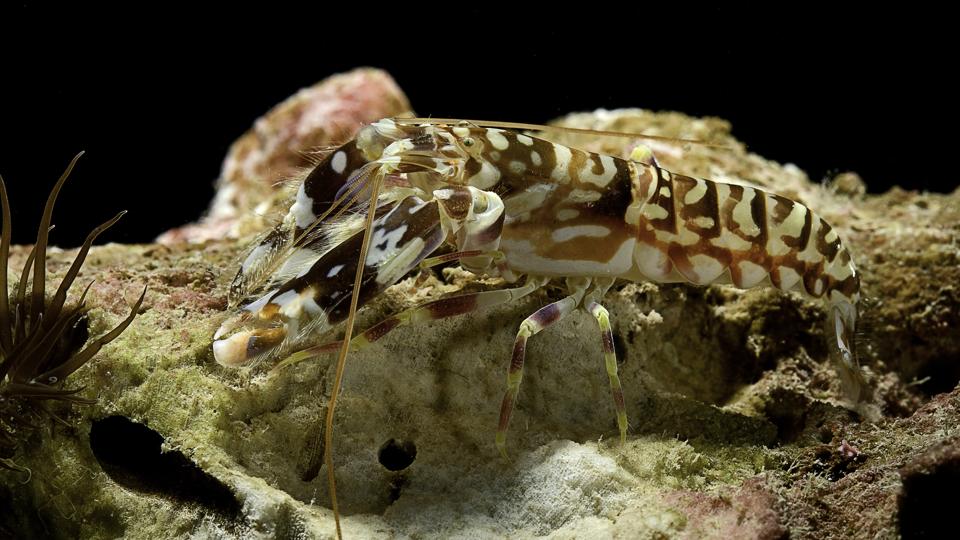
The pistol shrimp looks, at first glance, like nothing special. It’s no longer than a few centimeters, and it spends the majority of its life tucked away in burrows or reef crevices. You would not expect it to rival astrophysical extremes. And yet, under the right conditions, this little animal can generate a phenomenon that brushes up against one of the most extreme benchmarks we know of: the temperature at the surface of the Sun.
Shrimp of the family Alpheidae, also known as snapping shrimp or cracking shrimp, harness an elegant piece of physics, which unfolds on microscopic scales and vanishingly short timescales. The result is both fleeting and violent: a collapsing bubble that produces a shockwave, a flash of light and ridiculous temperatures.
To understand how this is possible, we need to look more closely — first at the animal itself, then at the ingenious physics it exploits.
The Pistol Shrimp — And The Discovery Of ‘Shrimpoluminescence’
Pistol shrimp are best known for their asymmetrical claws. One is relatively ordinary, but the other is anything but. In terms of appearance, it’s much larger and brighter colored than the other; in terms of function, it’s engineered for high speeds and force.
Biologists assumed for years that the shrimp’s signature “snapping” move was simply a mechanical impact, in which the two parts of the claw simply strike together. But this view began to shift as soon as researchers started looking more closely at the phenomenon by means of high-speed imaging.
A pivotal moment came in 2001, when a study published in Nature revealed something unexpected. Beyond producing the classic snapping sound, the researchers noticed that the snap was generating light, too. The researchers coined the term “shrimpoluminescence” to describe this effect.
Their observations were remarkable. When the shrimp snaps its claw shut, it ejects a high-speed jet of water. This jet creates a rapidly forming and collapsing bubble. At the moment of collapse, the bubble emits a tiny flash of light, an effect closely related to sonoluminescence. This was the first ever documented instance of an animal producing this mode of light.
The flash itself is brief and invisible to the naked eye. But its existence, even if only in the eyes of researchers, signals something epic: the shrimp is creating an environment, however momentary, that is energetic enough to excite atoms enough to produce photons.
How A Tiny Shrimp Generates So Much Heat
To understand how the pistol shrimp achieves this, we need to turn to the physics of cavitation, as explored in detail in a 2017 study published in Scientific Reports. Cavitation occurs when a liquid experiences a rapid pressure drop, causing small vapor-filled cavities to form — or, as most people call them, bubbles. These bubbles are inherently unstable; once the surrounding pressure rebounds, they collapse violently.
The pistol shrimp has evolved a way to trigger this process with extraordinary precision. When the snapping claw closes, it acts almost like a handgun (hence the shrimp’s apt name). Water is shot out of a socket at velocities that can exceed 100kmph (62mph). This rapid flow creates a localized low-pressure zone, which allows the cavitation bubble to form.
Only milliseconds later, when the bubble collapses, the gas inside it is compressed unfathomably quickly. And because this compression happens so rapidly, there’s no time for the generated heat to dissipate into the surrounding water. The process is effectively adiabatic: the energy is concentrated rather than lost.
The result is one of the most dramatic pressure and temperature spikes that occurs on the planet, housed inside a tiny bubble. According to the 2001 Nature study, as well as subsequent modeling, temperatures inside the collapsing bubble reach thousands of Kelvin. The researchers place estimates in the range of at least 5,000 K and upward (8540°F or 4726°C), comparable to the surface temperature of the Sun.
Simultaneously, the cavitation bubble collapse also generates a shockwave — a sudden pressure front that propagates outward through the water. This shockwave is strong enough to stun or kill small prey, which is precisely how the shrimp uses it in practice.
A few points are worth emphasizing here:
The extreme temperature is highly localized. It exists only within the collapsing bubble, which is microscopic in size. The surrounding water remains essentially unaffected.
The duration is incredibly short. It unfolds on the order of nanoseconds to microseconds. This is not sustained heat, but a fleeting spike.
Shrimpoluminescence is a byproduct of these extreme conditions. The light that the shrimp generates is not the goal of the process, but rather a clue to just how intense it is.
As impressive as the magnitude of these various forces is, the efficiency with which they’re generated is just as intriguing, if not more. This is especially the case considering that the shrimp is not expending enormous amounts of metabolic energy to achieve them. Instead, it is leveraging fluid dynamics. It turns a rapid mechanical motion into a cascade of physical effects: jet formation, cavitation, collapse, shockwave and light.
Why This Shrimp Matters
Ecologically speaking, the pistol shrimp’s snapping mechanism is one of the most effective predatory and defensive tools in all of the ocean. It enables the animal to incapacitate prey without direct contact, and at an incredible speed, too. This, in turn, reduces both risk and energy expenditure when facing prey or competitors. In some species, snapping is also used in communication, contributing to the acoustic landscape of marine environments.
But perhaps more intriguingly, the shrimp has become a source of inspiration for engineering. A 2025 study published in Heat and Mass Transfer highlights how the principles underlying pistol shrimp cavitation are currently being applied to immersion cleaning technologies. In industrial settings, cavitation can be used to remove contaminants from surfaces, particularly in hard-to-reach areas where ultrasonic or pressure flooding methods fall flat.
The idea is simple in concept but challenging in execution. One needs to generate controlled cavitation bubbles that collapse near a surface, producing highly localized shockwaves that dislodge particles. This seemed like a trying task — until the pistol shrimp offered engineers the perfect biological blueprint for achieving this efficiently.
Its claw design and snapping dynamics demonstrate one way to generate powerful cavitation events without large energy inputs. By studying these mechanisms, engineers hope to develop cleaning systems that are more effective, energy-efficient and adaptable.
In a broader sense, the pistol shrimp also teaches us how biology solves problems by exploiting underlying physical principles we’d never think to scale down, and in elegant ways, at that. It also shows us that even the most unassuming creatures can operate at the very edges of what we thought possible.
That said, the pistol shrimp doesn’t live its life “aiming” to create extreme temperatures or shockwaves; it simply snaps its claw shut instinctually. The rest follows from the physics of fluids under rapid motion. And yet, in doing so, it briefly recreates conditions that we normally only associate with stars.
This tiny shrimp’s ingenuity reveals just how much we overlook in the natural world. How connected do you feel to it? Take the science-backed Connectedness to Nature Scale to find out.