
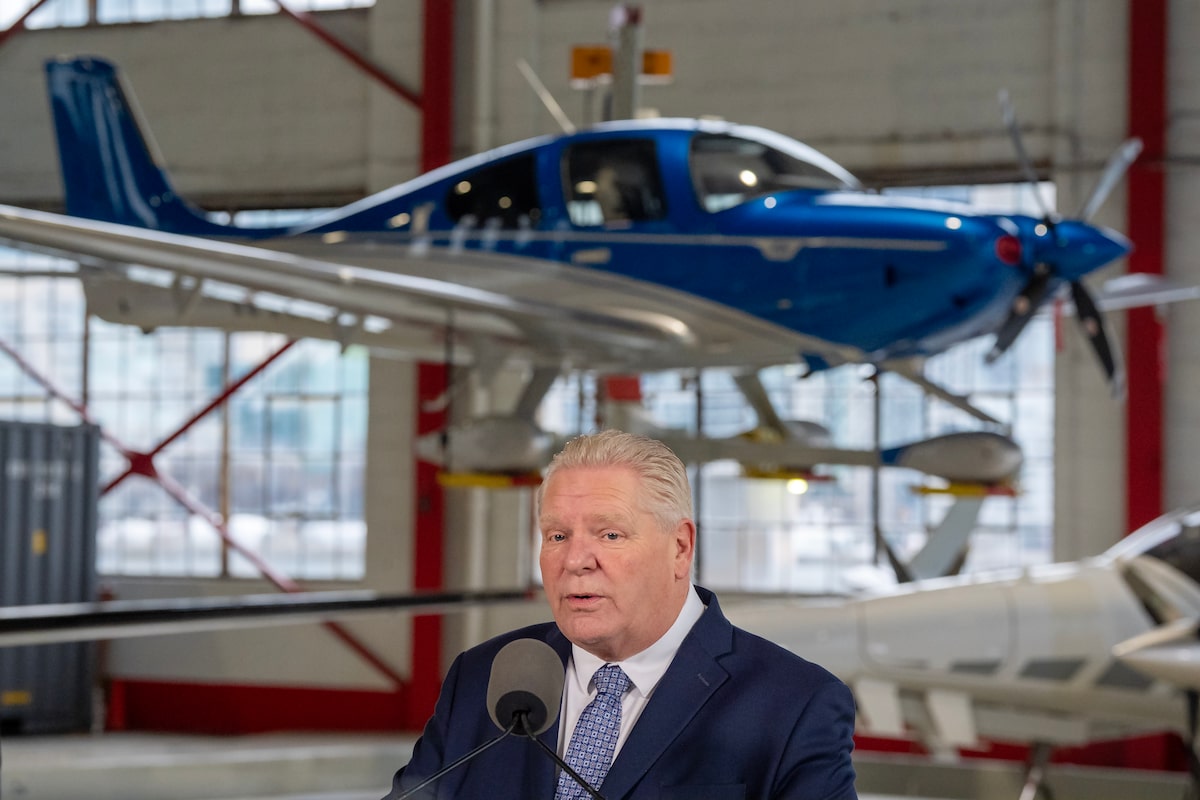
Ontario Premier Doug Ford speaks at an event at Toronto’s Billy Bishop airport on Monday.Frank Gunn/The Canadian Press
Yours to discover
Re “Memo to Doug Ford: There’s more to Ontario than Toronto” (Editorial, March 24): It seems to me that Doug Ford should spend as much per capita on Ontarians outside of Toronto as he is spending on that city. All of our social, recreational, cultural, economic and infrastructure needs are just as important.
To favour the capital over everyone else feels selfish and unfair. Rural MPPs should push back.
Naomi Norquay Grey Highlands, Ont.
This delightful editorial has a long and reasonable list of critical challenges needing careful attention and resolution, including how provincial debt will be more than a half-trillion dollars. Central to Doug Ford’s overreach is the status of Canadian cities being mere creatures of the provinces, despite many settlements being in existence well before the nation.
Changing this inferior status is overdue and would begin to resolve a few problems, including the chaos that Mr. Ford has brought to many Ontario cities, not just Toronto. Having a different result than a Liberal win in the upcoming University-Rosedale by-election, a riding close enough to the island airport and the city core, would be a good first step.
Hamish Wilson Toronto
One solution
Re “U.S. officials probe staffing, fatigue, communication failures after Air Canada crash” (March 25): Air-traffic control appears suitable for supervised computer control and an obvious application for artificial intelligence. Where are we with this?
D. M. Harvey Ottawa
In advance
Re “Alberta’s MAID bill is a chance for legal clarity” (Editorial, March 25): Somehow discussions about Track 2 medical assistance in dying seem to get lumped in with MAID for mental illness.
Track 2 is critical for those with incurable disease that will end in suffering and death, but not in the next 12 months, such as Alzheimer’s and other dementia-based diseases.
What is sadly not being discussed much is Quebec’s progressive stand to allow advance wishes. Those on a Track 2 path would have another way to ensure they do not suffer agonizing deaths when they are no longer able to provide consent.
Understanding the reasons people leverage Track 2, and whether advance wishes can provide similar dignity and comfort, should be what we discuss as a country. MAID for mental illness, Track 2 and advance wishes are too important to not give each their due space for proper discussion.
Remember: Dignity in death is a sign of kindness and love.
Cheryl Altman Collingwood, Ont.
There is also the unsettled question of advanced directives.
With the exception of Quebec, Canadians with diagnoses confirming inevitable loss of cognitive and physical capacity, who are clear about the kind of future they don’t want for themselves and their families, may be choosing to end their lives prematurely. This is tragic.
With the burgeoning aging population, this issue will only become more relevant. The most commonly expressed horror I hear from this demographic is the fear of becoming a burden to family though advanced dementia.
In 2021, the Senate approved an amendment to Bill C-7 allowing for advance directives, but it was subsequently overturned by the House. This vital issue should be reopened.
Mary King-Lyons Oakville, Ont.
Big haul
Re “Driverless big rigs will soon be on U.S. highways” (March 18): There is similar work being done in Canada.
The Canadian Automated Vehicle Initiative is leading a team of 49 stakeholders developing plans for an autonomous truck to travel from Halifax to Vancouver in 2028. When complete, this truck trip would hold the world record for the longest automated truck trip. Stakeholders include NuPort Robotics, a Toronto-based company that retrofits trucks for autonomous operation.
Unlike the United States, the truck driver shortage in Canada is still a major factor. Transport Canada predicts that the shortage will increase between 25,000 to 55,600 truck drivers from 2023 to 2035.
There is a focus on increasing Canada’s interprovincial trade. However, 90 per cent of trade is carried by truck and there is a limit to growth unless we use automation.
Barrie Kirk President, CAVI; Ottawa
Nature of thing
Re “There are two sides to David Suzuki. Both appear in this intimate stage play” (Arts & Books, March 14): I was catching up on my news reading before I went to bed recently. I was moved by the final paragraph expressing David Suzuki’s hopes for the future, that we “come together as a community and hunker down together, and take care of each other.”
I woke up in the morning recalling a vivid dream of Mr. Suzuki putting a bandage on my little finger. It felt like the ultimate kindness to have this celebrated person tend to such a small and insignificant detail. Not only can he still move audiences to tears with his unique speaking style, but he can apparently make them dream, too, about a kinder approach in our world.
At 90, our brilliant Canadian scientist has still got it, as have directors Ravi Jain and Miriam Fernandes. I too am “stunned” by the reach of even a description of their 90-minute play, and I haven’t even seen it.
Move over, Ibsen.
Thelma Fayle Victoria
The customer is…
Re “Fines for false made-in-Canada claims could chill investment, food manufacturers say” (Report on Business, March 19): Kudos to the Canadian Food Inspection Agency for the fines imposed on grocery firms for falsely labeling products as “Product of Canada.”
And shame on Food and Beverage Canada for suggesting the crackdown could cause “mistrust in our food system.” The mistrust is its own industry’s doing, brought about by consumers noticing the misrepresentations and reporting them to the inspection agency.
It is suggested that grocers might decide to stop the labelling practice altogether, saying “it’s not worth it.” Customers know what is important to them, and they’ll decide whether it is worth it or not.
Mike Gilchrist Calgary
Just browsing
Re “Video-rental stores were a source of productive frustration. Streaming services took that away” (Opinion, March 14): Here is a wider generalization: When I began my graduate studies, a librarian explained to me the “next-to rule.”
Select the books needed for an assignment. But rather than have them delivered to the library front desk for pickup, go into the stacks and seek them on the shelf. With astonishing frequency, the books physically next to one’s choice will prove key to the research.
Because of the Dewey Decimal System, the “next-to rule” can show a student things they’d never thought of and enrich a paper. I credit it with helping me get straight As in all my grad courses.
William Atkinson Toronto
Letters to the Editor should be exclusive to The Globe and Mail. Include your name, address and daytime phone number. Keep letters to 150 words or fewer. Letters may be edited for length and clarity. To submit a letter by e-mail, click here: letters@globeandmail.com