
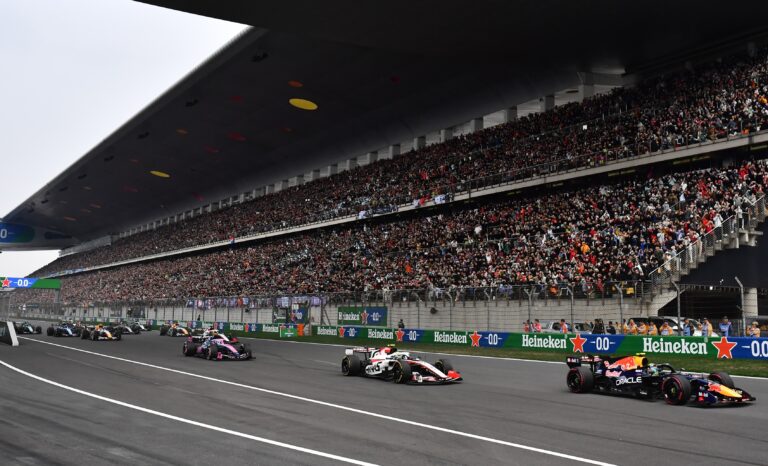
Formula 1’s governing body, the FIA, is reportedly reconsidering 2026 engine regulations after the Japanese Grand Prix that saw Ollie Bearman crash into the barriers with a force of 50Gs. Following this, the FIA reportedly agreed that a 50-50 power split between the internal combustion engine and the hybrid unit may have been a mistake.
Since the start of the 2026 F1 season early this month in Australia, several drivers have been calling out the new regulations. The concerns often surround excessive dependence on electrical energy and the management of this.
Advertisement
Several drivers also raised concerns over the way power is deployed in comparison to those in a super clipping stage, and the repercussions that could occur when closely following a car. This was the case with Ollie Bearman’s crash in Suzuka earlier today.
During Lap 23 of the Japanese GP, he closed in on Alpine driver Franco Colapinto on Turn 11 for an overtake. At the exit of the turn, Colapinto’s A526 F1 car started harvesting after it ran out of battery. Bearman, on the other hand, had more battery power available in his VF-26 and was deploying it for an overtake.
Read More from MotorBiscuit:
This led to a significant speed difference between the two cars, pushing Bearman to make an emergency maneuver by swerving abruptly to avoid crashing into Colapinto. His Haas then went over the grass, hitting the brake markers before spinning out and crashing into the barriers at high speed.
Advertisement
FIA Reversal After Horrific 50G Crash?
While Bearman escaped serious injuries, the other drivers have raised safety concerns, including the Grand Prix Drivers’ Association, urging FOM and the FIA to explore solutions.
Now, according to F1 journalist Thomas Maher, the Suzuka incident has forced the FIA to explore short-term and long-term changes in the sport, mainly regarding the way power is delivered by the power units. He shared on X:
“I’m hearing some interesting admissions off the back of Suzuka – namely, that there’s a growing awareness within the FIA that the 50/50 split has been the wrong direction.
Advertisement
“It’s understood that, in the short-term, energy deployment limits are being looked at while, longer-term, a change in the ICE vs. electrical split.
“Getting the drivers and teams in alignment is a hurdle to clear, with the teams not all agreeing with their drivers on the issues, but there is an awareness now that changes are needed.”
What this means in regards to how the powertrain could change is unknown. Maybe energy harvesting at the front axle, too? While it would be too early to say at this stage, it is likely that the FIA would explore this angle seriously for the long term.
Regardless of the solution, implementing changes won’t be an easy task since the teams and drivers will have to be on the same page. Not to mention the extensive research and testing these power units go through in their development phase, which means a suitable fix will take a while to arrive on the race track. Power unit manufacturers will also have to agree, considering their already substantial investment into the current regulations and interest in staying close to automotive industry trends.
Advertisement
The positive point is that the FIA has acknowledged the problem and is now working on solutions to make F1 faster and safer.