
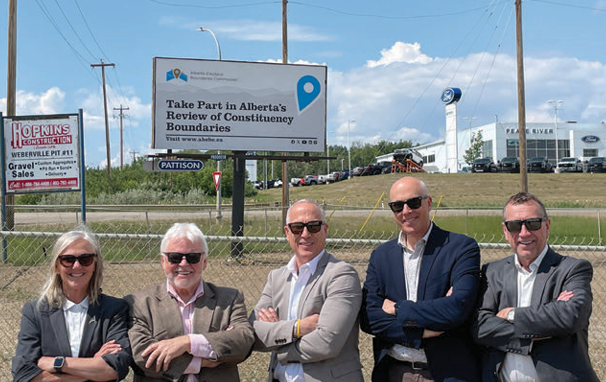
The Electoral Boundaries Commission (EBC) submitted its Final Report for the Proposed Electoral Division Areas, Boundaries, and Names for Alberta to the Speaker of the Legislative Assembly on the morning of March 26.
According to the majority report recommendations, the electoral districts of Highwood, Livingstone-Macleod, and Cardston-Siksika will see boundary and name changes.
No boundaries were added or removed in southern Alberta, though the Commission said existing boundaries were modified to create a more workable region and better reflect communities of interest.
Related Stories:
“Over the past eight years since the last EBC report, Alberta has seen extensive growth and changes in its social makeup,” said Dallas Miller, chair of the 2025-26 EBC.
“The year-long review of Alberta’s electoral boundaries was undertaken as required by law, and two new constituencies have been recommended. I want to thank the thousands of Albertans who provided feedback through oral presentations and written submissions. This helped the Commission greatly throughout the process.”
What electoral district will Okotoks be in?
According to the Final Report’s recommendations, Okotoks will be part of the Okotoks-Diamond Valley (ED #51) electoral district.
The Commission had initially proposed a hybrid district called Calgary-Okotoks, which was met with strong opposition.
“In the feedback to our interim report, there was a significant campaign by residents of Okotoks against being included with parts of the city of Calgary,” the Commission said. “In general, those opposed indicated that there was no community of interest between Calgary and Okotoks — Okotoks wants to retain its small-town feel and not be grouped together with Calgary.”
The proposed division will have a population of 55,284.
The division has gained adjacent portions of Foothills County from Banff-Kananaskis and lost some areas to the newly formed High River-Vulcan-Siksika division.
Okotoks-Diamond Valley will succeed the current electoral division of Highwood. The name change reflects the two largest municipalities in the riding and gives voters across the province a clearer sense of where “Highwood” is located.
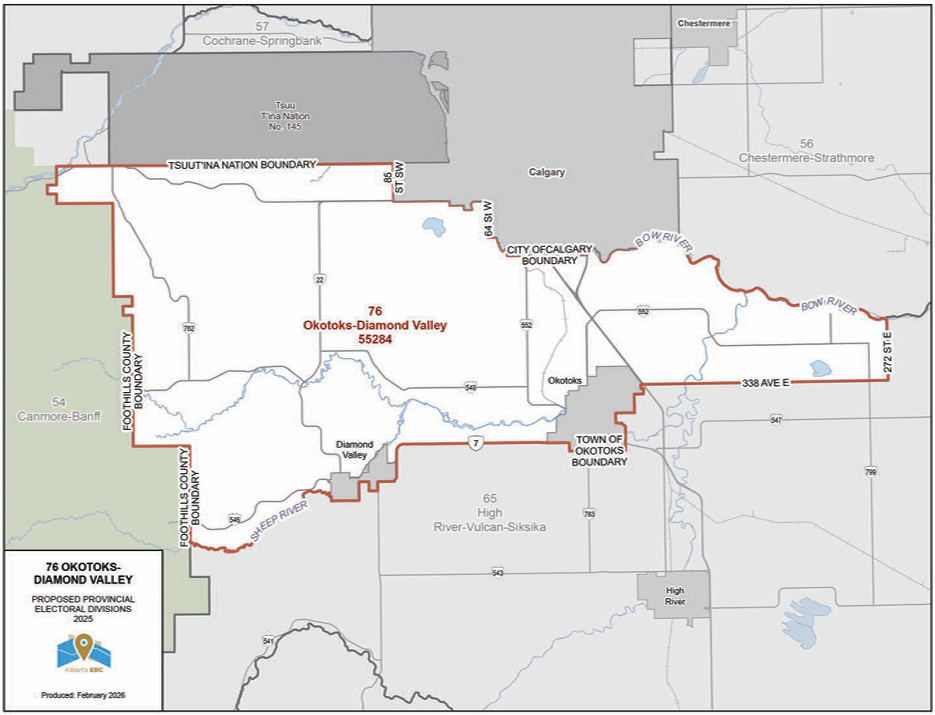 The proposed electoral division of Okotoks-Diamond Valley. Source: Alberta Electoral Boundaries Commission, P. 184.
High River, Vulcan, and Siksika to see new district
To the south, the current districts of Livingstone-Macleod and Cardston-Siksika will see significant changes.
The newly established High River-Vulcan-Siksika (ED #65) riding will absorb all of Vulcan County, portions of Wheatland County and Foothills County (excluding the area belonging to Okotoks-Diamond Valley), and areas of the Municipal District of Willow Creek north of Highway 520.
“We found general dissatisfaction with the existing three ridings of Taber-Warner, Cardston-Siksika, and Livingstone-Macleod,” the EBC said.
The new division is largely the successor to Cardston-Siksika, with significant changes resulting from shifts to neighbouring electoral divisions.
“This electoral division essentially unites rural areas south and east of Calgary in a logical ‘L’ shape. While residents would occasionally go to Calgary for services, these communities are rural — not suburban or bedroom communities. Uniting these counties keeps communities of interest together,” the Commission said.
The proposed electoral district will have a population of 53,351.
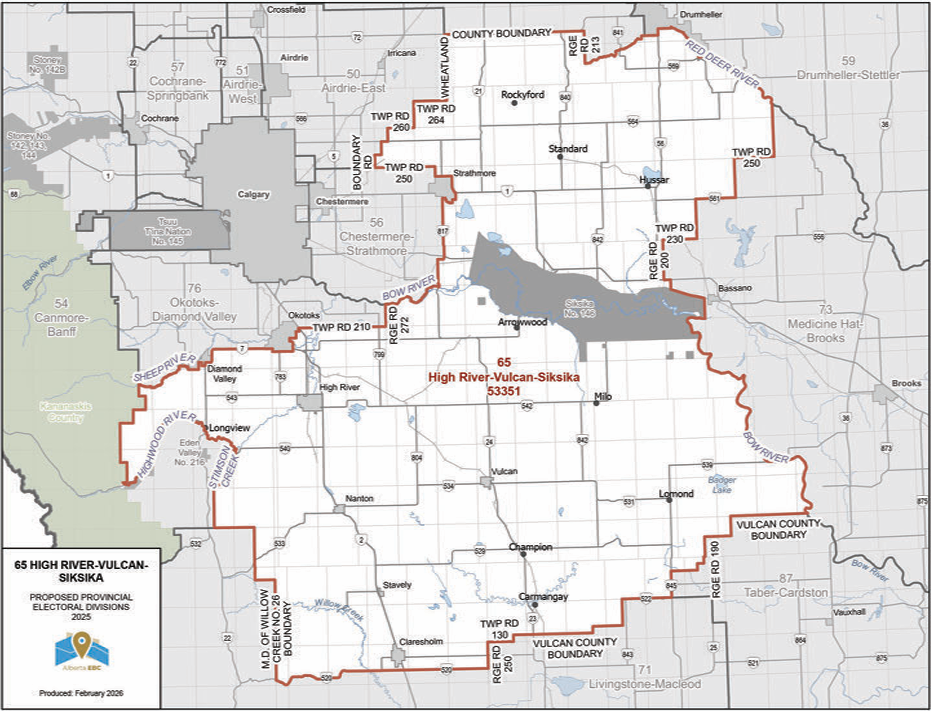 The proposed electoral division of High River-Vulcan-Siksika. Source: Alberta Electoral Boundaries Commission, P. 253.
The remains of Livingstone-Macleod
Livingstone-Macleod will keep its current name, but will see boundary changes following the creation of High River-Vulcan-Siksika.
It will absorb nearly all of Lethbridge County, much of the Municipal District of Willow Creek, all of the Municipal Districts of Pincher Creek and Ranchland, Waterton Lakes National Park, and the Municipality of Crowsnest Pass.
“These are communities of interest in rural southern Alberta and can be effectively represented. While the population is below the provincial average, the vast geography and distance from the Legislature justifies the variance,” the Commission said.
The proposed Livingstone-Macleod division will have a population of 50,144.
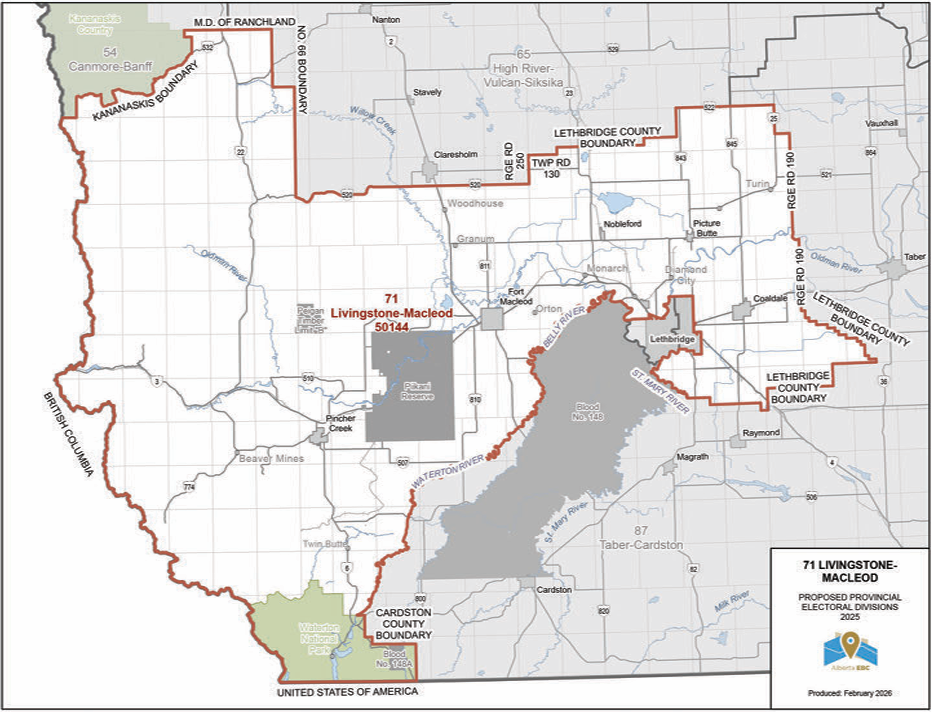 The proposed electoral division of Livingstone-Macleod. Source: Alberta Electoral Boundaries Commission, P. 259.
A struggle defining the divisions
The EBC was only permitted to add two new electoral divisions, despite the province’s significant population growth.
“The size of the legislature is increasing by two per cent despite the population increasing by 20 per cent. It is with regret that we have had to remove two ridings from central and north-central Alberta to meet the demands of high population growth in and around Calgary and Edmonton,” the EBC said.
The Commission recommended that future commissions be granted the power to set an appropriate number of electoral divisions — an authority already held by equivalent bodies in British Columbia and Quebec.
Neither the Legislature nor the opposition challenged the bill to increase the number of electoral divisions to 89 when it was proposed. However, the EBC noted that based on input from Members of the Legislative Assembly at public hearings, there appears to be regret on both sides of the House over that failure to act.