
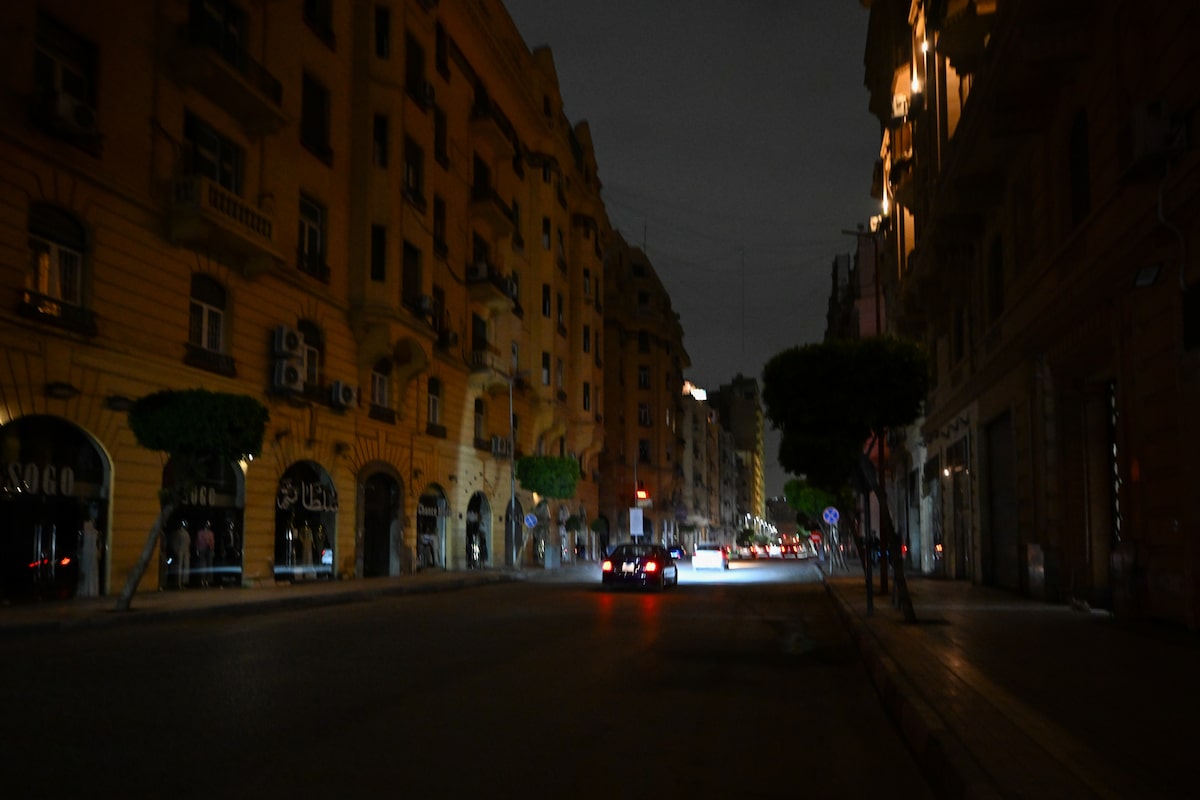
Shops are closed early on Saturday night in downtown Cairo to conserve electricity. Egypt’s studious neutrality as large swaths of the Middle East go up in flames did not insulate it from the energy crisis triggered by the war.Sayed Hassan/Getty Images
On Saturday evening, I was having a delicious dinner at a new Lebanese restaurant near my hotel, on Cairo’s Zamalek island on the Nile. At 8:55 p.m., when I had not quite finished my shish tawook, my waiter trotted over, bill in hand, and asked for payment. “We are closing in five minutes,” he said.
I paid. He wasn’t kidding. The lights went out at exactly 9 p.m. and all the patrons left the suddenly darkened restaurant. I had forgotten that the Egyptian government had ordered shops, restaurants, cafes and bars to shut down at that time starting Saturday. The effective curfew was an attempt to save energy and would last at least a month.
My half-kilometre walk back to my hotel felt eerie. Cairo, one of the world’s most densely packed, chaotic and vibrant cities, with half the population of all of Canada, had pretty much gone dark. Shop owners had hauled down their steel shutters. Street lights were dimmed or turned off. Tourists and residents shuffled back to their hotels and homes; there was nowhere else to go. I used a pocket flashlight to navigate Cairo’s sidewalks, which are treacherous even in daylight.
Related: Trump threatens destruction of Iran’s energy resources if a deal isn’t reached soon
Before the lights-out order, Egypt seemed entirely insulated from the U.S. and Israeli war on Iran.
No Iranian missiles or drones have hit Egyptian soil or the Suez Canal, the waterway between the Mediterranean and the Red Sea whose shipping revenues are vital to the economic health of the country. U.S. military bases throughout the Persian Gulf area have been hit by Iran, but there are none in Egypt.
A man closes his shop after earlier closing hours are applied in Cairo on Saturday. Rationing power is one measure the government has taken, but so is raising gasoline prices in a country where 80 per cent of the energy is generated by gas plants.Khaled Elfiqi/The Associated Press
Nor has Iran even hinted that it would attack Egypt, which comes as a pleasant surprise to some Egyptians, given its peace agreement with Israel and its status as a key U.S. ally in the Middle East. Egypt and Iran have never been the best of friends – until 2004, Tehran had a street named after the Egyptian army lieutenant who assassinated Egyptian President Anwar Sadat in 1981 (the street was renamed last year in honour of Hassan Nasrallah, the Lebanese Hezbollah leader killed by Israel in 2024). Still, they are far from enemies.
But Egypt’s studious neutrality as large swaths of the Middle East go up in flames did not insulate it from the energy crisis triggered by the war and Iran’s effective closure of the Strait of Hormuz. Until a decade ago, Egypt was a net exporter of natural gas. Since then, rapid economic and population growth, and falling domestic gas reserves, have made it rely more and more on imported fuel. About 80 per cent of Egypt’s electricity is generated by gas plants.
Gas prices all over the world have soared since Israel and U.S. attacks on Iran began on Feb. 28. The closure of Hormuz prevented 20 per cent of global oil and liquefied natural gas (LNG) supplies from reaching Asian, African and European markets. European prices are up by 60 per cent or more.
Egyptian prices have climbed even higher, in part because the country relies on Leviathan, the Israeli-controlled offshore gas field, for much of its imports. As a precautionary measure, Israel shut Leviathan at the start of the war and has no plans to reopen it any time soon. The Egyptian government has said its energy import bill will reach US$2.5-billion in March, up from US$1.2-billion in January – an increase of almost 110 per cent.
Streets in Cairo are darkened yet remain crowded after government measures to conserve power on Saturday night.Khaled Elfiqi/The Associated Press
The government in March jacked up retail gasoline prices by 15 per cent, diesel by 17 per cent and cooking gas by 22 per cent. The gas hike hurt consumers the most – everyone cooks.
Hence the 9 p.m. shop and restaurant closures. “We have no way but to reduce this bill through rationalizing consumption, which is a shared responsibility that falls on the government and the citizen together to realize the magnitude of the challenge,” said Egyptian Prime Minister Mostafa Madbouly, who is in charge of economic and energy policy.
There will be more economic pain. Higher energy costs are propelling food inflation everywhere. Poor countries, including Egypt, will suffer the most. The threat of higher bread prices in a place where cheap bread is considered a birthright has already spooked the Egyptian government. Most bread, specifically the circular, slightly inflated whole-wheat flatbread known as aish baladi, is subsidized. But the millions of Egyptians in the lower middle classes do not qualify for the subsidies and pay up to 20 times more for “private bread.”
The Editorial Board: A low-carbon future needs an electric jolt
The government introduced price caps on unsubsidized bread shortly after the war started. But there are already signs that the cap, which is virtually impossible to enforce, is being ignored by bakers as the price of fuel required to fire their ovens climbs. The government of President Abel Fattah el-Sisi is old enough to remember the so-called food intifada of 1977, when the government cut bread subsidies. Deadly riots broke out across the country and the government was forced to back down on the price hikes.
Hungry Egyptians, not Iranian bombs, are on his mind.