

On Feb. 24, just as the NHL was set to restart after the Olympic break, Brad Treliving sat next to Keith Pelley, the president and CEO of Maple Leaf Sports and Entertainment, as the pair watched the Toronto Maple Leafs practice.
And then, weirdly, the general manager mostly disappeared.
Treliving was no longer around the Leafs on a day-to-day basis in March — not at practice, not on road trips. Just gone, it seemed. And now he’s gone as GM, fired in dysfunctional fashion one hour and 23 minutes before the Leafs went for revenge against Radko Gudas and the Ducks in Anaheim.
The timing is the shocking part, and speaks to how the Leafs are being run under Pelley.
The why of it all is not shocking at all. In less than three seasons, Treliving took the Leafs backwards and leaves them in a worse position than when he got the job suddenly in the spring of 2023 after Brendan Shanahan fired Kyle Dubas. The team is older and less talented, and now at risk of having Auston Matthews decide he wants to go elsewhere this offseason.
It wasn’t all bad, of course. But the majority of Treliving’s activity, and non-activity, as Leafs GM didn’t work. In some cases, those decisions backfired in spectacular fashion, and the team as a result got increasingly worse, to the point there will be a playoff-less spring in Toronto for the first time in a decade.
How do we judge the work of a GM? That’s how. Were the majority of their moves (and non-moves) a success or not? Did the team get better as a result of their management? In both cases, the answer for Treliving is no.
It’s hard to find even one positive trade during his tenure, one deal the Leafs really, truly won. Most were either inconsequential or outright negative. The true disasters certainly hurt — none worse than the pair of deadline deals last spring for Brandon Carlo and Scott Laughton, which cost the Leafs a pair of first-round picks and Fraser Minten.
That the Leafs parted with first-round picks wasn’t the problem — not the biggest problem, anyway. It was who the Leafs were trading those first-round picks for: players who didn’t ultimately move the needle on the team’s chances of winning a Stanley Cup. The GM not only chose the wrong players but failed to prepare for the worst-case scenario in the case of the Carlo trade.
On the one hand, that scenario seemed unlikely at the time. On the other hand, the Leafs knew at that point that Mitch Marner, their second- or third-best player, was about to leave in free agency. A sharper front office might have expected to get worse for that reason alone, never mind the possibility of regression after a season of good fortune or injuries galore for an aging team.
It wasn’t just the big stuff, though.
It was the more marginal trades too, such as giving up anything (a fourth-round pick in this case) to acquire Dakota Joshua’s negative contract, which still has another two years remaining.
Treliving forever seemed to be patching the roster together one move at a time, without a clear grand plan in sight. What were his Leafs really truly about?
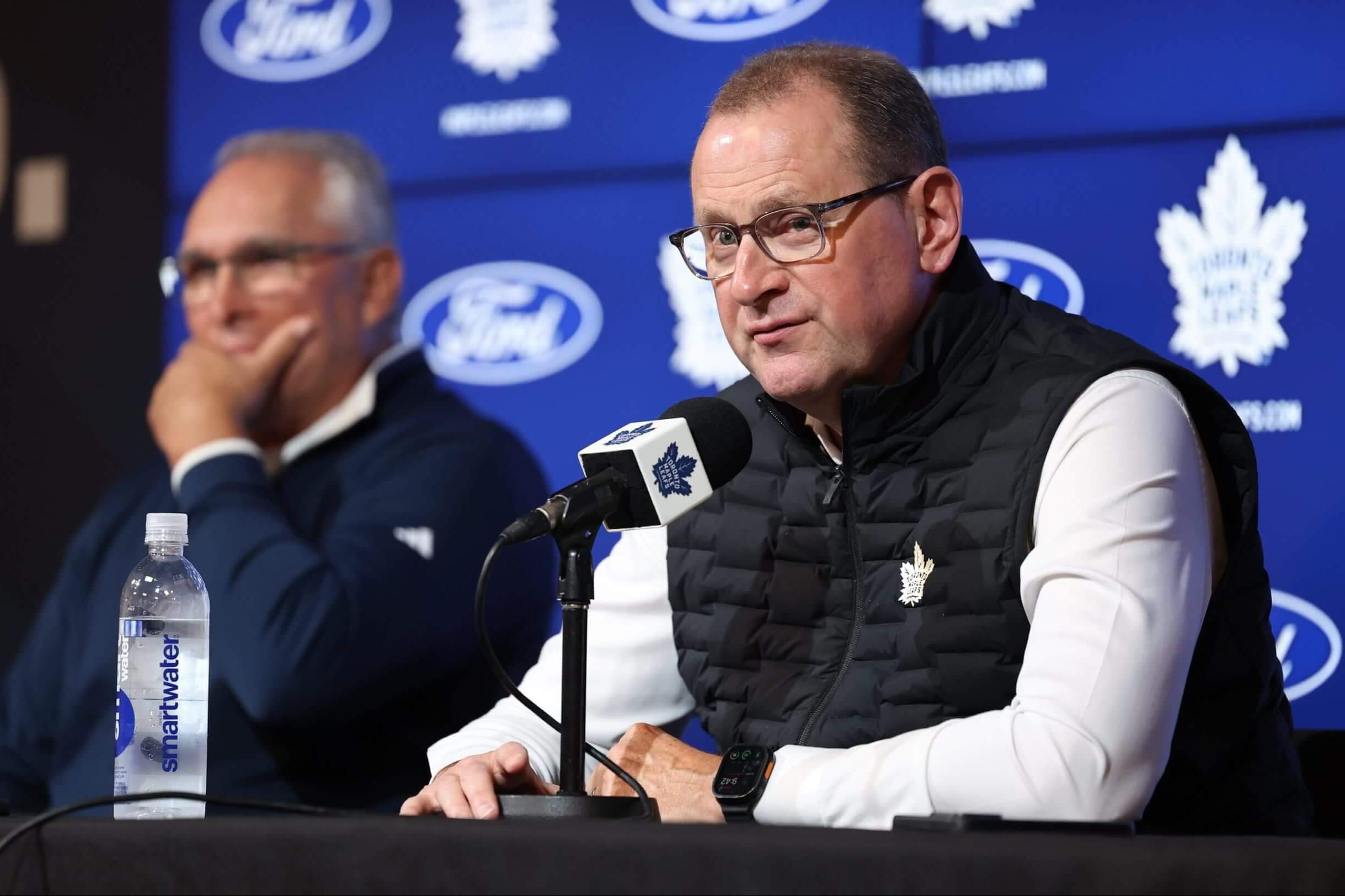
Brad Treliving stood by Craig Berube all season as the Leafs struggled. (Richard Lautens / Toronto Star via Getty Images)
Free agent signings were marginally better. Still, the free agent signings who worked only sort of worked in most cases.
Anthony Stolarz’s two-year contract in 2024, for instance, doesn’t look quite as good now as it did after last season, never mind the four-year extension that followed this past fall. And while it felt like the Leafs scored when they won the Chris Tanev sweepstakes, it took a six-year deal for the aging defenceman, which only slightly brought the cap hit down (to $4.5 million).
There were needless misfires over the years, like signing Ryan Reaves for three years because the Leafs needed “snot,” re-signing a difficult puzzle piece in Max Domi for four years, and betting $4.15 million in cap space on a banged-up John Klingberg.
Treliving never took big, bold and imaginative swings, not like his counterparts in Tampa and Florida did. There was no deal like the one Bill Zito made for Seth Jones. No crafty transaction like the one Julien BriseBois made to find the unheralded J.J. Moser.
Treliving’s Leafs stopped finding talent in hidden corners like the Dubas Leafs did in uncovering useful pieces in Michael Bunting, Justin Holl and Bobby McMann, among others. The Leafs became conventional under his watch, never outsmarting their opponents. Even the hiring of coach Craig Berube felt more like the obvious move rather than the right move.
Even teeny-tiny stuff that doesn’t seem like it matters made a difference when stacked on top of everything else. An example: allowing Pontus Holmberg, a useful forward, to walk away as a a free agent only to sign a more limited forward in Steven Lorentz to a three-year contract.
Often, Treliving’s failures resulted as much from inaction as action. After last season, for instance, Treliving highlighted the need for his team to acquire more puck-moving ability on defence as well as a top-six winger to help replace Marner. But when the offseason unfolded, the Leafs added nobody to fill either need.
And when this season began to go off the rails, nothing happened.
The Leafs didn’t swing a trade to address their need on defence, which had been magnified in Tanev’s absence, nor was Berube swapped out for another coach who might have gotten more out of the talent on the roster.
The Leafs didn’t have to hire Treliving. Had upper management (i.e. Shanahan) and ownership extended Dubas’ contract, there would have been no need. They also could have chosen someone different, someone with a richer record of success than Treliving had with the Calgary Flames, or a GM candidate on the rise.
They didn’t, and the Leafs are worse off now.