
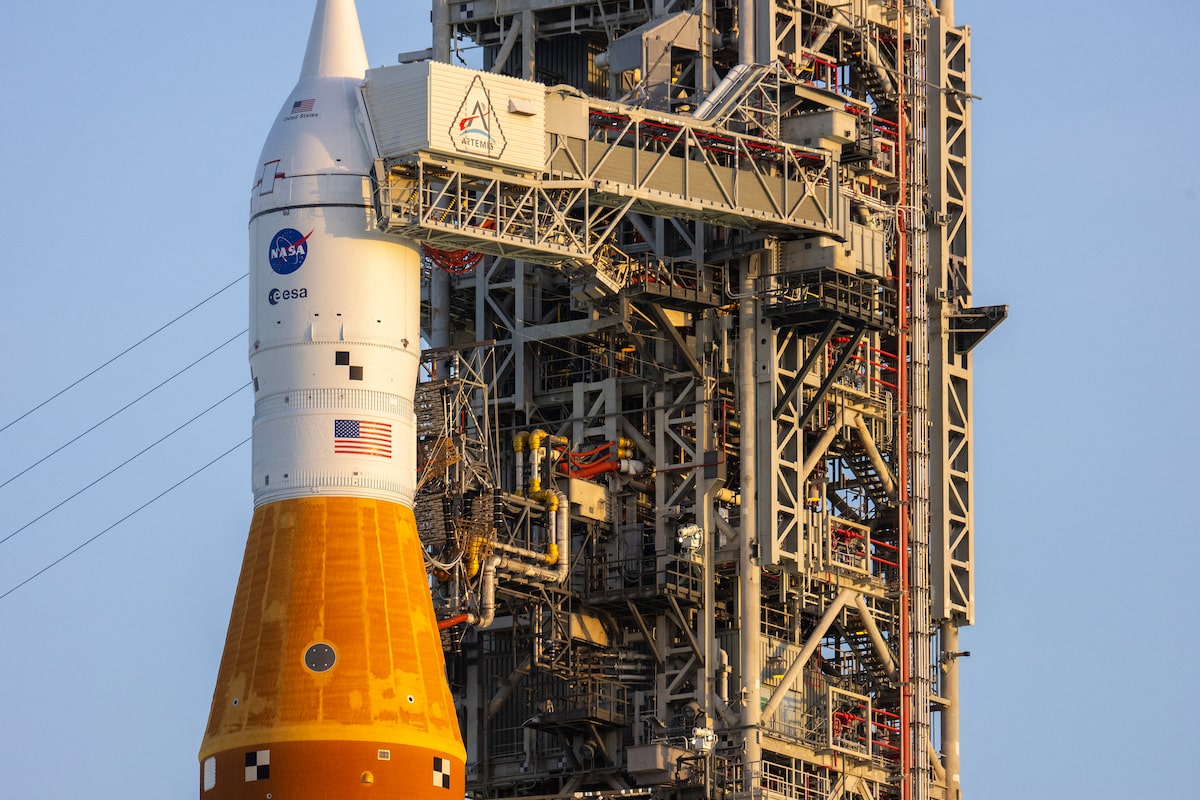
NASA’s Artemis II Space Launch System rocket and Orion spacecraft rest on Launch Pad 39B at Kennedy Space Center in Cape Canaveral, Fla. on Tuesday.JIM WATSON/AFP/Getty Images
If all goes to plan, a 2,600-tonne rocket will blast off on Wednesday evening and send four astronauts – three Americans and one Canadian – on a trip around the moon before safely splashing down in the Pacific Ocean just over nine days later.
But with the countdown in progress and the rocket standing ready on pad 39-B at NASA’s Kennedy Space Center, mission teams are busy finalizing preparations for a myriad of other possibilities that could see the crew of Artemis II coming back to Earth within minutes of taking off, or several days before expected.
All are contingencies that officials have had to consider for a historic test flight that will mark the first time the Space Launch System rocket topped by an Orion crew capsule heads into space carrying people on-board.
On Tuesday, mission managers were optimistic about the prospects for a liftoff during a two-hour window that opens on Wednesday at 6:24 pm. In general, launch opportunities for Artemis II are determined by a number of factors, including Earth’s orientation and the moon’s position in its monthly cycle.
Crew members, including mission specialist Jeremy Hansen – who is representing Canada on the spacecraft – commander Reid Wiseman, pilot Victor Glover and mission specialist Christina Koch, received briefings on final preparations and met with U.S. and Canadian officials behind glass due to quarantine restrictions ahead of flight.
“We thank them because they’re going to lift up humanity at a time when the world needs it,” said Lisa Campbell, president of the Canadian Space Agency, who was among those who met with the crew on Tuesday. “We can’t wait to celebrate with them when they’re home.”
Artemis II marks the first attempt to send astronauts beyond low Earth orbit and out to the moon in more than 53 years. No Canadian has ever made such flight, which NASA has called a crucial step in its broader effort to return astronauts to the lunar surface by 2028.
Countdown begins for Artemis II moon mission with Canadian astronaut, NASA says
Forecasts suggest only a 20 per cent chance that a weather event could arise that might delay the launch within that window or force a postponement to later this week.
But as soon as engines ignite, those alternatives will vanish and the launch team will instead be focused on several key milestones that come up almost immediately after the rocket clears its support tower.
“The first eight minutes are critical,” said Dan Florez, a test director for the ground-systems portion of the Artemis II mission. “That’s when we’re in powered flight for the ascent.”
During that time, the four engines on the launch system core stage will be burning fuel at a furious rate and pushing the rocket toward orbit.
Should a technical problem develop within the first three minutes of flight, Orion’s launch abort system can be activated to rapidly carry the capsule away from a malfunctioning rocket and bring the crew to a landing somewhere in the Atlantic Ocean.
What to know about NASA’s historic Artemis II moon mission
If this the happens while the rocket is still close to the launch site, helicopters from the nearby Patrick Space Force Base in Florida can be dispatched to retrieve the crew.
If the rocket has already travelled several hundred kilometres, the U.S. Air Force is prepared to conduct a pickup operation anywhere along the capsule’s possible flight path, with medical facilities on standby around the world as needed.
After three minutes, the abort system is jettisoned because the rocket will be too high at that point. Instead, if a problem arises, the astronauts will be coming down more like they would be if returning from space.
The rocket’s direction of travel will vary somewhat based on the precise time of the launch, but in general, it will take the crew over the southern hemisphere, past Africa and Australia. Six minutes into its flight, the rocket will be moving across the Pacific. If the crew needed to come down at that point, it will be closer to the mission’s expected splashdown location, some 130 kilometres southwest of San Diego.
Assuming that doesn’t happen, the core stage will separate after eight minutes and the launch will have put the capsule in an initial orbit that would send it around Earth in about two hours. Then, there would be another opportunity for a splashdown if necessary.
But if all is going well, before the two hours are up, additional burns by the rocket’s second stage would lift Orion into a higher, 24-hour orbit. Should problems arise after that, the next chance for a return to Earth would come about one day after launch.
Astronaut Jeremy Hansen speaks about his upcoming Artemis II mission at the Canadian Space Agency, in Longueuil, Que., in October, 2025.Graham Hughes/The Canadian Press
About one day after launch, the mission is scheduled for the “translunar injection burn” that is intended to put it on course for a swing around the moon.
At that point, there are still options for coming back early. But unless time is of the essence, those are unlikely to be used. This is because the capsule will be on what is called a “free-return trajectory” that is meant to send it around the moon and back in a way that minimizes the amount of fuel expended. To diverge from that would path mean more engine burns and a lot less certainty.
“In almost every situation, when you’re doing a risk trade, the risk of a highly dynamic burn versus a free-return trajectory where we use the gravity of the moon and earth to get ourselves back for free – almost always you’re going to err towards the free-return trajectory,” said Emily Nelson, NASA’s chief flight director, during a news briefing on Monday.
Mr. Florez said that while he and his colleagues have invested years in planning for various abort scenarios and other emergencies, it will be satisfying to cross them off one by one once the rocket is underway.
“We’ve done a lot of planning, a lot of training and it’s great to have all these capabilities,” he said. “We just hope we never have to use them.”