
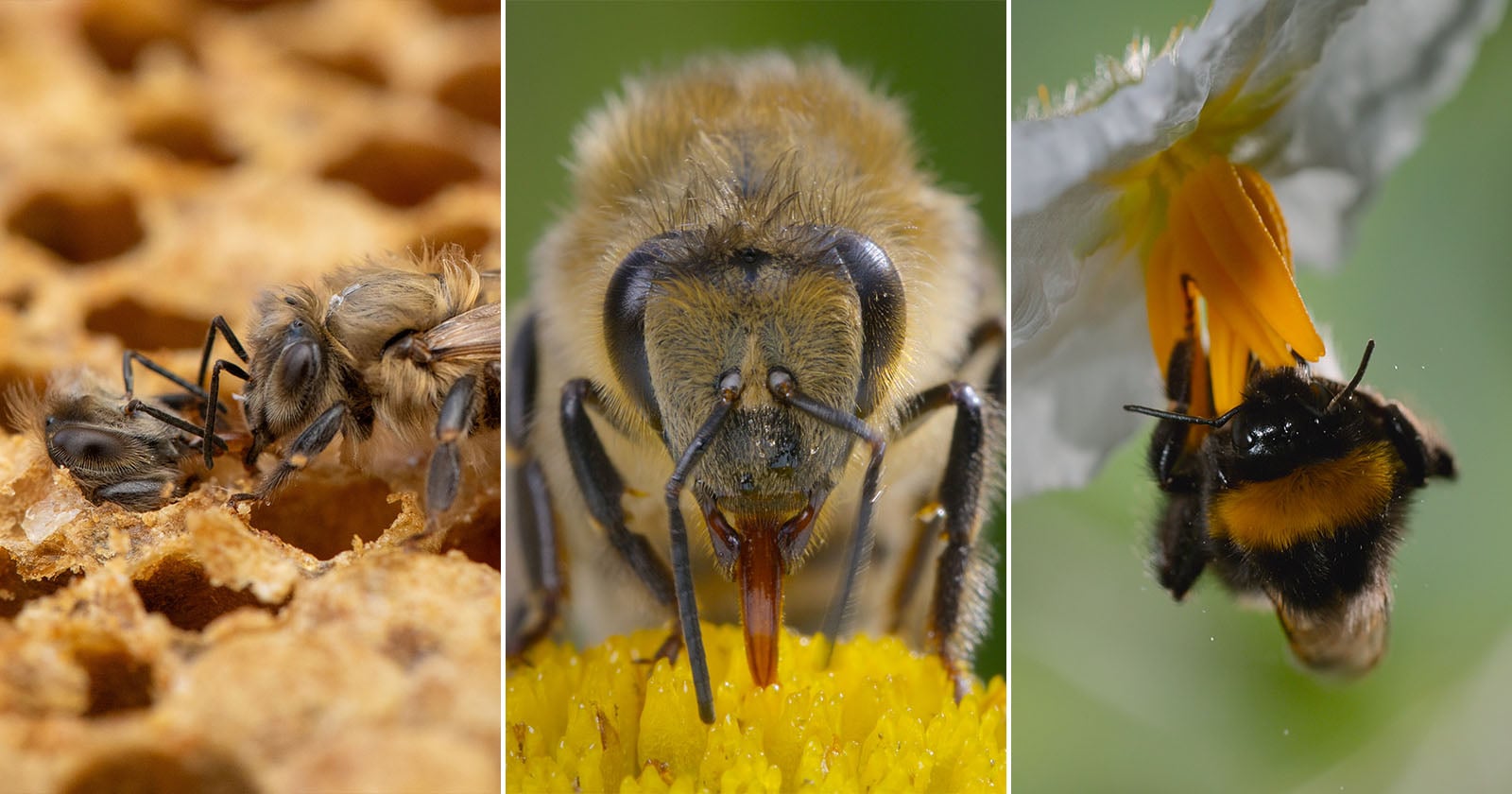
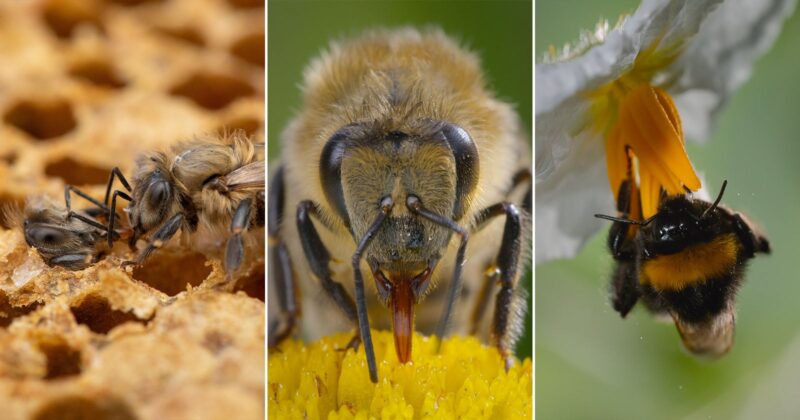
As its name suggests, National Geographic‘s new two-part documentary series, “Secrets of the Bees,” turns the lens toward one of Earth’s most important inhabitants: bees. The series is fascinating, full of interesting information and science about bees, but also replete with exceptional cinematography. The miniseries has many fantastic close-up shots of bees, unlike anything captured before.
The Cinematography of ‘Secrets of the Bees’
PetaPixel sat down with wildlife filmmaker John Brown, who is also an outstanding photographer, to discuss Brown’s work on “Secrets of the Bees.” The series features two principal photographers, Brown and the esteemed and influential wildlife filmmaker Alastair MacEwen. Sadly, MacEwen recently passed away, but his impact is felt through “Secrets of the Bees” and a very impressive filmography of great nature documentaries.
“Alastair did most of the honeybee filming, and I did most of the overseas, other bees,” Brown tells PetaPixel. This means Brown shot the Japanese hornet and honeybees, fire bees, vulture bees, and Dawson’s burrowing bee.
“He was one of my heroes,” Brown says of his late friend and colleague, Alastair MacEwen. “I think he was a hero to everyone in the industry. I mean, he set standards to which we all aspire. He was extremely passionate and intelligent and curious and just that sort of sense of wonder that never stopped. So he never stopped developing new bits of equipment. He never sat back on his laurels and all intrinsically driven.”
While MacEwen’s passing is very sad, Brown remarks that the outpouring of love and support for MacEwen and his lifetime of work has been wonderful.
“He was just an extraordinary person, a wonderful, extraordinary person,” Brown says.
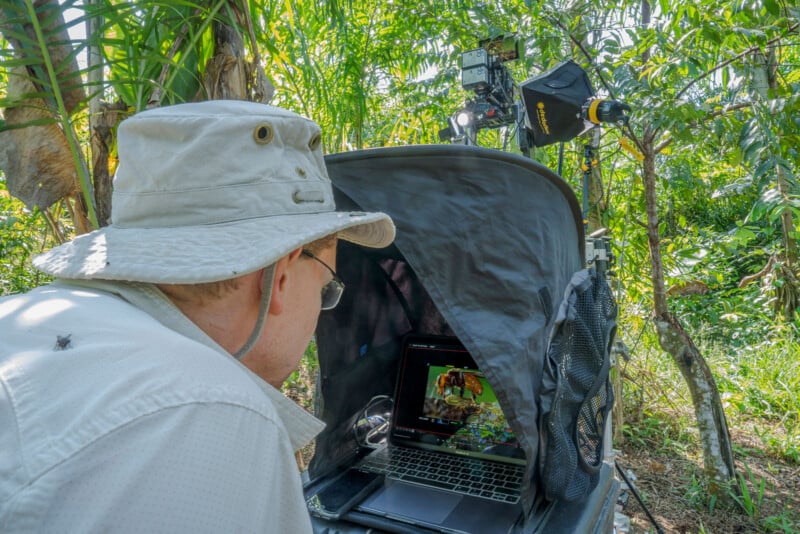 John Brown, camera operator, filming fire bee (Oxytrigona tataira)sequence. (credit: National Geographic/Javier Aznar González de Rueda) Multiple ‘World’s Firsts’
For his part on “Secrets of the Bees,” Brown captured many incredible shots, including rare and rarely discussed bees, such as vulture bees in South America. Also known as carrion bees, this group of just three stingless bees feeds on rotting meat.
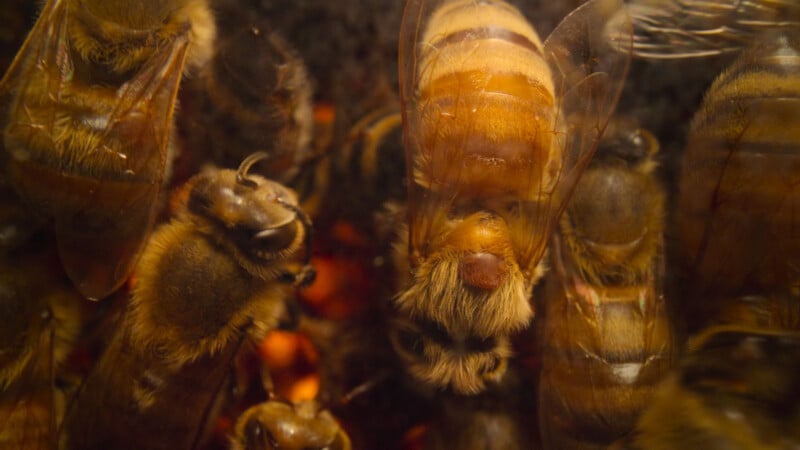 A Varroa mite latched onto the back of a young honeybee worker. (credit: National Geographic)
Brown is particularly proud of his work capturing Japanese bees defending their hive against a relatively massive, deadly Asian giant hornet, also known as a Japanese giant hornet. It’s a spectacular visual sequence and one of numerous scientific world’s firsts featured in “Secrets of the Bees,” which also includes the world’s first footage of a broomstick bee in flight, the first shot of a vulture bee nest, and the world’s first footage of honeybees defending themselves against a varroa mite invasion.
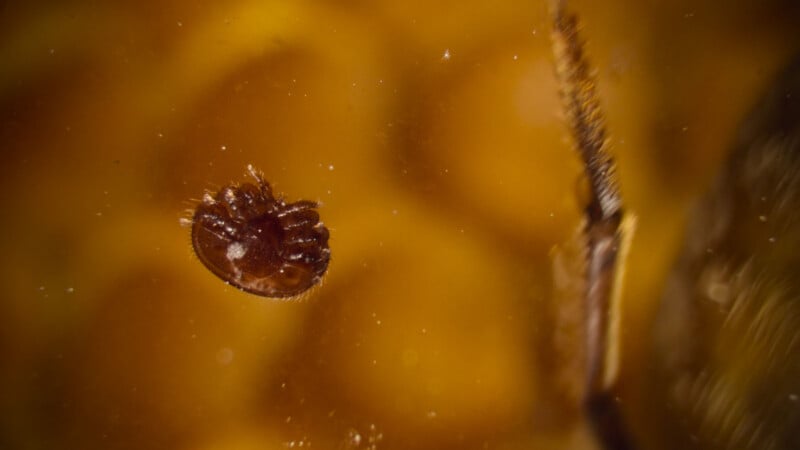 A Varroa mite parasite viewed from underneath waiting for a bee to latch on. (credit: National Geographic)
The spectacular shots showcased in “Secrets of the Bees” required significant time and effort to capture. As Brown explains, when doing macro video work, everything must be very precise.
“It’s funny because I’ve made films about tigers and chimpanzees and the kind of filming day where you’d be out from three in the morning to 10 o’clock at night, carrying half your body weight, but nothing is more tiring than trying to do this kind of macro work. It’s this kind of mental drain. It’s like doing neurosurgery. It’s that sort of incredible focus for just hours on end with a subject that doesn’t take direction that it’s going to do what it’s going to do,” Brown says.
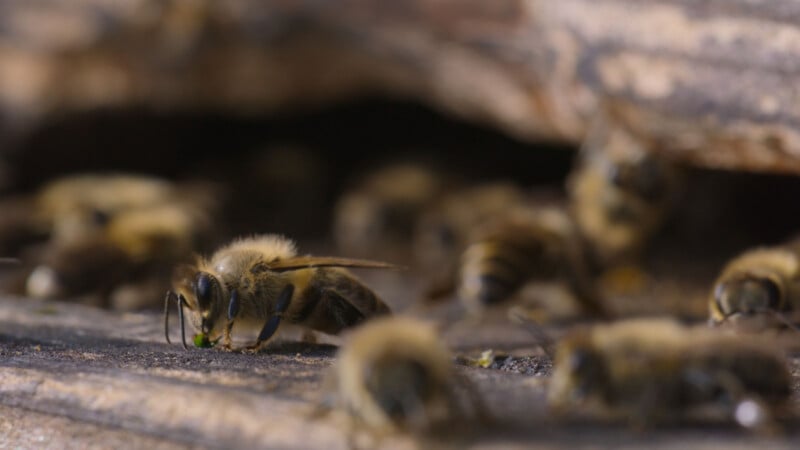 Asian Honeybee bee worker smears the front of the hive with leaf fragment. (credit: National Geographic)
 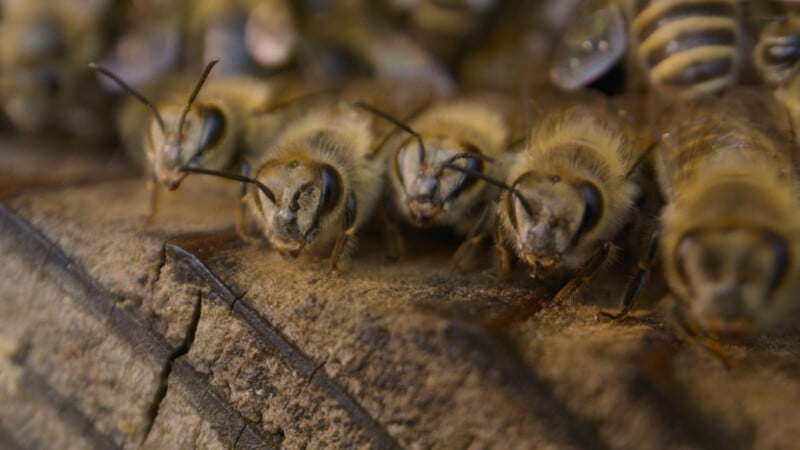 Alert Asian honeybee workers at the entrance of their hive. (credit: National Geographic)
 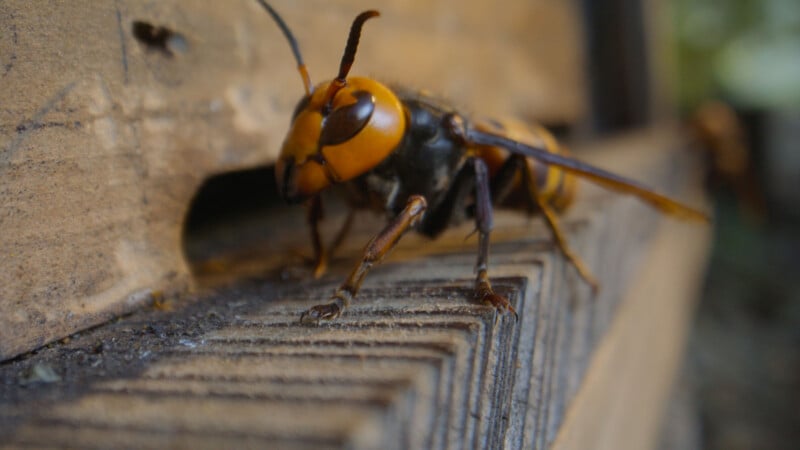 Asian giant Hornet portait at the entrance of an Asian honeybee hive. (credit: National Geographic) Macro Wildlife Filmmaking Is the Domain of Extreme Precision
He developed a special system that lets him control his camera in three-dimensional space with extreme precision, which he says he used for about 90% of his shots in “Secrets of the Bees.”
“So you are looking at a screen, you are moving the camera in two axes and panning and tilting and then focusing with your left hand. It’s almost like your entire processing bandwidth is being deployed to try and just keep these subjects in focus,” Brown explains.
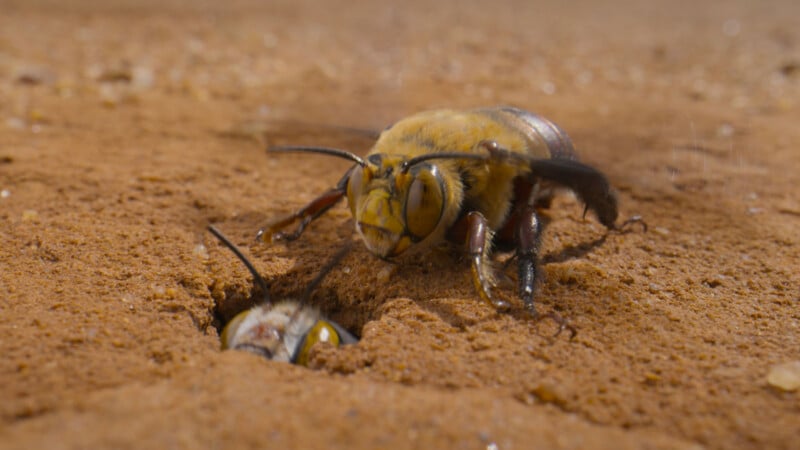 Male Dawson’s bees waiting for a female Dawson bee to come out of the burrow. (credit: National Geographic)
The filmmaker continues, saying that beyond the technical challenges, there are also significant artistic ones.
“You’re always having to think two or three shots in advance because you’re trying to tell a story. It’s not enough just to get one beautiful shot. You have to think what is going to be sufficient for the editor to tell a compelling story out of this sort of behavior that you’re seeing in front of you,” Brown says.
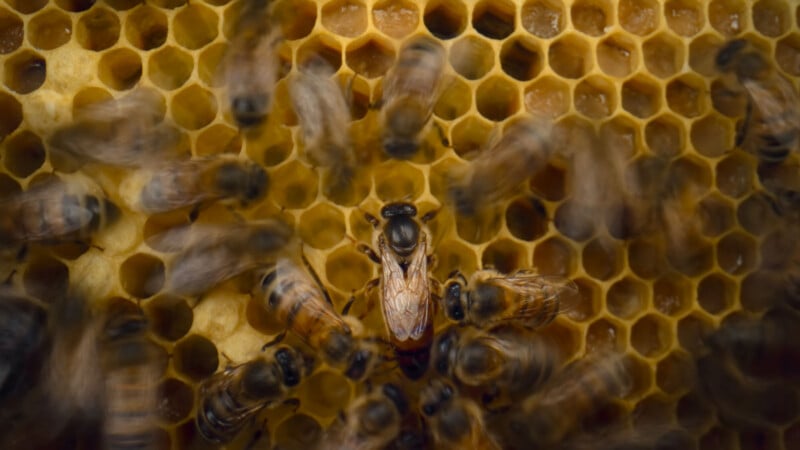 Queen Honeybee surrounded by busy workers. (credit: National Geographic)
“I mean, I absolutely love it, but you’re so trashed at the end of the day, even though you’ve done nothing physical,” he laughs.
For the vulture bee shots in particular, Brown was “sitting in a swamp for three weeks and getting bitten by stuff.” It was also raining the entire time. While the biggest challenges may be mental, there is also a significant physical strain to wildlife cinematography.
“But I find it really rewarding,” he adds.
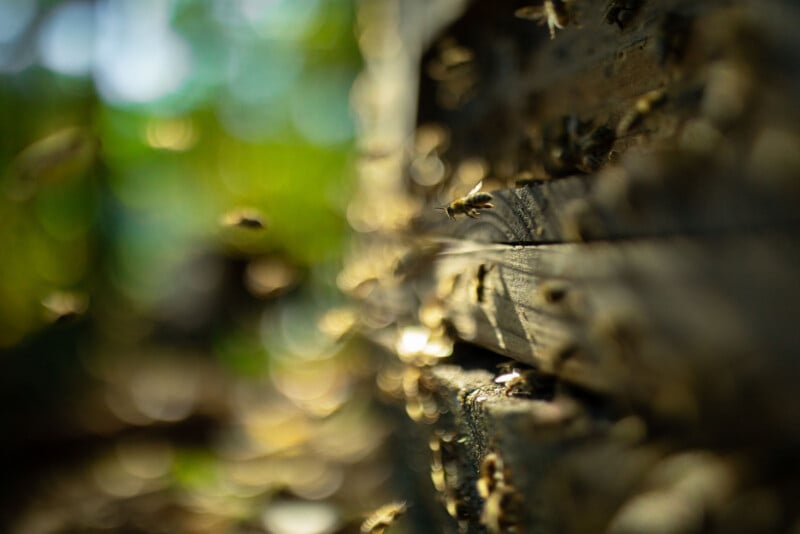 Japanese honey bees (Apis cerana japonica) flying towards bee hive. (credit: National Geographic/Alex Wickens)
His favorite sequence from “Secrets of the Bees,” which comprised about eight months of shooting spread out over a year and a half, was filming Japanese honeybees fighting off a Japanese giant hornet.
“So I think it worked really well. I think everything about the grade, it looked beautiful, the lighting worked, the behavior is just fantastic,” Brown says of the Japanese bee sequence. “You’re just there at the right time and the behavior plays out. It’s beautiful. And then this particular behavior of the bees going off and grabbing aromatic plant leaves and rubbing out the pheromone marks of the Hornets, which we’d read about, but no one had filmed it before. So just to be there and see that was just — and I love Japan, and it was just a great team. It was a deeply satisfying sort of process that when you have shoots like that, it’s just magic.”
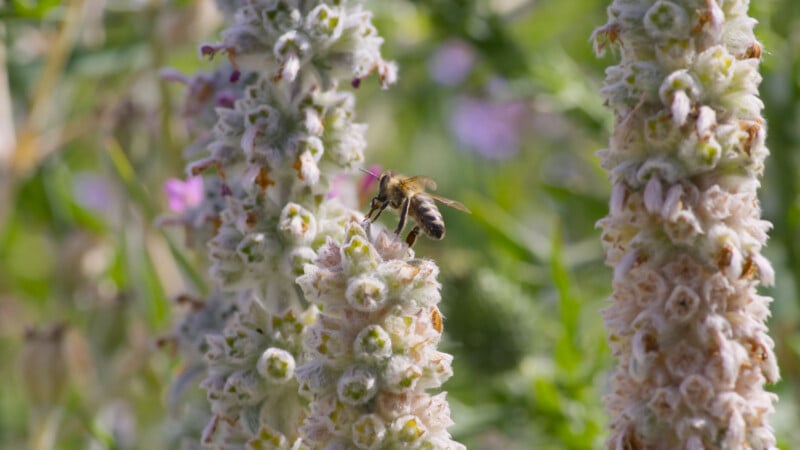 A Male Wool Carder bee hovering in amongst lamb’s ears plants. (credit: National Geographic) Scale in Macro Filmmaking
Given Brown’s extensive experience filming large animals, it’s interesting to hear how his approach to macro filmmaking differs. Or, rather, how similar it can be, even when the subjects are a tiny fraction of the size of a tiger or chimpanzee.
“I really try and avoid the kind of bug’s eye view perspective,” Brown says. “I want the bees, or whatever it is, ants, etc., to feel as engaging as if I was filming a human character. I really want to aesthetically be as respectful to these tiny subjects as I would be to something larger, and that really informs a lot of how I approach things. So it’s often not about really dramatic camera moves. It’s about the kind of subtle moves that you would see in a feature film.”
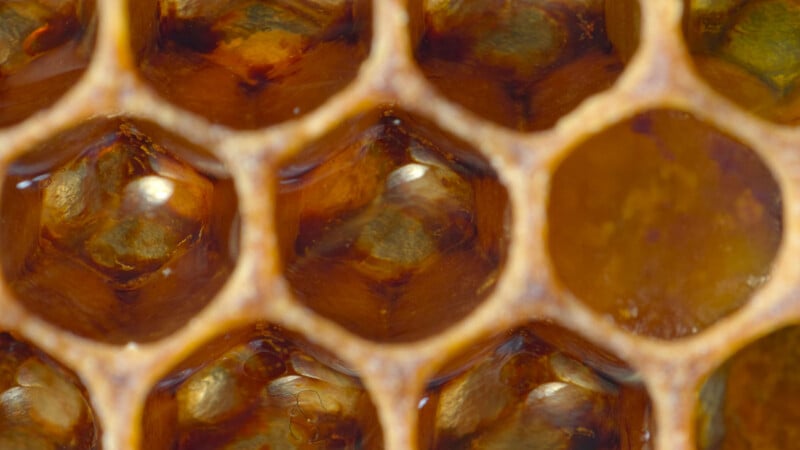 Detail of honey in cells on honeycomb. (credit: National Geographic)
 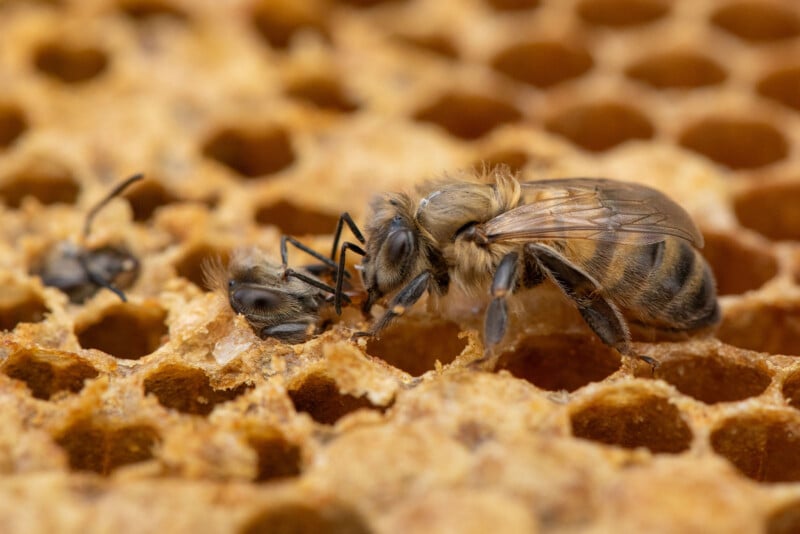 Honey bee helping another honey bee emerge from a honeycomb hole. (credit: National Geographic/Bertie Gregory)
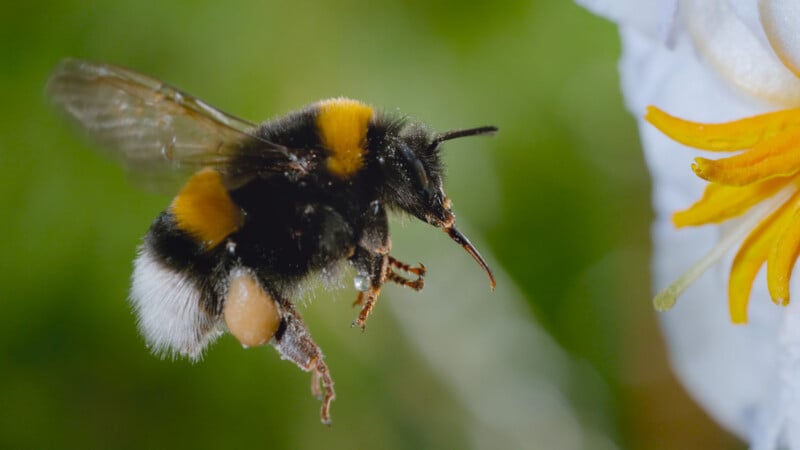 Bumble bee passes nectar from her fore legs to hind legs. (credit: National Geographic)
“And I think the big challenge is if you’re filming something the scale of a chimpanzee, similar to a human, you don’t really have to worry about depth of field issues. You’re not really fighting physics, but when you’re filming something like the vulture bees, the entire bee was about the size of a honeybee’s head. So you’re working with something that’s two or three millimeters long, absolutely tiny, but you still want to get the character of that creature across,” Brown says.
“So you’re really fighting against physics. You’re fighting against just the way that photons move through glass. And I think that’s one of the biggest, is knowing that sweet spot where you’re getting enough magnification so you can see detail, but you’re not pushing it too far that things feel a bit distorted and soft, if that makes sense.”
For many macro shots, Brown’s go-to lenses are the latest Laowa Pro2be macro lenses, including the 24mm and 35mm macro probe lenses.
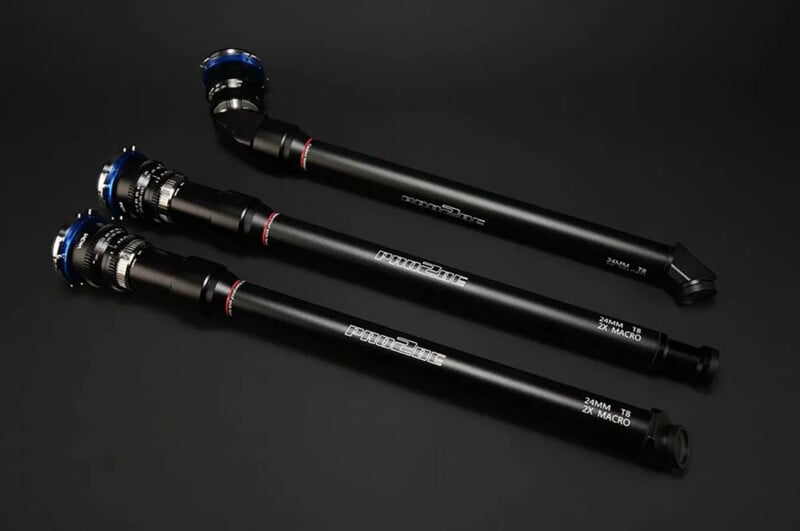 Credit: Venus Optics
“They’re really fantastic,” Brown says.
These wide-angle macro lenses deliver a very different look than more traditional, longer macro lenses. With a wide-angle field of view, Brown can preserve a strong sense of scale so that tiny subjects really are small in the frame, allowing the viewer to see their environment while the subject remains detailed. He estimates that about 60 to 70 percent of what he shot was using Laowa Macro Probe lenses.
“As a filmmaker, you’re trying to create these ‘aha’ moments in the viewer’s mind. And if you come quite wide and the viewers had to work a bit to find the subject in the frame, I think that’s just a nice viewing sort of sensation, if that makes sense.”
Although it may seem strange at first, Brown believes it’s important that even macro shots don’t get too close.
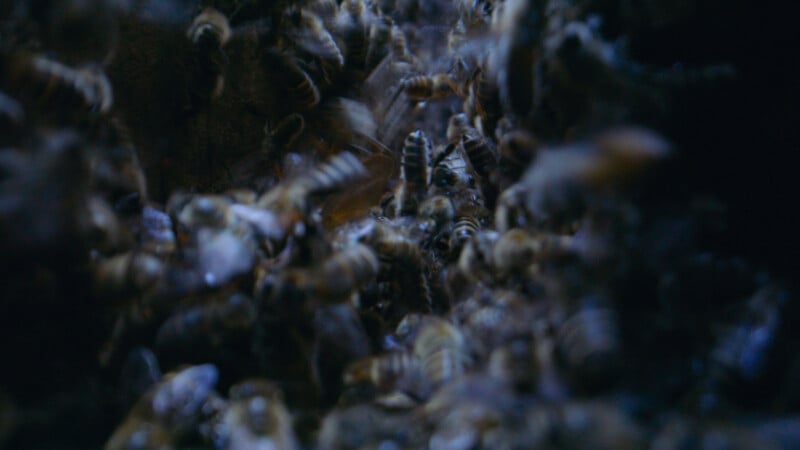 An Asian honeybee swarm balling a Giant Hornet that has managed to get inside their hive. (credit: National Geographic)
“If you’re telling a character-driven story, the close-up can break the spell slightly because that’s not how we see the world as humans. We’re kind of reading a bigger picture of what’s in front of us. It’s slightly counterintuitive because I think macro is often seen as a discipline that’s all about the closeup. But over the years, I’ve realized that actually it’s a discipline about wide shots.”
‘Secrets of the Bees’ Premieres Tonight, March 31
“Secrets of the Bees” premieres tonight, March 31, on National Geographic at 8 PM, 7 PM central. It will be available to stream on Hulu and Disney+ starting tomorrow, April 1.
While this is not a review, the two-part series is a fantastic watch for all nature fans. For even more Emmy Award-winning enjoyment, prior installments in the “Secrets of” franchise, including “Secrets of the Whales,” “Secrets of the Elephants,” and “Secrets of the Octopus,” are available to stream now.
Image credits: National Geographic