
Several schools and school boards in the Greater Toronto and Hamilton Area have higher-than-acceptable amounts of lead in their drinking water, a new report by the Canadian Environmental Law Association (CELA) has found.
In 2019, Health Canada strengthened its limit on lead in school drinking water, allowing for five parts-per-billion (ppb). However, Ontario and Saskatchewan have not adopted those guidelines and have long opted for a threshold of 10 ppb.
The report, titled ‘F’ for Effort: Ontario is falling behind on getting lead out of school drinking water, analyzed provincial data to reveal its ranking of the top 10 schools in the province with lead tests over 5 and 10 ppb in 2024-2025. They also revealed the school boards with the highest number of schools with lead-in-drinking-water levels above those levels.
Individual school rankings
Beaver River Public School in Beaverton, Ont., topped the list with 15 tests exceeding 10 ppb during that time frame and 33 with more than 5 ppb.
Mississauga’s St. Francis of Assisi Separate School came in sixth place with seven tests at more than 10 ppb and nine with more than 5 ppb.
Hamilton’s Sherwood Secondary School in Hamilton placed eighth with six tests exceeding 10 ppb and 11 exceeding 5 ppb.
St. Kevin Separate School in Brampton rounded out the list, coming in 10th place with five tests with more than 10 ppb and 10 with more than 5 ppb.
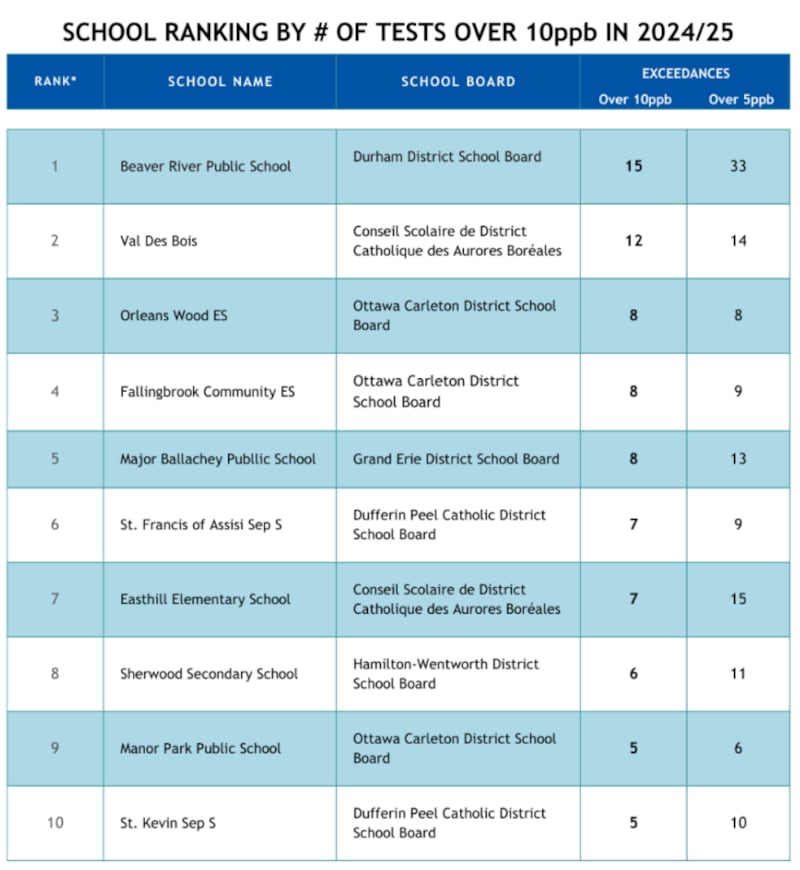 Lead in school drinking water 2024-2025 A ranking of the Top 10 schools in Ontario with the highest levels of lead in drinking water. (CELA image) School board rankings
The Ottawa Carleton District School Board came in first place with 104 schools over 10 ppb and 156 over 5 ppb.
The Dufferin Peel Catholic District School Board placed second with 40 schools with more than 10 ppb of lead in their water and 95 with more than 5 ppb, while the Toronto District School Board took the third spot, with 30 schools having more than 10 ppb of lead and 53 with more than 5 ppb.
Next was the Peel District School Board, placing fourth, with 23 schools with more than 10 ppb and 46 with more than 5 ppb of lead.
The Durham District School Board rounded out the GTHA school boards, finishing in ninth with 15 schools having a drinking water lead reading of more than 10 ppb and 34 with more than 5 ppb.
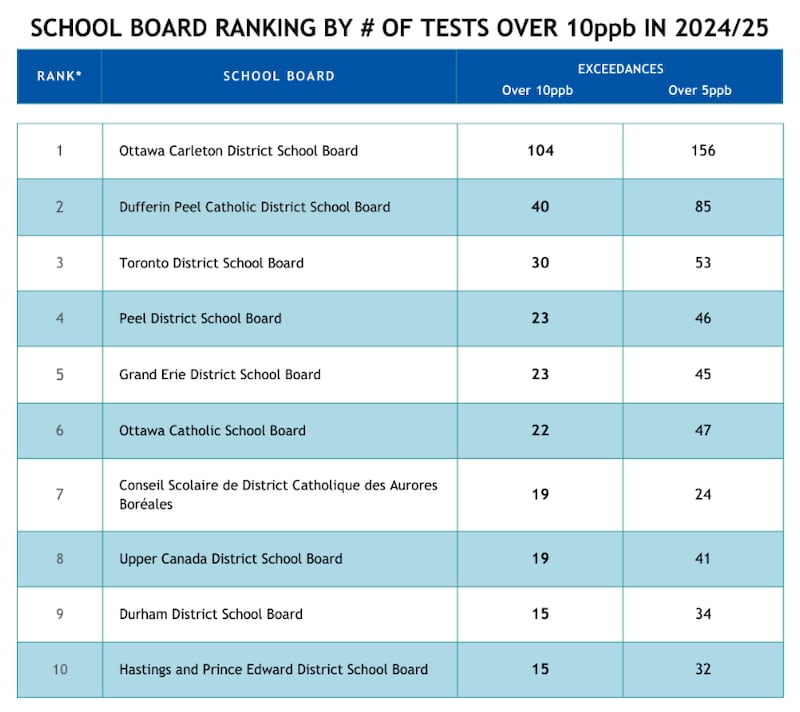 Lead Ontario schools boards 2024-2025 A ranking of the Top 10 schools boards in Ontario with the highest level of lead in drinking water. (CELA image) Problem likely underreported: CELA
The Canadian Environmental Law Association noted that the true scope of this problem is likely being underreported.
“Many schools with known lead infrastructure have been exempt from regular testing and are not represented in the data. This is because Ontario still uses an outdated limit on lead in water to decide where and when testing is required,” the report’s author Julie Mutis, a community outreach worker with CELA, said in a news release earlier this month.
“Ontario is allowing children in schools to drink water that would be considered unsafe in most of the country. And that is not acceptable.”
‘More dangerous than we previously thought’
Mustis added that lead in school drinking water is “more dangerous than we previously thought,” especially for children.
“Other provinces and territories are responding to this science with the seriousness it demands, but Ontario has fallen behind,” she said.
“Although Ontario has been regulating lead in school drinking water since 2007, children continue to be exposed to it today. Ontario has gone from a leader in school drinking water safety to the bottom of the class.”
 water A new study conducted by more than 120 journalists and 10 media groups has found that some Canadian cities have higher levels of lead in their drinking water than Flint, Michigan, which has become synonymous with contaminated H20. (Daria Shevtsova) Province has ‘comprehensive’ testing, mitigation strategy
Gary Wheeler, a spokesperson for the Ontario Ministry of Environment, Conservation and Parks, said the province makes sure Ontarians have safe drinking water through “comprehensive” testing and mitigation strategies.
“Every fixture used to prepare food or provide drinking water to children in schools, private schools, and childcare centres must be tested for lead. Facilities are also required to flush their plumbing on a daily or weekly basis, depending on the most recent fixture test results,” Wheeler said in a written statement provided to CP24.
“Where lead levels exceed the provincial drinking water quality standard of 10 micrograms per litre (10 µg/L), facility owners—such as school boards and the operators of private schools and childcare centres—must take immediate corrective action as directed by the local medical officer of health.”
Quebec has most rigorous school drinking water lead regulations in Canada
Quebec has the most rigorous regulations in Canada when it comes to lead in school drinking water.
Since 2019, it has required all school water fixtures to be tested and progress reports on lead removal from schools are made publicly available.
According to CELA, since completing a screening of all taps and fountains in the summer of 2021, 61 per cent of non-compliant taps in public schools have been removed, replaced, or made safe to use.
“Ontario needs to follow the rest of the country and recognize that no amount of lead is safe, prevent lead exposure using the most up-to-date mitigation methods, and improve how information about school drinking water is shared with parents,” Mutis said.
Negative effects of lead
Lead, which is a metal found naturally in the environment, can be a health risk, as it can negatively affect the development of the brains of fetuses, infants, and children. According to Health Canada, exposure to lead in drinking water can cause effects on neurological development and behaviour, like a lower IQ in children and increased blood pressure or kidney problems in adults.
Lead is more likely to be found in the drinking water of older homes and neighbourhoods, as the National Plumbing Code of Canada had considered it an acceptable material to use in pipes that bring water to homes until 1975.