
Maia Cesario (she/her) is The Ubyssey’s Women’s Soccer Reporter, and she has been covering the team since Sept. 2024. She is a fourth-year student studying Psychology and English Literature. You can reach her at m.cesario@ubyssey.ca.
For the past two seasons, the UBC women’s soccer team has been historically dominant. They went undefeated in the regular season in both campaigns. They won a national championship in 2024. While they couldn’t repeat that feat in 2025, coming in second nationally, they still stood out for a big reason. In every one of their regular season games, they had no goals against.
Ending every game in a shutout victory — while also scoring 42 goals — was something the Canada West had never seen before.
The defensive superiority has been a trademark for UBC women’s soccer. Since the COVID-cancelled 2020 season, the most goals they’ve allowed in a single season is 11. And they’ve improved almost every year. Last season, the T-Birds allowed only four goals, which, at the time, set a conference record for fewest goals allowed. That was, until 2025.
This shutout streak began in the 2024 postseason, where the Thunderbirds had all shutout victories to earn their second straight national championship. The defence was a large factor in this strong postseason run.
Nowhere was that more evident than in the gold medal game. Off a Sophia Ferreira goal, UBC took the lead 1–0 in the final moments before halftime against l’Université Laval Rouge et Or. That one goal was all they’d need.
Even with a slim lead, the Thunderbirds were in control. Throughout the second half, the T–Birds’ ability to stop Laval from tying the score by holding possession and working hard to get back the ball if lost was the difference-maker. Ferreira’s goal may have been the game-winner, but it wasn’t what won the game.
“Defence wins championships,” said Ella Sunde, the team’s captain last season. “We need to score too, but the big thing is not letting the other team score.”
This defensive prowess that UBC has boasted from season to season isn’t just about the talent of their players. Instead, it exists as a culture and mindset propelling them to success.
That’s not to say they don’t have talent. Of course, with a program like UBC’s they have skilled players year in and year out. The defence in the 2024 national championship win boasted stars across the back line. They had young phenoms such as the Canada West Rookie of the Year Olivia Gomez and previous Canada West Rookie of the Year Sarah Rollins. They had veteran experience with Canada West Defender of the Year Jacqueline Tyrer and national championship all-tar Sophia Ferreira. But in 2025, the T-Birds had none of them.
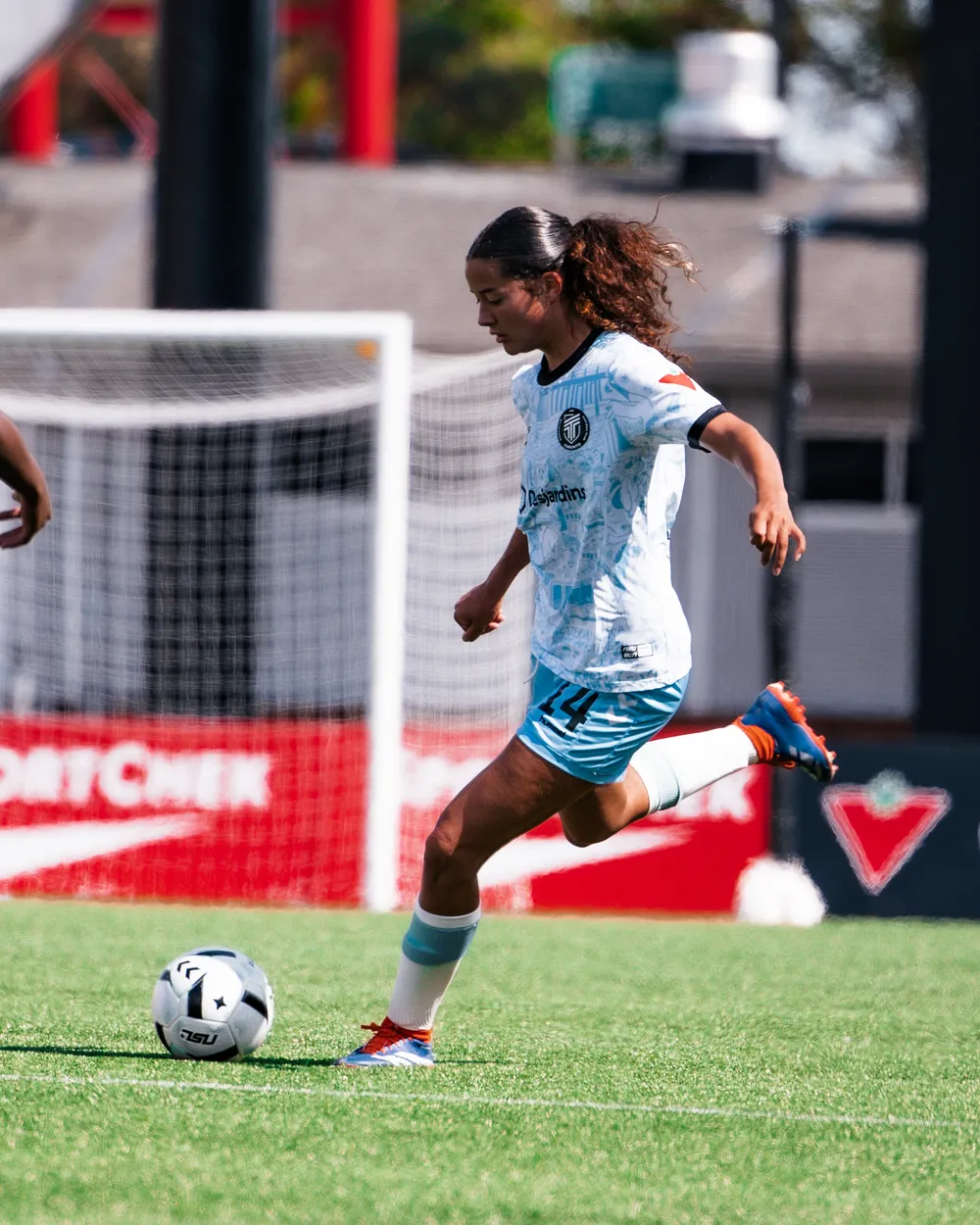
After two years with the Thunderbirds, defender Sarah Rollins went pro, joining AFC Toronto of the Northern Super League. Courtesy AFC Toronto
Rollins left UBC for the pros, signing to AFC Toronto for the Northern Super League’s (NSL) inaugural season. Tyrer graduated after the season. Ferreira was the most unexpected loss, injuring her knee and being ruled out for the season.
That left only two of the six defenders who had been rostered for the 2024 national championship game on the squad for 2025. With essentially their entire defensive core gone or ruled out, it would make sense for UBC to stumble. Instead, their back line picked up right where they left off, extending the shutout streak another 15 games. Because of the defensive culture tied to the program, they are able to keep up their defensive success, even through personnel changes as dramatic as this.
This mindset was first embedded in the team structure by current head coach Jesse Symons. When he first joined the program, UBC had a very different style of play — focused on winning games through their offence, trying to come out on top in high-scoring contests. This stylistic emphasis catered to the strengths of that iteration of the ‘Birds, but was also a reflection of the mindset the team held. Defence wasn’t as crucial.
Joining the team in 2016, Symons started to switch the team’s style, pushing the importance of defence. The progress was slow initially. They allowed 20 goals in his first year. Then, 18 in year two. In years three and four, it continued to decline, first to 15, then to 13. Yet, it was after COVID where this change became much more evident. In the five seasons since the ‘Birds returned to play, they’ve averaged 6.8 goals against per year. The difference from 2016 is stark.
“The team’s bought into an understanding of defensive structure and organization,” said Symons. “It’s really built us to this super high level of success.”
This defensive culture has seen sustained growth because of how it has been cultivated by the rest of the coaching team and the players. The players buy into the mindset shared by the coaches and fully embody it in their play. The coaching staff, in turn, grants a lot of flexibility in how theT-Birds play in their formation, allowing for individual players’ to adapt and play to their skills.
As a result, regardless of whether the team is playing high-press defence, or if they’re compact near the box — the back line will be playing the whole field.
This defensive structure isn’t just about the back line, however. In Symons’ system, defence is important for every player, no matter their position. Their midfielders become an extension of the defence quickly — even as UBC plays a high press defence — the midfielders are always tracking back, prepared to jump on a defensive play. This means a lot of running for them — but you see the hustle. Fourth-year Taiya Dennehy, the holding mid for UBC, is a great example of this. Dennehy is constantly at the scene of a defensive stop, cutting off opposing players, taking the defensive responsibilities of her role to the next level.
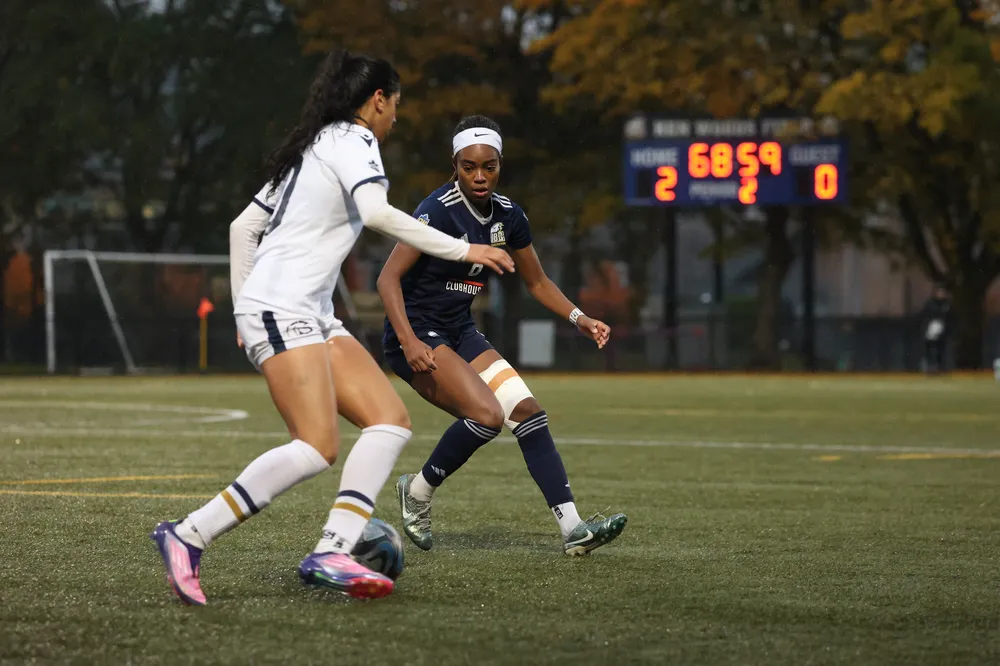
UBC counts on defensive contributions from all over the field, with midfielders like Taiya Dennehy (#6) jumping back in the play on defence often. Sidney Shaw / The Ubyssey
While there is adaptability in how Symons deploys his unit, the core defensive philosophies remain consistent. For one, there’s a focus on the need to hold possession. This goes for all players, but especially when their defence or midfielders have the ball down low, they do not give it away in transition. A mistake like that could easily cost them, as if they turn the ball over, they would be off balance in transition, leaving space open for opponents close to the net to attack.
Yet, even if they do lose the ball, the Thunderbirds are always prepared to react and fight back quickly. The backline consistently closes off incoming attackers quickly and shutting them down, using their positioning to close space. Because of this aggression, UBC’s defence rarely lets opponents bring the ball into the box — or even near it — and this sets the standard for their defence.
“How much we stress on defensive structure and strategies, there’s probably not a lot of other teams spending as much time on it as we do,” said Sunde.
That level of detail extends to their roster construction as well. UBC puts their best players on the pitch — no matter their level of experience. They trust everyone from rookies to veterans to succeed if they have proven themselves creating depth in their defensive line.
“That’s our secret sauce with our team,” said Symons. “Everyone’s going to play and compete and help the team be successful in the season.”
For the players, this approach to experience means that learning how to play defensively under Symons is a quick study. Sunde learned that first-hand. Before she came to UBC, she was focused more on offence in how she played — but once she became a T-Bird, she embraced the role of a full back. Although she still contributes on offence — with six goals in her senior season — because she bought into the UBC culture, it’s no longer her main goal.
Yet, if it was that simple, every team would do it. It’s not just about emphasizing defence — for players, having the devotion to always keep a defensive-oriented mindset is not a guarantee. So how does UBC end up with players who are willing to forego offence — and the visible statistics that go with it — to uphold the team’s defensive superiority?
It’s about looking beyond just skill. It’s finding a player who is talented, but also a player who hustles, can lead, has smarts, and, most crucially, plays for the team.
This comes down to how Symons does recruiting. He looks for players with the right mindset, the kind of player he knows will excel on the team. Then, once the new T-Bird actually joins the team, they can mesh well right away, because their character already matches the culture. From there, it’s just about nurturing and growing that culture, with the coaching and leadership of older players helping the rookies gain confidence.
“It was something that I bought into when I came,” said rookie defender Sophie Harrison. “As soon as I got here, everyone was determined to keep clean sheets and not let a goal in.”
While team culture is central, the success born from it is reflected in the T-Birds’ individual accolades. UBC defenders have won Canada West Rookie of the Year three years in a row, with Harrison keeping the streak alive this year. It isn’t just the rookies. The Thunderbirds had the Canada West Defensive Player of the Year three years in a row with Sunde winning this season.
Unfortunately, that sustained success didn’t translate to the postseason this year. In the national championship, the Thunderbirds fell short after allowing two early goals by their opponents, the University of Montreal Carabins. It was an uncharacteristic defensive breakdown that left them chasing a goal for the rest of the game, and although they netted one with Harrison’s first goal of the season, they came up short in the end.
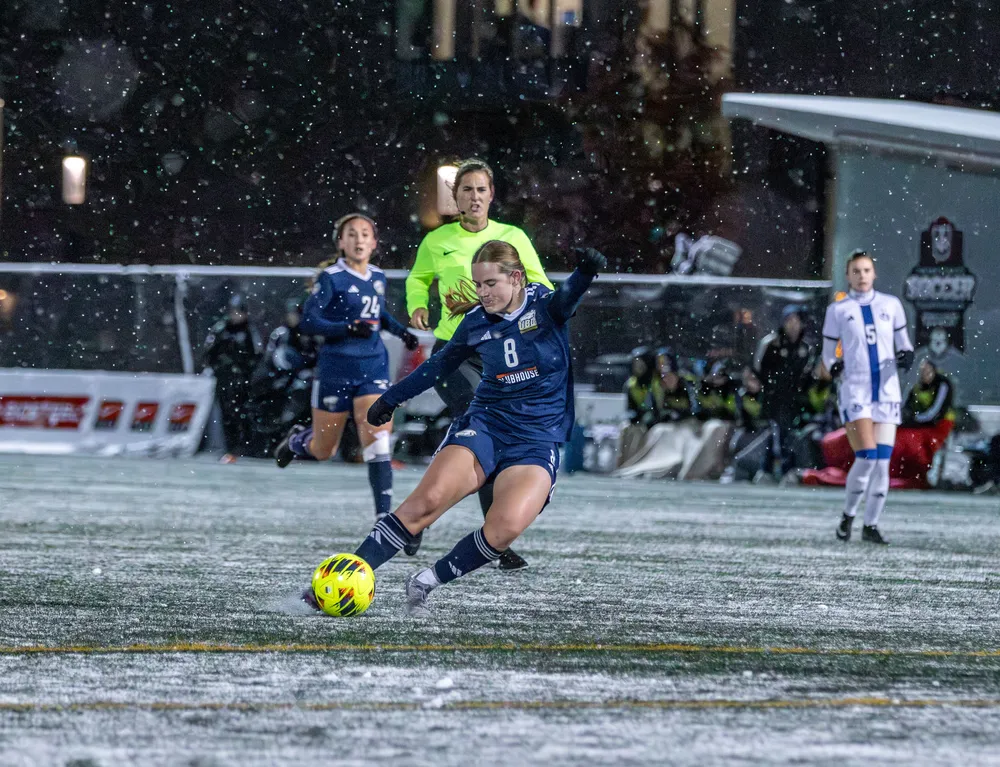
While Canada West Rookie of the Year Sophie Harrison (#8) scored a goal against Montreal in the gold medal game, thanks to the team’s earlier defensive lapses, it wasn’t enough. Courtesy McMaster University Athletics
The Thunderbirds let Montreal into the box early in the game, and these close attacks set the Carabins up well. Although UBC’s defence had deflected initial shots before both goals, the Carabins’ press was tightening around UBC, allowing them to quickly jump on the ball and find the net. While, as they had all season, the T–Birds barely allowed their opponents to hold possession the rest of the game, on the highest stage, where the margins are thinnest, this slight defensive lapse defined the game. There was perhaps no better reminder as to why their defensive identity is so crucial.
“[Defensive mindset] is driven from the coach, but then you have to implement what he’s coaching us when you’re in the game,” said Harrison.
After losing the national title this past season UBC will have to bounce back, as they will again have to deal with some big losses on their back end. The team’s captain, Sunde, is graduating this year and is now playing professionally with Austria Klagenfurt for the rest of this season. They will also lose their all-Canadian goalkeeper Dakota Beckett, finishing her career as a T-Bird this season.
Beckett had an incredible season, being a major part of UBC’s clean sheet streak, not allowing a single goal. But it doesn’t stop there. Beckett also became the all-time Canada West leader in goals-against-average (0.267) and save percentage (0.915), in addition to being the now-winningest goalkeeper in UBC history.
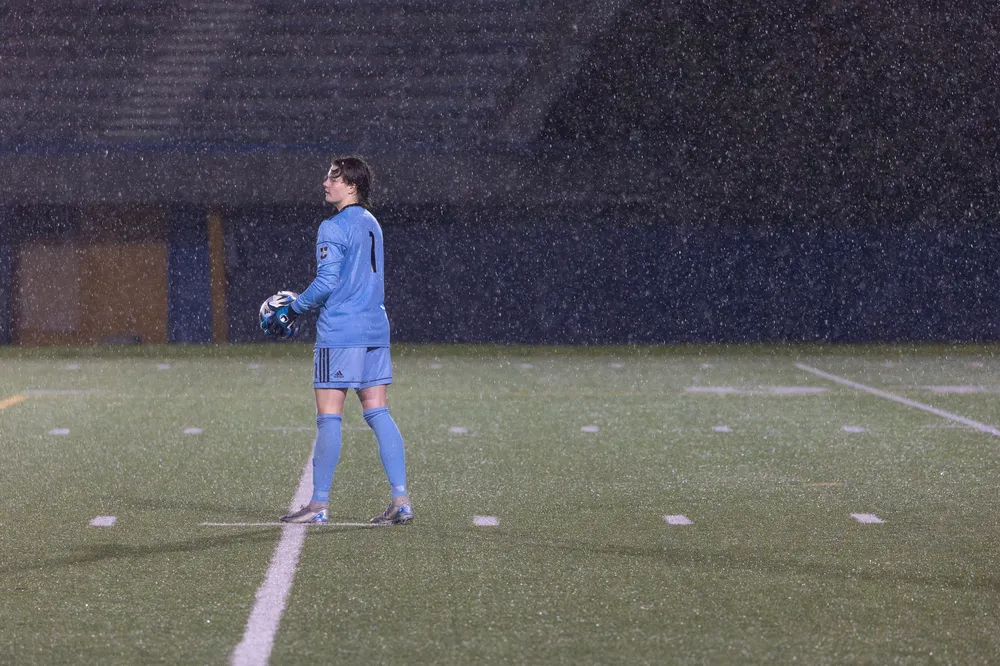
UBC keeper Dakota Beckett (#1) will leave big shoes to fill, graduating as one of, if not the greatest player to play her position in program history. Sidney Shaw / The Ubyssey
To replace Beckett, they’ll likely turn to rookie keeper Emma Sparrow, who played six games this season, keeping the shutout streak for UBC in all of them. However, at most, she faced three shots in a game.
Symons is not worried, as he believes in both the keepers they have and their new recruit, Marilena Spagnolo, who is coming to UBC as a graduate student off a championship with League 1 in Ontario. While I think UBC has the opportunity to continue succeeding in goal, their regular season defensive success will look somewhat different next season.
Another season of only shutout victories is unlikely. There’s a reason it had never been done before, so expecting to do it back-to-back will be nearly impossible. But that doesn’t mean they can’t expect success.
Yes, they’re losing players. But that hasn’t bothered them yet. Similarly to this year, the Thunderbirds should be able to continue their dominant defensive play from the back line, even without Sunde and Beckett. As they showed this season, they can quickly adapt from the loss of some major defensive players and find their ways to succeed. The key, as it has been throughout Symons’ tenure, will be in their defensive culture and mindset.
But their roster won’t be barren, either. Compared to last offseason, UBC faces fewer line changes and even gains a player back, with Ferreira returning from injury to supplant some of the veteran leadership that will be lost in Sunde’s absence.
They’ll have some great young talent to help them as well. Since Symons’ philosophy is to play his best players regardless of year, the team’s young players earned minutes this season to develop as players, so the Thunderbirds certainly have depth to choose from. Even in losing their all-time winningest goalkeeper and the Canada West Defensive Player of the Year, there is not a massive gap left to fill, because every player on the roster all grows together.
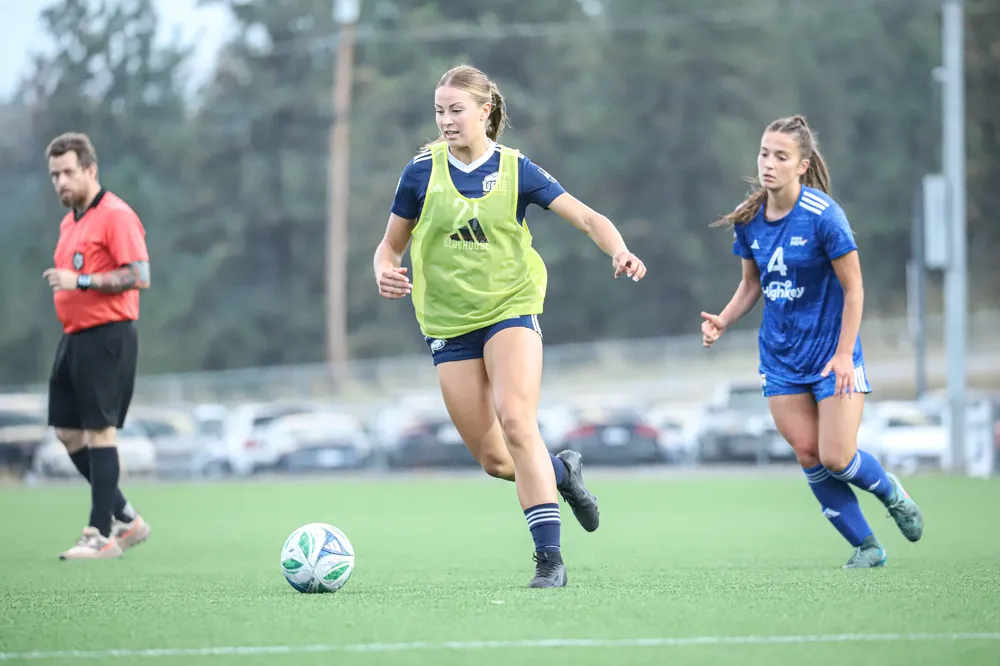
Zoelle Apps (#21) is a testament to how coach Jesse Symons’ program of development on defence works. Apps got playing time early in her career, helping her step up into a starting role in her second year. Courtesy Kaczur Photography
Second-year Zoelle Apps demonstrated this well. In her first year, she was able to earn minutes and develop her skills in real time in games. This season, she filled into the starting centreback role, having big shoes to fill, replacing Tyrer and Rollins. She didn’t miss a beat. She held down the back line like a veteran player on the field excelling in a tough position. Apps isn’t the only young standout. Harrison will certainly continue to light it up on defence, also starting in almost every game in a breakout first year, alongside fellow rookie defender Heike Clarke.
However, even with this young talent showing much promise, there is still some room for improvement if they hope to continue both as the best defensive team in Canada West and one of the best in the country. In the postseason, some unfortunate mistakes cost them. At nationals, they took penalties in the box, gave up set pieces in multiple games, and, of course, they gave up two goals in eventual loss in the championship.
The Thunderbirds defence, as always, will be exciting to watch next season. With a chip on their shoulder from their loss at nationals, I think their defence can propel them back to the championship. There might be more bumps along the road in the regular season — it’s impossible not to when the bar is, quite literally, perfection — but even if they don’t have another shutout streak, that doesn’t mean they’ll be taking a step back.
Maia is a fourth year Psychology and English Literature and Language major. She reports on Women’s Basketball and Women’s Soccer, and you can reach her at m.cesario@ubyssey.ca.