
Let’s turn this whole country into a waterbomber assembly line. The demand isn’t going anywhere
Allison Smith is the editor of Village Media’s TorontoToday, a sister site of SooToday.
Growing up in the Greater Toronto Area, smog days were par for the course.
Residents regularly woke up to hazy, polluted skies and warnings about the health impacts of poor air quality. The words “smog” and “smoggy” were part of the region’s lexicon. Locals were discouraged from spending time outdoors.
Then, for a brief decade, the problem of air quality seemed mostly solved.
In 2014, Ontario celebrated a smog-free summer, a milestone credited to the provincial Liberals decision to shutter coal plants. Zero smog days were declared that year, down from a peak of 53 in 2005.
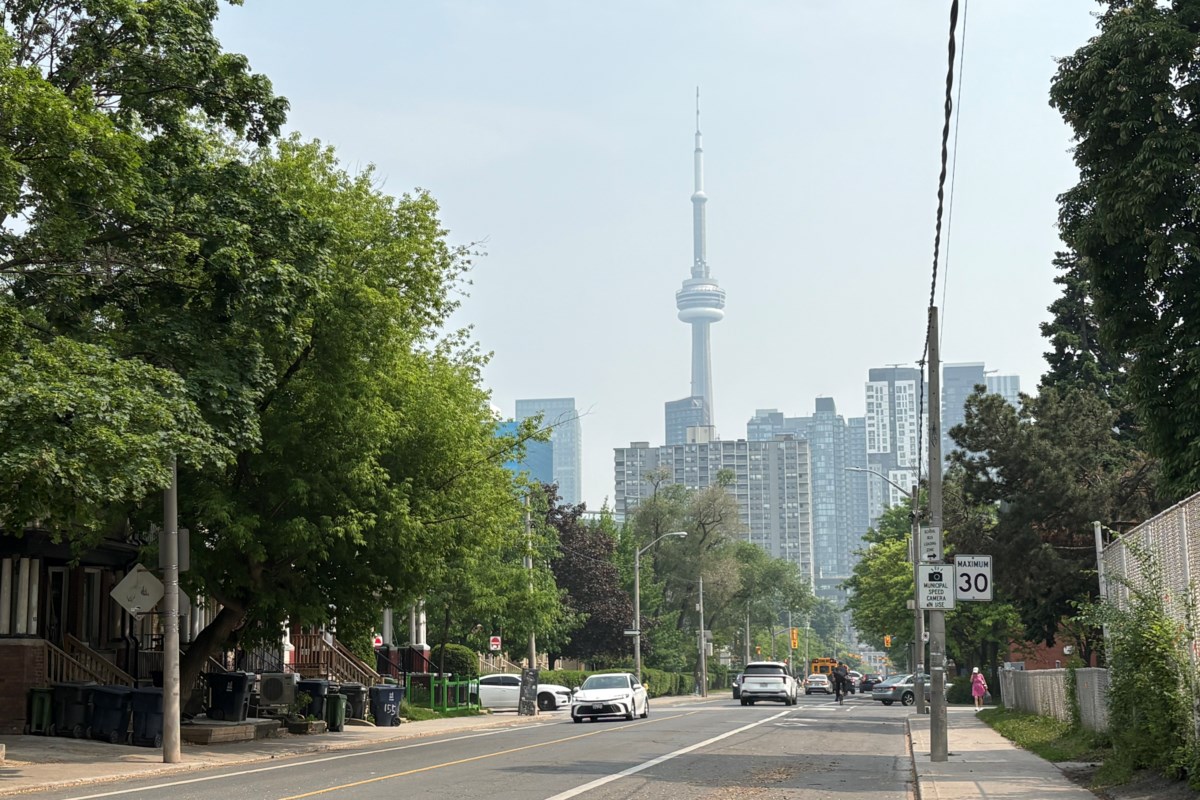
Fast forward to this summer. Environment Canada has placed Toronto under a special air quality advisory on three separate occasions in response to smoke from western wildfires blanketing the city.
We’ve traded our smog days for smoke days.
It’s once again unhealthy to gather in parks and on beaches, and for kids to play sports with their pals.
Denizens of the city seem to be taking the air pollution in stride. A new normal has already been accepted despite June 2023 being the first time Toronto was significantly impacted by forest fire smoke.
That year was Canada’s worst wildfire season on record. This year is shaping up to be the county’s second-worst, a title previously held by 2024.
Complaints about wildfire smoke from a Torontonian will seem quaint to residents of British Columbia and the Prairies, who have been dealing with increasingly bad forest fire impacts for 20 years. In many parts of Canada, it’s the fires themselves — which have consumed entire towns and resort communities — that are a threat, not just uncomfortable smoke.
The ashtray that is northern Saskatchewan and Manitoba. Wildfire smoke as far as the eye can see. pic.twitter.com/7WiSeHZ66K
— Anthony Farnell (@AnthonyFarnell) August 1, 2025
The provinces need more waterbombers
As the world gets hotter, wildfires will continue to become more frequent and more powerful.
But that doesn’t mean there is nothing Canada can do.
Improving wildfire response should be an imperative of Prime Minister Mark Carney and his newly formed government.
The smoke that infiltrated Toronto over the August long weekend came from dozens of forest fires burning across northern Saskatchewan — a province that owns just 11 water-bomber planes, four of which have been out-of-commission this season due to maintenance. Another is brand new but does not yet have certified pilots, per CBC.
Things aren’t much better in Ontario, where the Ministry of Natural Resources told the Toronto Star last month that it has just nine waterbombers in operation this fire season.
Premier Doug Ford has said six new aircraft have been ordered from the manufacturer De Havilland Canada, which is building a new waterbomber factory outside Calgary. However, Ontario is nowhere near first in line, as European customers secured the initial round of orders back in 2022.

The De Havilland Canadair 515, a next generation waterbomber aircraft being manufactured in Alberta. Photo credit: De Havilland Canada
Wildfires will burn no matter how many waterbombers Canada has, but there is no question there would be fewer homes destroyed, less First Nations forced to evacuate and fewer air quality alerts issued if Saskatchewan had 600 aircraft in action right now, rather than six.
As U.S. President Donald Trump’s tariffs threaten to hobble Canada’s manufacturing sector, Carney’s Liberal government could prioritize wildfire fighting technology as an industrial policy opportunity.
Let’s turn this whole country into a waterbomber assembly line. The demand isn’t going anywhere — domestically or internationally.
In the meantime, the federal government needs to ramp up funding transfers to the provinces for wildfire fighter and pilot training programs and equipment purchases.
Billions should be available to provinces that commit to properly staffing — and paying — their wildfire fighting fleets, and training the next generation of forest management professionals.
On the flip side, provincial governments that continue to fail to adequately prepare their wildfire response should be held accountable by voters, other premiers and Ottawa.
Asserting sovereignty and mitigating (more) climate change
Getting forest fires under control is also an act of sovereignty.
While Trump may have cooled it on the 51st state talk, Republican members of Congress from the upper Midwest are fed up with smoke from Canada ruining summer weather in Wisconsin and Minnesota.
“We would like to know how your government plans on mitigating wildfire and the smoke that makes its way south,” Rep. Tom Tiffany wrote to Canadian Ambassador to the United States Kirsten Hillman in mid-July. “Our communities shouldn’t suffer because of poor decisions made across the border.”
There’s billions in new defence money that Carney is preparing to spend. Maybe technology that helps us not tick off our neighbours should be on the menu.
Plus, extinguishing wildfires is not only an act of climate change adaptation — it’s also about mitigating further emissions outputs.
Canada’s 2023 wildfire season spewed 640 million metric tons of carbon into the atmosphere over just five months, according to NASA researchers.
We can’t sit by year-after-year as Canada’s boreal forest — one of the world’s key carbon sinks — is turned to ash.
It takes the Canadian government a long time to get things done. We’ve already waited too long. Let’s go, Ottawa: the people of Toronto want to have a nice day on the beach.